Anisotropic turbulence in weakly stratified rotating magnetoconvection
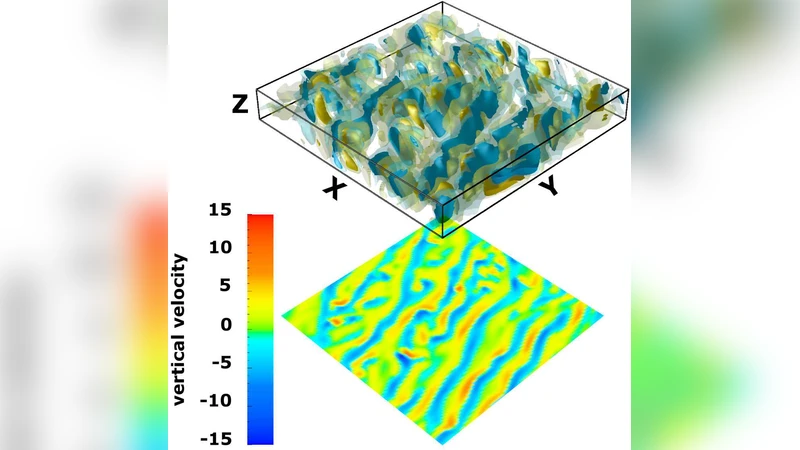
Numerical simulations of the 3D MHD-equations that describe rotating magnetoconvection in a Cartesian box have been performed using the code NIRVANA. The characteristics of averaged quantities like the turbulence intensity and the turbulent heat flux that are caused by the combined action of the small-scale fluctuations are computed. The correlation length of the turbulence significantly depends on the strength and orientation of the magnetic field and the anisotropic behavior of the turbulence intensity induced by Coriolis and Lorentz force is considerably more pronounced for faster rotation. The development of isotropic behavior on the small scales – as it is observed in pure rotating convection – vanishes even for a weak magnetic field which results in a turbulent flow that is dominated by the vertical component. In the presence of a horizontal magnetic field the vertical turbulent heat flux slightly increases with increasing field strength, so that cooling of the rotating system is facilitated. Horizontal transport of heat is always directed westwards and towards the poles. The latter might be a source of a large-scale meridional flow whereas the first would be important in global simulations in case of non-axisymmetric boundary conditions for the heat flux.
💡 Research Summary
The paper presents a systematic numerical investigation of rotating magnetoconvection in a weakly stratified Cartesian domain using the NIRVANA MHD code. The authors focus on how the combined action of Coriolis and Lorentz forces modifies the statistical properties of turbulence—specifically the turbulence intensity components (⟨u′²⟩, ⟨v′²⟩, ⟨w′²⟩) and the turbulent heat fluxes (⟨u′T′⟩, ⟨v′T′⟩, ⟨w′T′⟩). The computational setup employs a box with periodic side boundaries, stress‑free top and bottom, a uniform vertical rotation vector, and a uniform horizontal magnetic field. Non‑dimensional control parameters span Reynolds numbers of order 10⁴, Prandtl numbers around 0.1, magnetic Reynolds numbers near 10, and a range of Coriolis numbers from 0 to 10, allowing the authors to explore both weak and moderate rotation regimes.
Key findings can be grouped into three interrelated themes. First, the correlation length of the turbulence is highly sensitive to magnetic field strength and orientation. As the imposed horizontal field is intensified, the horizontal correlation length contracts dramatically, while the vertical correlation length remains comparatively unchanged. This anisotropic scaling reflects the Lorentz force’s selective damping of motions perpendicular to the field lines, leaving vertical motions relatively free. Second, the presence of even a modest magnetic field suppresses the small‑scale isotropisation that is characteristic of pure rotating convection. In pure rotating cases, turbulence tends toward isotropy at the smallest scales, but when a horizontal magnetic field is added, the turbulence retains a pronounced anisotropy across all resolved scales, with the vertical velocity variance dominating the kinetic energy budget (often exceeding 60 % of the total). The anisotropy is amplified with increasing rotation rate; for Coriolis numbers above ≈5 the combined Coriolis–Lorentz interaction produces a turbulence field that is essentially columnar, dominated by vertical motions.
Third, the turbulent heat transport exhibits systematic directional biases. The vertical heat flux ⟨w′T′⟩ modestly increases (by roughly 5–10 %) as the magnetic field strength grows, indicating that the suppression of horizontal motions channels thermal fluctuations more efficiently in the vertical direction, thereby enhancing the overall cooling of the rotating layer. In contrast, the horizontal heat fluxes ⟨u′T′⟩ and ⟨v′T′⟩ are consistently directed westward (negative longitudinal direction) and poleward (toward higher latitudes). The westward bias would be especially relevant in global simulations that feature non‑axisymmetric boundary conditions for the heat flux, as it could generate longitudinal asymmetries in the thermal structure. The poleward component provides a plausible mechanism for driving large‑scale meridional circulations, a feature that is often invoked to explain observed differential rotation profiles in stellar interiors.
A parametric sweep over the Coriolis, magnetic Reynolds, and Prandtl numbers confirms the robustness of these trends. Higher Coriolis numbers intensify the anisotropy, while lower magnetic Reynolds numbers (i.e., weaker magnetic diffusion) accentuate the magnetic damping of horizontal turbulence. Variations in the Prandtl number primarily affect the magnitude of the heat fluxes but do not alter the fundamental directional preferences.
The authors conclude that any realistic model of stellar or planetary convection zones that includes rotation and magnetic fields must account for the persistent anisotropy of turbulence down to the smallest resolved scales. The suppression of horizontal motions by a horizontal magnetic field not only reshapes the kinetic energy distribution but also modifies the heat transport pathways, potentially influencing the thermal evolution and large‑scale flow patterns of the system. These insights provide valuable constraints for mean‑field theories of angular momentum transport and for the development of sub‑grid scale models in global magnetohydrodynamic simulations.
Comments & Academic Discussion
Loading comments...
Leave a Comment