Private Information Disclosure from Web Searches. (The case of Google Web History)
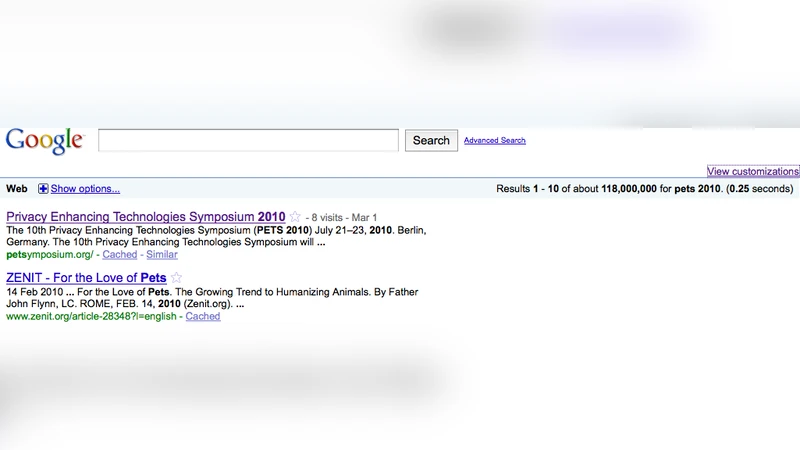
As the amount of personal information stored at remote service providers increases, so does the danger of data theft. When connections to remote services are made in the clear and authenticated sessions are kept using HTTP cookies, data theft becomes extremely easy to achieve. In this paper, we study the architecture of the world’s largest service provider, i.e., Google. First, with the exception of a few services that can only be accessed over HTTPS (e.g., Gmail), we find that many Google services are still vulnerable to simple session hijacking. Next, we present the Historiographer, a novel attack that reconstructs the web search history of Google users, i.e., Google’s Web History, even though such a service is supposedly protected from session hijacking by a stricter access control policy. The Historiographer uses a reconstruction technique inferring search history from the personalized suggestions fed by the Google search engine. We validate our technique through experiments conducted over real network traffic and discuss possible countermeasures. Our attacks are general and not only specific to Google, and highlight privacy concerns of mixed architectures using both secure and insecure connections.
💡 Research Summary
The paper investigates privacy risks inherent in modern web services by focusing on Google’s architecture and, in particular, the exposure of a user’s Web History. The authors begin by mapping Google’s service landscape and discover that, despite the widespread adoption of HTTPS for high‑value services such as Gmail, a substantial portion of Google’s ecosystem still communicates over plain HTTP. Authentication is maintained via cookies that lack the “Secure” and “HttpOnly” flags, making them trivially stealable by any passive network eavesdropper. The authors demonstrate that once a cookie is captured, a classic session‑hijacking attack grants an adversary full access to the victim’s account, allowing retrieval of search logs, Maps history, YouTube watch history, and other personal data.
The core contribution is a novel attack called the “Historiographer.” Google’s Web History feature is advertised as being protected against session hijacking through an additional access‑control layer. However, the search engine’s personalized suggestion mechanism—auto‑completion and “related searches” that appear as a user types—relies on the same authenticated session and leaks fragments of the user’s past queries. The Historiographer exploits this side channel: after obtaining the victim’s authentication cookie, the attacker issues a series of crafted search requests with varying prefixes. For each request, the server returns a list of suggested completions drawn from the user’s historical queries. By observing which suggestions appear, the attacker can infer which terms have been searched before.
To make the reconstruction efficient, the authors adopt a binary‑search‑style probing strategy. The attacker partitions the alphabet (or Unicode space) into intervals, queries each interval, and recursively narrows down intervals that yield suggestions. This logarithmic approach reduces the number of required HTTP requests dramatically; in the authors’ experiments, roughly 30–40 requests sufficed to recover thousands of past search terms. Queries that do not surface in the suggestion list can be uncovered through combinatorial prefix expansion or by leveraging additional contextual cues (e.g., location‑based suggestions). The attack is not limited to the Web History page; once the search history is known, the adversary can infer related activity in other Google services that reuse the same personalization data, effectively chaining the breach across the entire Google account.
The paper validates the technique on real network traffic captured from volunteers who consented to the study. The authors show that the Historiographer works reliably across different browsers, devices, and account configurations. They also discuss the impact of recent security improvements (e.g., forced HTTPS for some services) and demonstrate that mixed‑security deployments still leave a large attack surface: a single insecure HTTP endpoint can be the gateway to the entire authenticated session.
In the mitigation discussion, the authors propose several defenses. At the infrastructure level, Google should enforce HTTPS for all services and set the “Secure” flag on cookies to prevent their transmission over clear‑text connections. The “HttpOnly” attribute would further protect cookies from client‑side script extraction. For the suggestion API, the authors recommend tightening authentication checks, introducing short‑lived, request‑specific tokens, and possibly redesigning the suggestion algorithm to avoid returning raw historical terms (e.g., using hashed or anonymized representations). From a user perspective, enabling two‑factor authentication, regularly clearing cookies, and using private browsing modes can reduce exposure. The paper also suggests that browsers could warn users when a site mixes secure and insecure resources within the same session.
Overall, the study illustrates how a seemingly innocuous feature—personalized search suggestions—can become a powerful privacy‑leak vector when combined with insecure transport. The Historiographer attack is generic enough to apply to any service that mixes HTTPS and HTTP while exposing user‑specific data through side channels. The authors conclude that service providers must adopt a holistic, end‑to‑end security model rather than patching individual components, and that users should remain vigilant about the security posture of the services they rely on.