The Lemniscate of Bernoulli, Without Formulas
In this paper we give purely geometrical proofs of the well-known properties of the lemniscate of Bernoulli.
Authors: Arseny Akopyan
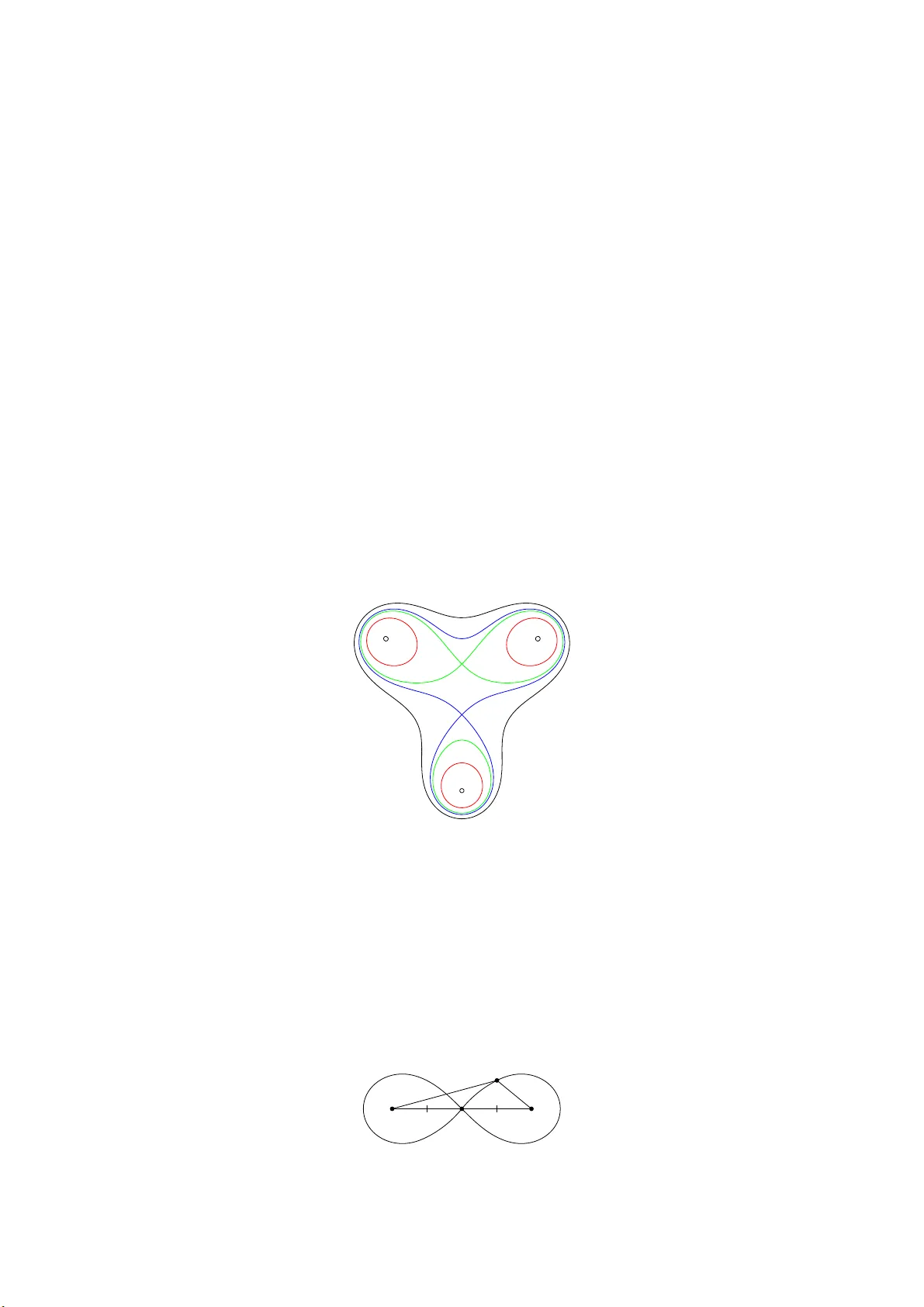
The Lemniscate of Bernoul li, without F orm ulas Arseniy V. Ak opy an Abstract In this pap er, we giv e pur ely geo metrical pro ofs of the well-kno wn prop er ties of the lemniscate of Bernoulli. What is the lemniscate? A p olyno mial lemnisc ate with fo ci F 1 , F 2 , . . . , F n is a lo cus of p oin ts X su c h that the prod uct of d istances from X to the foci is constan t ( Y i =1 ,...,n | F i X | = const ). The n -th ro ot of this v alue is call ed the r adius of the lemniscat e. It is clear, that lemniscat e is an algebraic curv e of degree (at most) 2 n . Y o u c an s ee a family of lemniscates with three foci in Figure 1. Fig. 1. The lemniscate with three fo ci. A lemniscate w ith t wo fo ci is called a Cassini oval . It is n amed after the astronomer Gio v anni Domenico Ca ssin i wh o studied them in 16 80. The m ost w ell-kno wn Cassini o v al is the lemnisc ate of Bernoul li whic h w as describ ed by Jako b Bernoulli in 1694. T h is is a curv e suc h that for eac h p oin t of the curve, th e pro d u ct of distances to fo ci equals quarter of square of the distance b et ween the fo ci (Fig. 2). Bernoulli considered it as a mo dification of an ellipse, whic h has the similar d efinition: the lo cus of p oin ts with the sum of distances to fo ci is constan t. (Bernoulli was not familiar with the work of Cassin i). It is clear that the lemniscate of Bernoulli passes thr ou gh th e midp oin t b et ween the fo ci. Th is p oin t is called the junctur e or double p oint of the lemniscate. F 1 F 2 O X Fig. 2. | F 1 X | · | F 2 X | = | F 1 O | · | F 2 O | . 1 The lemniscate of Bernou lli has many very in teresting p rop erties. F o r example, the area b ound ed b y the lemniscate is equal to 1 2 | F 1 F 2 | 2 . In this pap er w e p ro ve s ome other prop erties, mainly using purely syn thetic arguments. Ho w to construct t he lemniscate of Bernoulli? There exists a ve ry simp le metho d t o construct the lemniscate of Bernoulli using th e follo wing three-bar link age. This construction was inv en ted by J ames W at t: T ak e t w o equal ro ds F 1 A an d F 2 B of the length 1 √ 2 | F 1 F 2 | an d fixed at th e p oints F 1 and F 2 resp ectiv ely . Let p oint s A and B lie on opp osite sides of the line F 1 F 2 . The thir d ro d cinn ects the p oint s A and B and its length equals | F 1 F 2 | (Fig. 3). Th en , during the motio n of the link age the midp oint X of the r o d AB tr ac es the lemnisc ate of Bernoul li with fo ci at F 1 and F 2 . F 1 F 2 A B X Fig. 3. Pr o of. Note th at the quadrilateral F 1 AF 2 B is an isosceles trap ezoid (Fig. 4). Moreo v er, triangles △ AF 1 X and △ AB F 1 are similar, b ecause they h a v e the common angle A an d the follo wing relation on their sides holds: | AF 1 | | AX | = | AB | | AF 1 | = √ 2 . F o r the same reason, triangle s △ B X F 2 and △ B F 2 A are similar. They ha ve the com- mon angle B , and the ratios of the length of the sides w ith endp oin ts at B is √ 2. Th erefore, w e can write the follo wing equations: ∠ AF 1 X = ∠ AB F 1 = ∠ B AF 2 = ∠ X F 2 B . F 1 F 2 A B X O Fig. 4. Let us remark that in the trap ezoi d F 1 AF 2 B angles ∠ A and ∠ F 2 are equal. Since angles ∠ X AF 2 and ∠ X F 2 B are equal to o, w e obtain ∠ F 1 AX = ∠ X F 2 A . This implies that triangles △ F 1 AX and △ AF 2 X are sim ilar. Therefore, | F 1 X | | AX | = | AX | | X F 2 | ⇒ | X F 1 | · | X F 2 | = | AX | 2 = | F 1 O | 2 . 2 Th u s, w e ha ve sh o wn that p oint X lies on the lemniscat e of Bernoulli Since the motion of the p oin t X is con tin uous and X attains the farthest p oin ts of the lemniscate, the tra jectory of X is the whole lemniscate of Bernoulli. F 1 F 2 A B X O M M M M M M M M M M M M M M M M M M M M M M M M M M M M M M M M M M M M M M M M M M M M M M M M M M M M M M M M M M M M M M M M M N O ′ O ′ O ′ O ′ O ′ O ′ O ′ O ′ O ′ O ′ O ′ O ′ O ′ O ′ O ′ O ′ O ′ O ′ O ′ O ′ O ′ O ′ O ′ O ′ O ′ O ′ O ′ O ′ O ′ O ′ O ′ O ′ O ′ O ′ O ′ O ′ O ′ O ′ O ′ O ′ O ′ O ′ O ′ O ′ O ′ O ′ O ′ O ′ O ′ O ′ O ′ O ′ O ′ O ′ O ′ O ′ O ′ O ′ O ′ O ′ O ′ O ′ O ′ O ′ O ′ Fig. 5. Let O b e the midp oint of the segmen t F 1 F 2 (double p oin t of the lemniscate). Denote b y M and N the midp oints of the segmen ts F 1 A and F 1 B resp ectiv ely (F ig. 5 ). T ranslate the p oint O b y the vec tor − − → N F 1 . Denote the new point by O ′ . Observe that triangles △ F 1 M O ′ and △ N X O are congruent . Moreo v er, the follo w ing equation holds: | F 1 M | = | F 1 O ′ | = 1 √ 2 | F 1 O | . In other words, the p oin ts M and O ′ lie on the circle w ith cent er at F 1 and radius 1 √ 2 | F 1 O | . Using this observ ation, w e can obtain another elegan t metho d to construct the lem- niscate of Bernoulli. F 1 F 2 O O O O O O O O O O O O O O O O O O O O O O O O O O O O O O O O O O O O O O O O O O O O O O O O O O O O O O O O O O O O O O O O O B A A A A A A A A A A A A A A A A A A A A A A A A A A A A A A A A A A A A A A A A A A A A A A A A A A A A A A A A A A A A A A A A A X Fig. 6. Let us construct the circle with center at one of th e fo ci and radius 1 √ 2 | F 1 O | . On eac h secan t O AB (where A and B are the p oint s of inte rsection of the circle and the secan t) c hose p oin ts X a n d X ′ suc h that | AB | = | O X | = | O X ′ | (Fig. 6). The union of all p oints X an d X ′ form the lemniscate of Bernoulli with foci F 1 and F 2 . F 1 F 2 O O O O O O O O O O O O O O O O O O O O O O O O O O O O O O O O O O O O O O O O O O O O O O O O O O O O O O O O O O O O O O O O O A B C X Y Fig. 7. Another in teresting wa y to construct lemniscate with the link ages giv en in Figure 7. The lengths of the segmen ts F 1 A and F 1 O are equal. Th e p oint A is the vertex of ro ds AX and AY of the le n gth √ 2 | F 1 O | . Denote the midp oin ts of these ro ds by B an d C , and join them with O b y the an other ro d of th e length | AX | 2 . In the p ro cess of rota ting of p oint A around the circle eac h of th e p oints X and Y generates a half of the lemniscate of Bernoulli with fo ci F 1 and F 2 . 3 The lemniscate of Bernoulli and equilateral h yp erb ola. T h e hyper b ola is a muc h more w ell-kno wn curve. Hyperb ola w ith fo ci F 1 and F 2 is a set of all p oin ts X suc h that v alue | F 1 X | − | F 2 X | is constan t. Poi nts F 1 and F 2 are called the fo ci of the h yp erb ola. Among all hyp erb olas, w e single out e quilater al or r e ctangular hyp erb olas , i. e., the set of p oin ts X suc h that | F 1 X | − | F 2 X | = | F 1 F 2 | √ 2 . The lemniscate of Bernoulli is an in ve rsion image of an equilateral hyp erb ola . Before pro ving this claim, let us recall the definition of a inv ersion. Definition 1. Inv ersion with resp ect to the circle with cen ter O and r ad iu s r is a trans- formation whic h maps ev ery p oin t X in the p lane to the p oin t X ∗ lying on th e ray O X suc h that | O X ∗ | = r 2 | O X | . The in v ersion has man y interesting prop erties, see, for example [2]. Among the prop- erties, is the follo win g: a circle or a line will inv ert to either a circle or a line, d ep endin g on whether it passes through the origin. W e w ill prov e h ere ju s t one s im p le lemma that will help us later. Lemma 1. Supp ose A is an ortho gonal pr oje ction of the p oint O on some line ℓ . Then inversion image of the line ℓ with r esp e ct to a c ir cle with c enter at O is the ci r cle with diameter O A ∗ , wher e A ∗ is the inversion image of the p oint A . O A B A ∗ A ∗ A ∗ A ∗ A ∗ A ∗ A ∗ A ∗ A ∗ A ∗ A ∗ A ∗ A ∗ A ∗ A ∗ A ∗ A ∗ A ∗ A ∗ A ∗ A ∗ A ∗ A ∗ A ∗ A ∗ A ∗ A ∗ A ∗ A ∗ A ∗ A ∗ A ∗ A ∗ A ∗ A ∗ A ∗ A ∗ A ∗ A ∗ A ∗ A ∗ A ∗ A ∗ A ∗ A ∗ A ∗ A ∗ A ∗ A ∗ A ∗ A ∗ A ∗ A ∗ A ∗ A ∗ A ∗ A ∗ A ∗ A ∗ A ∗ A ∗ A ∗ A ∗ A ∗ A ∗ B ∗ O ∗ 1 ℓ Fig. 8. Pr o of. Let B b e an y p oint on the line ℓ , and let B ∗ b e its image (Fig. 8). Since | O A ∗ | = r 2 | O A | and | O B ∗ | = r 2 | O B | , w e obtain that triangles △ O AB and △ O B ∗ A ∗ are similar. Therefore the angle ∠ O B ∗ A ∗ is a righ t angle and the p oin t B ∗ lies on the circle w ith diameter OA ∗ . Note that th e c enter O ∗ 1 of this cir cle is the inversion of the p oint O 1 , wher e O 1 is the p oint symmetric to O with r esp e ct to the line ℓ . No w, let us pro ve that the lemnisc ate of Bernoul li with fo ci F 1 and F 2 , is an inversion of the e quilater al hyp erb ola with fo ci F 1 and F 2 with r esp e ct to the cir cle with c enter at O and r adius | O F 1 | . F or this pro of, we will use the results w e obtained in the pro of of correctness of the first metho d to construct the le mn iscate (Fig. 4). Let P b e the p oin t of the in tersection of th e lines F 1 A and F 2 B and let Q b e symmetric p oin t to P with resp ect to the line F 1 F 2 (Fig. 9). Note that | F 2 Q | − | F 1 Q | = | F 2 P | − | F 1 P | = | AP | − | F 1 P | = | F 1 A | = | F 1 F 2 | √ 2 . Therefore, the p oin ts P an d Q lie on the equilat eral h yp erb ola with fo ci at F 1 and F 2 . No w it r emains to show that p oin ts X and Q are the images of eac h other un der the in ve rs ion with cen ter at O and radius | O F 1 | . First, le t us s ho w that tr iangles △ F 1 X O and △ P F 1 O are similar. 4 F 1 F 2 A B X O O O O O O O O O O O O O O O O O O O O O O O O O O O O O O O O O O O O O O O O O O O O O O O O O O O O O O O O O O O O O O O O O P Q Fig. 9. The qu ad r ilateral F 1 X O B is a trap ezoi d. Therefore ∠ OX F 1 + ∠ X F 1 B = 180 ◦ . Also, w e h a v e ∠ AF 1 O + ∠ O F 1 P = 180 ◦ . Since the angle ∠ X F 1 B is equal to th e angle ∠ AF 1 O , w e obtain that ∠ O X F 1 and ∠ O F 1 P are equal to eac h other. Since a n gels ∠ X F 2 B and ∠ X F 1 A are equal, w e ha v e that ∠ X F 1 P + ∠ P F 2 X = 180 ◦ . In other w ords, the quadrilateral P F 1 X F 2 is inscrib ed . Therefore, w e ha v e ∠ F 2 F 1 X = ∠ F 2 P X = ∠ F 1 P O . The last equation provided th at p oints O an d X are symmetric to eac h other with resp ect to the p erp endicular bisector of the segmen t F 1 B . Th u s, triangles △ F 1 X O and △ P F 1 O are similar b ecause they hav e t wo corresp ondin g pairs of equal angles. I t f ollo ws that ∠ F 1 O X and ∠ F 1 O P are equal, and we ha v e that the point Q lies on the ra y O X . In addition, from similarit y of triangles △ F 1 X O and △ QF 1 O (it is congruent to the triangle △ P F 1 O ), w e obtain | O X | | O F 1 | = | O F 1 | | O Q | ⇒ | O X | · | O Q | = | O F 1 | 2 . It means that p oin ts Q and X are images of eac h other un der the in version w ith cen ter at O and radius | OF 1 | . F 1 F 2 O P P P P P P P P P P P P P P P P P P P P P P P P P P P P P P P P P P P P P P P P P P P P P P P P P P P P P P P P P P P P P P P P P Q Q Q Q Q Q Q Q Q Q Q Q Q Q Q Q Q Q Q Q Q Q Q Q Q Q Q Q Q Q Q Q Q Q Q Q Q Q Q Q Q Q Q Q Q Q Q Q Q Q Q Q Q Q Q Q Q Q Q Q Q Q Q Q Q X ℓ Fig. 10. If we lo ok at Figure 9, w e can mak e another observ ation: the p oints X and O lie on the circle with cen tered at P . It is in teresting that this cir cle touches th e lemnisc ate of Bernoul li. Pr o of. Supp ose ℓ is a tangent lin e to the hyperb ola in the p oin t Q . F rom Lemma 1, it follo ws that the image of the line ℓ under the in v ersion with center at O and radius | F 1 O | 5 is a circle ω ℓ passing through the point O . Sin ce X is the in version image of the p oint Q , w e see that the circle ω ℓ touc hes the lemniscate at the p oint X . F rom the same Lemma w e conclud e that the cen ter of this circle lies on the normal line from the p oin t O to the line ℓ . Let us sho w that lines O P and O Q are symmetric to eac h other with r esp ect to the line F 1 F 2 . It follo ws that the p oin t P is the cen ter of the circle ω ℓ . F 1 O Q R S P Fig. 11. Without loss of generalit y , w e can assume that the equation of the hyp erb ola is y = 1 x . Supp ose line ℓ in tersects the abscissa and th e ordinate in the p oin ts R and S resp ecti vely (Fig. 11). It is wel l-known that the deriv ative of the fun ction 1 x at the p oint x 0 is equal to − 1 x 2 0 . It follo ws that th e point Q is the midp oin t of the segmen t RS , and OQ is the median of the righ t triangle △ RO S . Therefore, the angles ∠ QO R and ∠ QRO are equal. Since angles ∠ P OS an d ∠ QO R are also equal, w e obtain th at the lines O P and RS are p erp endicular, as wa s to b e p ro ve d . F 1 F 2 P P P P P P P P P P P P P P P P P P P P P P P P P P P P P P P P P P P P P P P P P P P P P P P P P P P P P P P P P P P P P P P P P O O O O O O O O O O O O O O O O O O O O O O O O O O O O O O O O O O O O O O O O O O O O O O O O O O O O O O O O O O O O O O O O O X 2 α 2 α 2 α 2 α 2 α 2 α 2 α 2 α 2 α 2 α 2 α 2 α 2 α 2 α 2 α 2 α 2 α 2 α 2 α 2 α 2 α 2 α 2 α 2 α 2 α 2 α 2 α 2 α 2 α 2 α 2 α 2 α 2 α 2 α 2 α 2 α 2 α 2 α 2 α 2 α 2 α 2 α 2 α 2 α 2 α 2 α 2 α 2 α 2 α 2 α 2 α 2 α 2 α 2 α 2 α 2 α 2 α 2 α 2 α 2 α 2 α 2 α 2 α 2 α 2 α α Fig. 12. Let us note the follo wing: Since the circle ω ℓ touc hes the lemniscate at the p oin t X , the radius P X of this circle is a normal (p erp endicular to the tangen t line) to the lemniscat e at X (Fig. 12). Note that the triangle △ X P O is isosceles, and th e lines X O and P O are symmetric with resp ect to the line F 1 O . Therefore, we can write these equations: ∠ P X O = ∠ X O P = 2 ∠ P O F 1 . It follo ws that th ere exists the f ollo wing very simple metho d to constr u ct the normal to the lemniscate of Bernoulli: F or an y p oin t X on the lemniscate, take th e line forming with the line inte rsecting O X at X , with the angle of intersecti on equ al to 2 ∠ X O F . This line will b e a normal to the lemniscate . References [1] h ttp://xahlee.info/Sp ecialPlaneCurv es dir/LemniscateOfBernoulli dir/lemniscateOfBernoulli.h tml. [2] R. A. Johnson. Adv anced Euclidean Geometry. Do ver Publications New Y ork, N. Y, 2007. [3] J. D. Lawrence. A c atalo g of sp e cial plane curves . Do v er Publications New Y ork, N. Y, 1972. 6
Original Paper
Loading high-quality paper...
Comments & Academic Discussion
Loading comments...
Leave a Comment