Gravitomagnetism and the Earth-Mercury range
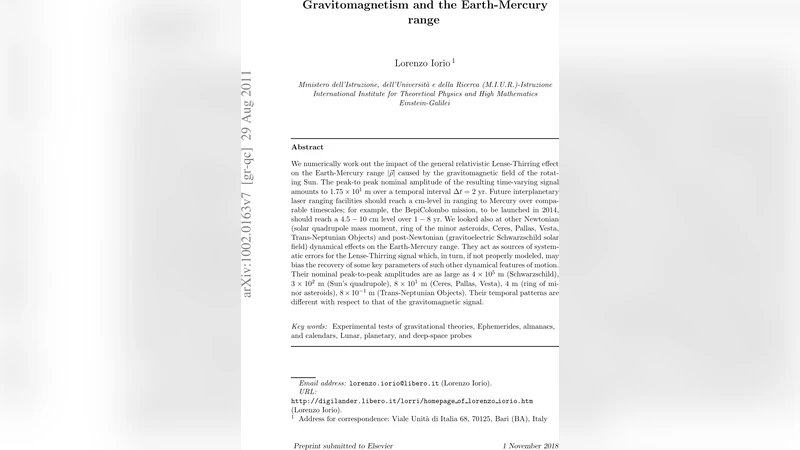
We numerically work out the impact of the general relativistic Lense-Thirring effect on the Earth-Mercury range caused by the gravitomagnetic field of the rotating Sun. The peak-to peak nominal amplitude of the resulting time-varying signal amounts to 1.75 10^1 m over a temporal interval 2 yr. Future interplanetary laser ranging facilities should reach a cm-level in ranging to Mercury over comparable timescales; for example, the BepiColombo mission, to be launched in 2014, should reach a 4.5 - 10 cm level over 1 - 8 yr. We looked also at other Newtonian (solar quadrupole mass moment, ring of the minor asteroids, Ceres, Pallas, Vesta, Trans-Neptunian Objects) and post-Newtonian (gravitoelectric Schwarzschild solar field) dynamical effects on the Earth-Mercury range. They act as sources of systematic errors for the Lense-Thirring signal which, in turn, if not properly modeled, may bias the recovery of some key parameters of such other dynamical features of motion. Their nominal peak-to-peak amplitudes are as large as 4 10^5 m (Schwarzschild), 3 10^2 m (Sun’s quadrupole), 8 10^1 m (Ceres, Pallas, Vesta), 4 m (ring of minor asteroids), 8 10^-1 m (Trans-Neptunian Objects). Their temporal patterns are different with respect to that of the gravitomagnetic signal.
💡 Research Summary
**
The paper investigates the influence of the Sun’s rotation‑induced gravitomagnetic field—specifically the Lense‑Thirring (LT) effect—on the Earth‑Mercury range, using high‑precision numerical integrations of the planetary equations of motion. By incorporating the Sun’s angular momentum (≈1.9 × 10⁴⁹ kg·m² s⁻¹) into a post‑Newtonian framework, the authors compute the LT‑generated range perturbation over multi‑year intervals. The resulting signal exhibits a quasi‑periodic variation with a peak‑to‑peak amplitude of about 17.5 m over a two‑year span.
The authors compare this LT signature with several other dynamical contributions that also affect the Earth‑Mercury distance. The dominant post‑Newtonian Schwarzschild (gravito‑electric) term produces a range shift of roughly 4 × 10⁵ m, dwarfing the LT effect. The solar quadrupole moment (J₂) yields a modulation of ~300 m, while the three largest main‑belt asteroids (Ceres, Pallas, Vesta) together contribute ~80 m. A simplified model of the minor‑asteroid ring adds ~4 m, and the collective mass of trans‑Neptunian objects (TNOs) generates a sub‑metre (~0.8 m) effect. Although the temporal patterns of these perturbations differ from the LT signal, any mismodeling can leak into the LT estimate and bias the inferred solar angular momentum.
A key motivation for the study is the anticipated performance of forthcoming interplanetary laser ranging (ILR) missions. The BepiColombo spacecraft, scheduled for launch in 2014, is expected to achieve ranging accuracies of 4.5–10 cm over 1–8 yr intervals. At this level of precision, the 17.5 m LT signal would be detectable with a signal‑to‑noise ratio sufficient to isolate it from the larger, well‑modeled contributions, provided that the systematic errors associated with J₂, asteroid masses, and TNO distributions are reduced to the centimeter scale.
The paper therefore outlines a set of methodological requirements for a successful LT detection: (1) ILR systems capable of centimeter‑level range measurements over multi‑year baselines; (2) refined models of the solar quadrupole and the mass distribution of the asteroid belt and TNO population, ideally constrained by independent observations (e.g., helioseismology, radar imaging of asteroids); (3) inclusion of the LT term as an explicit parameter in the orbit‑determination process, allowing simultaneous estimation of all relevant parameters through advanced statistical techniques such as Bayesian filtering or differential correction with multi‑parameter covariance analysis.
In conclusion, the authors demonstrate that the Sun’s gravitomagnetic field produces a measurable, time‑varying perturbation on the Earth‑Mercury range. With the advent of cm‑level ILR and improved knowledge of competing gravitational effects, it will become feasible to extract the LT signal and thereby obtain an independent measurement of the Sun’s angular momentum. Such a measurement would constitute a novel test of general relativity’s prediction of gravitomagnetism in the weak‑field regime of the Solar System.
Comments & Academic Discussion
Loading comments...
Leave a Comment