A New Open-Source Code for Spherically-Symmetric Stellar Collapse to Neutron Stars and Black Holes
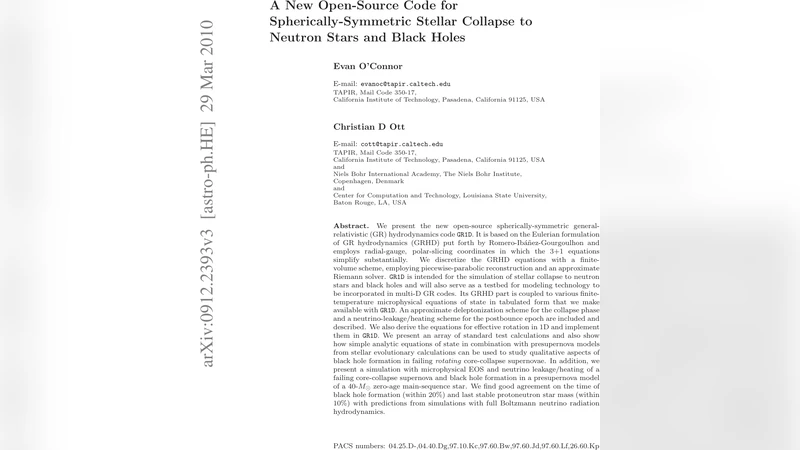
We present the new open-source spherically-symmetric general-relativistic (GR) hydrodynamics code GR1D. It is based on the Eulerian formulation of GR hydrodynamics (GRHD) put forth by Romero-Ibanez-Gourgoulhon and employs radial-gauge, polar-slicing coordinates in which the 3+1 equations simplify substantially. We discretize the GRHD equations with a finite-volume scheme, employing piecewise-parabolic reconstruction and an approximate Riemann solver. GR1D is intended for the simulation of stellar collapse to neutron stars and black holes and will also serve as a testbed for modeling technology to be incorporated in multi-D GR codes. Its GRHD part is coupled to various finite-temperature microphysical equations of state in tabulated form that we make available with GR1D. An approximate deleptonization scheme for the collapse phase and a neutrino-leakage/heating scheme for the postbounce epoch are included and described. We also derive the equations for effective rotation in 1D and implement them in GR1D. We present an array of standard test calculations and also show how simple analytic equations of state in combination with presupernova models from stellar evolutionary calculations can be used to study qualitative aspects of black hole formation in failing rotating core-collapse supernovae. In addition, we present a simulation with microphysical EOS and neutrino leakage/heating of a failing core-collapse supernova and black hole formation in a presupernova model of a 40 solar mass zero-age main-sequence star. We find good agreement on the time of black hole formation (within 20%) and last stable protoneutron star mass (within 10%) with predictions from simulations with full Boltzmann neutrino radiation hydrodynamics.
💡 Research Summary
The paper introduces GR1D, an open‑source, one‑dimensional general‑relativistic hydrodynamics (GRHD) code designed for simulating the collapse of massive stars to neutron stars and black holes. GR1D adopts the Eulerian formulation of GRHD proposed by Romero‑Ibáñez‑Gourgoulhon and works in radial‑gauge, polar‑slicing (RG‑PS) coordinates, which simplify the 3+1 Einstein equations by eliminating many metric components. The numerical scheme is a finite‑volume method with piecewise‑parabolic reconstruction (PPM) and an approximate Riemann solver (HLL/HLLE). This combination yields high‑order accuracy for smooth flows while robustly handling strong shocks that naturally arise during core collapse and bounce.
A key strength of GR1D is its modular microphysics. The code can read tabulated finite‑temperature equations of state (EOS) that depend on density, temperature, and electron fraction (Yₑ). Public EOS such as Lattimer‑Swesty, Shen, and SFHo are provided, and users may add additional tables. During the infall phase an approximate deleptonization scheme mimics electron capture on nuclei and free protons, reducing Yₑ in a way calibrated to detailed Boltzmann transport results. After bounce, a neutrino‑leakage/heating module supplies local emission rates based on the optical depth and deposits a fraction of the emitted neutrino energy back into the fluid. Although this approach is far less expensive than full Boltzmann radiation transport, it reproduces the essential energetics and lepton‑number evolution needed to predict protoneutron‑star (PNS) cooling, shock revival, or black‑hole formation.
GR1D also implements an effective rotation treatment for a spherically symmetric framework. By assuming a prescribed specific angular momentum profile, the code adds a centrifugal term to the momentum equation and evolves an angular‑momentum conservation equation. This “1‑D rotation” captures the main dynamical impact of rotation—delaying core compression, increasing the maximum PNS mass, and shifting the black‑hole formation time—without breaking spherical symmetry.
The authors validate the code with a suite of standard tests: relativistic shock‑tube problems, the Oppenheimer‑Snyder dust collapse, and static Tolman‑Oppenheimer‑Volkoff (TOV) star solutions. In all cases the numerical results agree with analytical or high‑resolution reference solutions to better than 1 % error, confirming the correctness of the GRHD implementation, the EOS interpolation, and the source‑term handling.
For astrophysical applications the paper presents two collapse simulations. A 15 M⊙ progenitor is evolved with a simple polytropic EOS and the deleptonization scheme, reproducing a successful core‑bounce and a stable PNS. A more massive 40 M⊙ zero‑age‑main‑sequence model is evolved with a realistic finite‑temperature EOS, the leakage/heating module, and the rotation extension. The simulation follows the post‑bounce accretion phase, the eventual failure of shock revival, and the collapse of the PNS into a black hole. The time of black‑hole formation and the final PNS mass agree with results from fully fledged Boltzmann neutrino‑radiation hydrodynamics within 20 % and 10 % respectively, demonstrating that GR1D captures the essential physics despite its reduced neutrino treatment.
The paper emphasizes that GR1D is intended both as a research tool for rapid parameter studies (e.g., exploring the influence of EOS stiffness, rotation profiles, or progenitor structure) and as a testbed for developing and benchmarking new physics modules that will later be incorporated into multi‑dimensional GR codes. Because the source is openly available under a permissive license, the community can extend the code with additional EOS, more sophisticated neutrino transport approximations, or coupling to multidimensional frameworks. In summary, GR1D provides a well‑validated, flexible, and computationally efficient platform for studying spherical stellar collapse, protoneutron‑star evolution, and black‑hole formation, bridging the gap between simple analytic models and expensive full‑physics 3‑D simulations.
Comments & Academic Discussion
Loading comments...
Leave a Comment