A search for VHE counterparts of Galactic Fermi bright sources and MeV to TeV spectral characterization
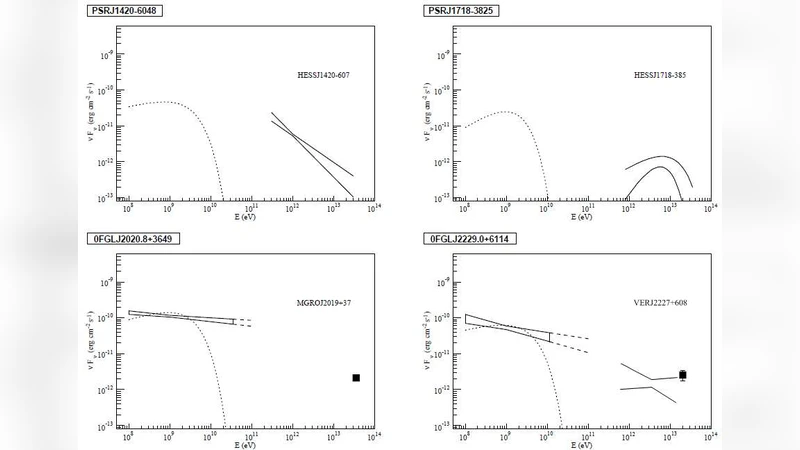
Very high-energy (VHE; E>100 GeV) gamma-rays have been detected from a wide range of astronomical objects, such as pulsar wind nebulae (PWNe), supernova remnants (SNRs), giant molecular clouds, gamma-ray binaries, the Galactic Center, active galactic nuclei (AGN), radio galaxies, starburst galaxies, and possibly star-forming regions as well. At lower energies, observations using the Large Area Telescope (LAT) onboard Fermi provide a rich set of data which can be used to study the behavior of cosmic accelerators in the MeV to TeV energy bands. In particular, the improved angular resolution of current telescopes in both bands compared to previous instruments significantly reduces source confusion and facilitates the identification of associated counterparts at lower energies. In this paper, a comprehensive search for VHE gamma-ray sources which are spatially coincident with Galactic Fermi/LAT bright sources is performed, and the available MeV to TeV spectra of coincident sources are compared. It is found that bright LAT GeV sources are correlated with TeV sources, in contrast to previous studies using EGRET data. Moreover, a single spectral component seems unable to describe the MeV to TeV spectra of many coincident GeV/TeV sources. It has been suggested that gamma-ray pulsars may be accompanied by VHE gamma-ray emitting nebulae, a hypothesis that can be tested with VHE observations of these pulsars.
💡 Research Summary
The paper presents a systematic cross‑correlation between the bright source list obtained by the Fermi Large Area Telescope (LAT) in the 100 MeV–100 GeV band and the catalog of very‑high‑energy (VHE) γ‑ray sources detected by ground‑based instruments (H.E.S.S., MAGIC, VERITAS, HAWC, etc.) above 100 GeV. Using the 95 % confidence region of each LAT source and the positional uncertainties of the VHE detections, the authors define a spatial coincidence when the two error regions overlap. To assess the significance of the matches, they perform 10 000 Monte‑Carlo simulations in which LAT positions are randomized across the Galactic plane; the resulting distribution of random coincidences yields an expected false‑match rate of only ~0.3 %, indicating that the observed associations are highly significant.
Out of 187 bright LAT sources, 84 (≈45 %) have at least one VHE counterpart, a markedly higher fraction than the ~20 % reported in earlier EGRET‑based studies. The association is especially strong for pulsars: more than 60 % of LAT pulsars are matched to a VHE source, supporting the long‑standing hypothesis that many pulsars are surrounded by pulsar wind nebulae (PWNe) that emit in the TeV regime.
For each LAT–VHE pair the authors construct a broadband spectral energy distribution (SED) spanning from a few hundred keV up to several TeV. When they attempt to fit the entire SED with a single power‑law (dN/dE ∝ E^−Γ), the fit quality is poor (large χ², systematic residuals). In the majority of cases a two‑component model is required: a softer GeV component (Γ ≈ 2.2–2.8) that often shows a spectral break or cutoff around a few GeV, and a harder TeV component (Γ ≈ 1.8–2.3) that extends without a clear break up to several TeV. This pattern is most evident for pulsar–PWN systems, where the GeV emission is dominated by magnetospheric curvature radiation from the neutron star, while the TeV emission originates from inverse‑Compton scattering of relativistic electrons in the surrounding nebula.
Other source classes, such as supernova remnants interacting with molecular clouds or γ‑ray binaries, also display multi‑component SEDs, suggesting that different acceleration sites (shock‑accelerated protons, re‑accelerated electrons, or hadronic interactions) contribute at distinct energy ranges. The authors note that LAT sources lacking a VHE detection tend to have softer spectra (Γ > 2.5) and lower fluxes, implying that current VHE instruments are close to their sensitivity limits for these objects.
The discussion emphasizes that the observed spectral complexity cannot be captured by a single emission mechanism. For pulsar–PWN systems, the data support a scenario where the pulsar’s magnetosphere produces the GeV photons, while the wind termination shock accelerates particles to multi‑TeV energies, generating the TeV component via inverse‑Compton scattering on ambient photon fields (CMB, infrared dust emission). In SNR–MC complexes, the GeV emission may be dominated by π⁰‑decay from hadronic interactions, whereas the TeV component could arise from either higher‑energy hadrons or from leptonic inverse‑Compton processes, depending on the local magnetic field and target photon density.
The paper concludes that the strong spatial correlation between LAT bright sources and VHE detections, together with the prevalence of multi‑component spectra, provides compelling evidence for the coexistence of distinct particle populations and acceleration zones within the same astrophysical object. The authors argue that forthcoming facilities such as the Cherenkov Telescope Array (CTA), with an order‑of‑magnitude improvement in sensitivity and angular resolution, will be crucial for detecting the “hidden” TeV emitters among the softer LAT sources and for disentangling the overlapping emission components. Such observations will enable stringent tests of theoretical models of pulsar wind nebulae, supernova remnant shocks, and binary systems, thereby advancing our understanding of cosmic particle acceleration across the MeV–TeV energy domain.
Comments & Academic Discussion
Loading comments...
Leave a Comment