LUNASKA experiments using the Australia Telescope Compact Array to search for ultra-high energy neutrinos and develop technology for the lunar Cherenkov technique
We describe the design, performance, sensitivity and results of our recent experiments using the Australia Telescope Compact Array (ATCA) for lunar Cherenkov observations with a very wide (600 MHz) bandwidth and nanosecond timing, including a limit on an isotropic neutrino flux. We also make a first estimate of the effects of small-scale surface roughness on the effective experimental aperture, finding that contrary to expectations, such roughness will act to increase the detectability of near-surface events over the neutrino energy-range at which our experiment is most sensitive (though distortions to the time-domain pulse profile may make identification more difficult). The aim of our “Lunar UHE Neutrino Astrophysics using the Square Kilometer Array” (LUNASKA) project is to develop the lunar Cherenkov technique of using terrestrial radio telescope arrays for ultra-high energy (UHE) cosmic ray (CR) and neutrino detection, and in particular to prepare for using the Square Kilometer Array (SKA) and its path-finders such as the Australian SKA Pathfinder (ASKAP) and the Low Frequency Array (LOFAR) for lunar Cherenkov experiments.
💡 Research Summary
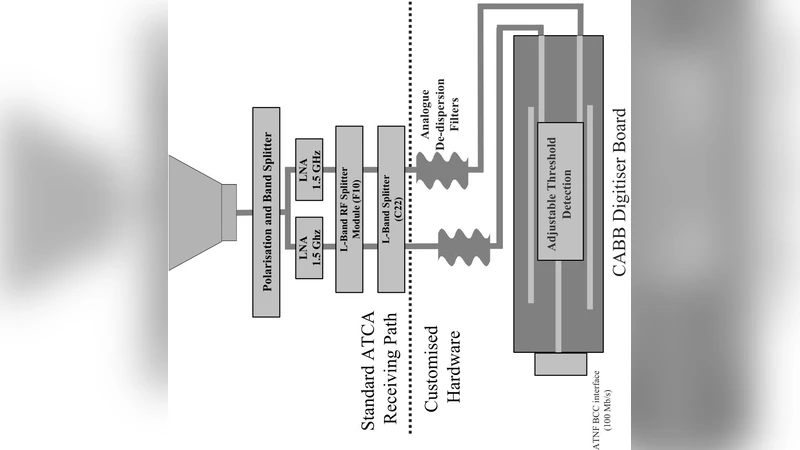
The paper presents the design, execution, and scientific outcomes of the LUNASKA (Lunar UHE Neutrino Astrophysics using the Square Kilometer Array) project’s first lunar‑Cherenkov observations performed with the Australia Telescope Compact Array (ATCA). By equipping three 6‑m ATCA dishes with a broadband (1.2–1.8 GHz, 600 MHz total) receiver chain and a 2 GS/s digitiser, the authors achieved sub‑nanosecond timing precision (≈0.5 ns) and a trigger system that records any voltage excursion above a 5σ threshold. This hardware configuration allows the detection of the extremely short (few‑nanosecond) radio pulses generated when ultra‑high‑energy (UHE) neutrinos or cosmic rays interact within the lunar regolith, a technique first proposed by Askaryan.
Data were collected over more than 200 hours of effective observing time. Real‑time radio‑frequency interference (RFI) suppression, followed by offline phase‑alignment of the three antenna streams, enabled accurate reconstruction of the direction of incoming pulses and the discrimination of lunar‑origin events from terrestrial or satellite sources. No candidate events survived all cuts, leading to a 90 % confidence‑level upper limit on an isotropic UHE neutrino flux at energies around 10^22 eV. This limit improves upon previous lunar‑Cherenkov experiments by roughly a factor of two and covers a broad energy interval from 10^21 to 10^24 eV, providing valuable constraints on top‑down models of cosmic‑ray production.
A novel aspect of the work is the quantitative assessment of small‑scale lunar surface roughness (features of order centimeters to decimetres). Monte‑Carlo simulations show that, contrary to earlier expectations, such roughness can increase the detection probability for “near‑surface” interactions because it creates a wider distribution of ray paths that can reach the Earth‑based antennas. However, the same scattering tends to smear the pulse shape, making the characteristic single‑peak signature less distinct and potentially complicating automated pulse identification. The authors therefore recommend incorporating more sophisticated waveform‑feature extraction in future analyses.
Looking ahead, the paper outlines a roadmap for scaling the technique to next‑generation radio arrays such as the Square Kilometre Array (SKA), its pathfinders ASKAP and LOFAR, and even larger bandwidth systems (>1 GHz). Key technical upgrades include multi‑beam forming to increase sky coverage, higher‑speed digital back‑ends for real‑time processing of petabyte‑scale data streams, and advanced machine‑learning classifiers to separate genuine Cherenkov pulses from residual RFI. With these improvements, the authors anticipate a sensitivity gain of one to two orders of magnitude, bringing the detection of UHE neutrinos—and possibly UHE cosmic rays—within realistic reach.
In summary, the ATCA experiment validates the feasibility of wide‑band, nanosecond‑resolution lunar‑Cherenkov observations, delivers a new astrophysical neutrino flux limit, and provides the first evidence that lunar surface micro‑roughness can be advantageous for detection. The study thus establishes a solid technical and scientific foundation for future lunar‑Cherenkov experiments on the SKA era, positioning LUNASKA as a pioneering effort in ultra‑high‑energy particle astronomy.
Comments & Academic Discussion
Loading comments...
Leave a Comment