A categorical approach to cyclic duality
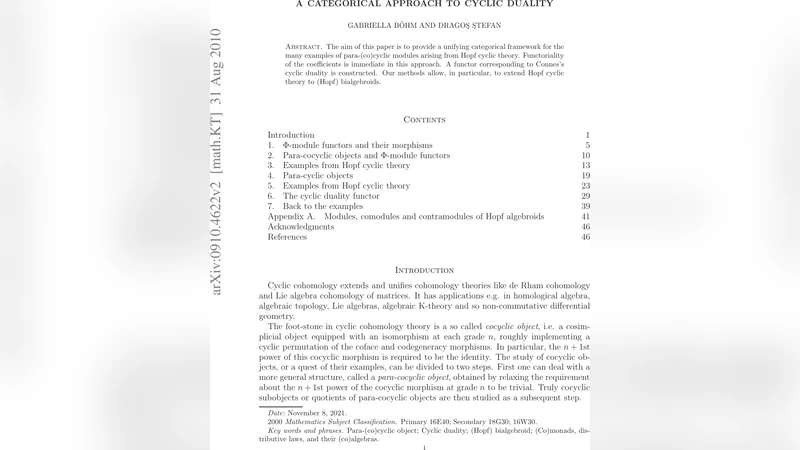
The aim of this paper is to provide a unifying categorical framework for the many examples of para-(co)cyclic modules arising from Hopf cyclic theory. Functoriality of the coefficients is immediate in this approach. A functor corresponding to Connes’s cyclic duality is constructed. Our methods allow, in particular, to extend Hopf cyclic theory to (Hopf) bialgebroids.
💡 Research Summary
The paper sets out to place the myriad examples of para‑(co)cyclic modules that have appeared in Hopf‑cyclic theory into a single, coherent categorical framework. The authors begin by recalling that most constructions to date have been carried out on a case‑by‑case basis: one fixes a Hopf algebra (or a Hopf‑module) and then builds a para‑cyclic object by hand, often with ad‑hoc choices of coefficients. This fragmented approach obscures the underlying structural commonalities and makes functoriality of coefficients difficult to express.
To remedy this, the authors introduce a 2‑categorical setting in which a “para‑cyclic object’’ is defined as a quadruple ((C_\bullet, d_\bullet, s_\bullet, t_\bullet)) consisting of a graded object, a differential, a forward shift (s) and a backward shift (t). The crucial point is that (s) and (t) need not be inverses; the axioms only require the usual simplicial relations together with a weakened cyclic condition that accommodates non‑invertible shift maps. Dually, a “para‑cocyclic object’’ is defined by reversing the direction of the shift maps. This abstraction captures all known examples, whether they arise from Hopf algebras, Hopf‑module coalgebras, or more exotic coefficient systems.
The heart of the paper is the construction of a functor (C) that implements Connes’s cyclic duality at the categorical level. The functor first takes the transpose of the underlying para‑cocyclic complex, then applies a “dualizing” operation on the coefficient functor, thereby converting a para‑cyclic object into a para‑cocyclic one and vice‑versa. The authors prove that (C) is an equivalence of categories, not merely a contravariant correspondence: it preserves the differential, the shift operators (up to canonical isomorphism), and, most importantly, the coefficient module structure. In this way the duality becomes functorial and can be applied uniformly across all examples.
Having established the duality, the authors turn to Hopf bialgebroids, which generalize Hopf algebras by allowing a non‑commutative base algebra and distinct left and right actions. They define a “bimodule‑bicoaction’’ coefficient object that simultaneously carries a left‑right module structure over the base and a compatible left‑right coaction of the bialgebroid. A new technical condition, called “virtual normality,” guarantees that the shift maps are well‑defined when tensoring over the base. With these ingredients, the para‑(co)cyclic construction extends verbatim to the bialgebroid setting, showing that the categorical framework is robust enough to handle the extra asymmetry.
The paper concludes with three detailed families of examples. The first revisits the classical Hopf‑Galois extensions, showing that the traditional cyclic module is recovered as the image of the categorical construction with the obvious coefficient functor. The second treats module‑comodule pairs over non‑commutative algebras, illustrating how the para‑cocyclic structure emerges from the coaction alone. The third example involves a quantum group viewed as a bialgebroid; here the authors verify that the duality functor (C) interchanges the para‑cyclic and para‑cocyclic complexes exactly as predicted. In each case the new approach streamlines calculations, makes the functorial dependence on coefficients transparent, and eliminates the need for ad‑hoc adjustments.
Overall, the work provides a unifying categorical language for para‑(co)cyclic modules, establishes a functorial version of Connes’s cyclic duality, and demonstrates that Hopf‑cyclic cohomology can be naturally extended to the broader context of Hopf bialgebroids. The authors suggest that this framework opens the door to higher‑categorical generalizations, to systematic computational tools for cyclic (co)homology, and to the discovery of new invariants in non‑commutative geometry.
Comments & Academic Discussion
Loading comments...
Leave a Comment