Pseudorandom Generators for Polynomial Threshold Functions
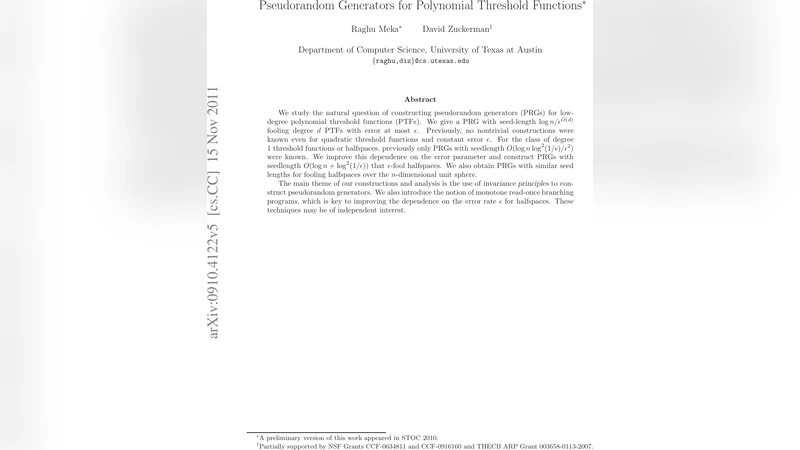
We study the natural question of constructing pseudorandom generators (PRGs) for low-degree polynomial threshold functions (PTFs). We give a PRG with seed-length log n/eps^{O(d)} fooling degree d PTFs with error at most eps. Previously, no nontrivial constructions were known even for quadratic threshold functions and constant error eps. For the class of degree 1 threshold functions or halfspaces, we construct PRGs with much better dependence on the error parameter eps and obtain a PRG with seed-length O(log n + log^2(1/eps)). Previously, only PRGs with seed length O(log n log^2(1/eps)/eps^2) were known for halfspaces. We also obtain PRGs with similar seed lengths for fooling halfspaces over the n-dimensional unit sphere. The main theme of our constructions and analysis is the use of invariance principles to construct pseudorandom generators. We also introduce the notion of monotone read-once branching programs, which is key to improving the dependence on the error rate eps for halfspaces. These techniques may be of independent interest.
💡 Research Summary
The paper addresses the long‑standing problem of constructing pseudorandom generators (PRGs) that fool low‑degree polynomial threshold functions (PTFs). A PTF is a Boolean function of the form f(x)=sign(p(x)), where p is a real polynomial of degree d over n variables. Such functions capture a wide range of models in learning theory, circuit complexity, and approximation algorithms. Prior to this work, no non‑trivial PRG was known even for quadratic (degree‑2) threshold functions with constant error, and the best known generators for linear threshold functions (halfspaces) required seed length O(log n·log²(1/ε)/ε²).
The authors present two families of generators. The first works for any fixed degree d. By leveraging an invariance principle—a high‑dimensional analogue of the Berry‑Esseen theorem—they show that a k‑wise independent distribution over {−1,1}ⁿ behaves almost identically to a standard Gaussian distribution when evaluated by any degree‑d polynomial, provided k = O(d·log(1/ε)). Using a standard construction of k‑wise independent bits, the seed length becomes O(k·log n) = O(log n·ε^{‑O(d)}). The analysis proceeds by a Lindeberg replacement argument: each coordinate of a Gaussian vector is gradually replaced by a bounded‑independence bit, and the cumulative error is bounded by the sum of fourth‑moment terms, which are controlled because the polynomial has bounded degree. Consequently, for any degree‑d PTF the generator outputs a distribution that the PTF cannot distinguish from uniform with advantage greater than ε.
The second, more refined, result focuses on degree‑1 PTFs, i.e., halfspaces f(x)=sign(w·x−θ). The authors observe that evaluating a halfspace can be modeled as a monotone read‑once branching program (Monotone ROBP): the computation reads the input bits in a fixed order, and the acceptance probability is a monotone function of the partial sum of weighted bits. By exploiting this monotonicity, they introduce the notion of “ε‑approximate monotonicity” and construct a generator that only needs to preserve this weaker property rather than full k‑wise independence. The generator partitions the seed into O(log(1/ε)) blocks, each generating a small set of almost‑Gaussian values; the monotone structure guarantees that the error contributed by each block adds up to at most ε. The resulting seed length is O(log n + log²(1/ε)), a dramatic improvement over the previous O(log n·log²(1/ε)/ε²) bound.
The paper also extends the halfspace generator to the spherical setting, where inputs are drawn uniformly from the unit sphere S^{n‑1}. By noting that a uniform point on the sphere can be obtained by normalizing a Gaussian vector, the same invariance‑principle analysis applies after a simple scaling step. The monotone ROBP representation remains valid, and the same seed length O(log n + log²(1/ε)) is achieved.
Technical highlights include: (1) a careful quantitative version of the invariance principle for low‑degree polynomials, (2) a novel use of monotone ROBPs to reduce the randomness requirements for halfspaces, (3) explicit constructions of the required bounded‑independence distributions with optimal seed length, and (4) extensions to spherical halfspaces via Gaussian normalization. The authors discuss limitations: the dependence on ε for degree‑d generators is ε^{‑O(d)}, which becomes prohibitive for large d, and they suggest that more refined moment‑matching or higher‑order invariance techniques might improve this. They also propose investigating whether monotone ROBP ideas can be applied to deeper circuits such as depth‑2 neural networks or polynomial‑size threshold circuits.
In summary, the paper introduces a new paradigm that combines invariance principles with space‑bounded pseudorandomness to obtain the first efficient PRGs for polynomial threshold functions, achieving near‑optimal seed lengths for linear thresholds and opening avenues for further reductions in higher‑degree settings.
Comments & Academic Discussion
Loading comments...
Leave a Comment