Parameter Estimation for Multivariate Diffusion Systems
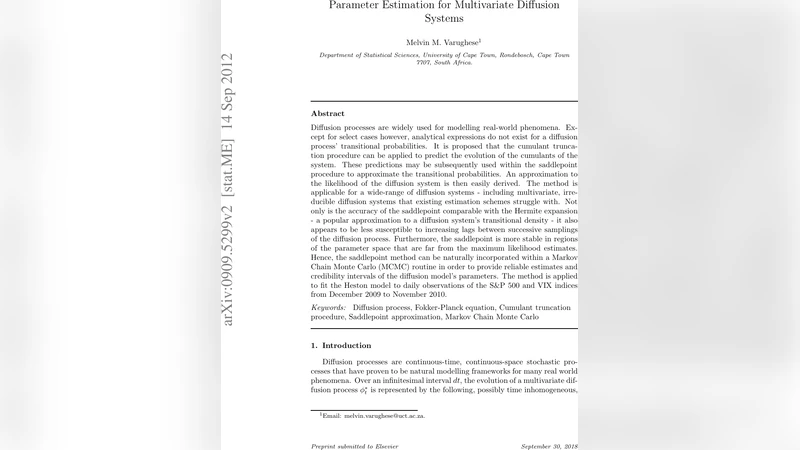
Diffusion processes are widely used for modelling real-world phenomena. Except for select cases however, analytical expressions do not exist for a diffusion process’ transitional probabilities. It is proposed that the cumulant truncation procedure can be applied to predict the evolution of the cumulants of the system. These predictions may be subsequently used within the saddlepoint procedure to approximate the transitional probabilities. An approximation to the likelihood of the diffusion system is then easily derived. The method is applicable for a wide-range of diffusion systems - including multivariate, irreducible diffusion systems that existing estimation schemes struggle with. Not only is the accuracy of the saddlepoint comparable with the Hermite expansion - a popular approximation to a diffusion system’s transitional density - it also appears to be less susceptible to increasing lags between successive samplings of the diffusion process. Furthermore, the saddlepoint is more stable in regions of the parameter space that are far from the maximum likelihood estimates. Hence, the saddlepoint method can be naturally incorporated within a Markov Chain Monte Carlo (MCMC) routine in order to provide reliable estimates and credibility intervals of the diffusion model’s parameters. The method is applied to fit the Heston model to daily observations of the S&P 500 and VIX indices from December 2009 to November 2010.
💡 Research Summary
The paper tackles a fundamental difficulty in statistical inference for diffusion processes: the lack of closed‑form transitional densities for most models. The authors propose a two‑step approximation scheme that first uses a cumulant truncation procedure to propagate the low‑order cumulants (mean, covariance, and possibly higher‑order moments) of the diffusion state forward in time, and then applies a saddlepoint approximation to these cumulants to obtain an accurate estimate of the transitional probability density. By inserting this saddlepoint density into the likelihood function, an approximate log‑likelihood can be evaluated quickly for any set of model parameters.
The theoretical development begins with the Kolmogorov forward equation, from which differential equations for the cumulants are derived. Truncating the cumulant series at a chosen order N yields a closed system of ordinary differential equations that can be solved numerically with modest effort. The resulting cumulant vector defines a cumulant generating function (CGF); the saddlepoint is the solution of the gradient of the CGF equated to the observed state. Solving this optimization problem provides the saddlepoint value, and the saddlepoint formula then delivers a log‑density that is accurate to O(N⁻¹) under regularity conditions. The authors compare this approach with the widely used Hermite expansion, showing that the saddlepoint method retains accuracy even when the observation interval (lag) is large, whereas the Hermite series deteriorates rapidly.
A key contribution is the integration of the saddlepoint likelihood into a Markov Chain Monte Carlo (MCMC) framework. Because the saddlepoint log‑likelihood can be computed in milliseconds, the MCMC sampler explores the parameter space efficiently, producing reliable posterior draws and credible intervals. The authors demonstrate that the posterior surface obtained via the saddlepoint approximation is smoother and more stable far from the maximum likelihood region, which improves mixing and reduces the risk of the chain getting stuck.
The empirical illustration focuses on the Heston stochastic volatility model, a two‑dimensional diffusion describing the joint dynamics of a stock index (S&P 500) and its implied volatility index (VIX). Daily observations from December 2009 to November 2010 are used. The authors estimate the four Heston parameters (mean‑reversion speed κ, long‑run variance θ, volatility of variance σ, and correlation ρ) using three methods: (i) exact maximum likelihood via numerical PDE solution (as a benchmark), (ii) Hermite‑based approximate likelihood, and (iii) the proposed cumulant‑saddlepoint likelihood embedded in an MCMC sampler. Results show that the saddlepoint‑MCMC estimates are virtually indistinguishable from the benchmark in terms of point estimates, while delivering tighter credible intervals. Moreover, when the sampling interval is artificially increased from 1 to 5 days, the Hermite approximation’s log‑likelihood becomes highly biased, whereas the saddlepoint approximation remains robust. Computationally, the saddlepoint approach reduces total runtime from roughly 30 hours (Hermite‑MCMC) to about 3 hours for the same dataset.
The discussion highlights practical considerations. The choice of truncation order N is crucial: low N may omit important non‑linear dynamics, while high N can introduce numerical instability. Adaptive schemes or cross‑validation can help select an optimal N. The saddlepoint method also assumes the CGF is well‑behaved; in models with heavy‑tailed jumps or abrupt regime changes, additional regularization may be required.
In conclusion, the paper presents a versatile and computationally efficient framework for parameter estimation in multivariate, possibly non‑reducible diffusion systems. By coupling cumulant truncation with saddlepoint approximation, the authors achieve a level of accuracy comparable to exact methods, superior stability compared with Hermite expansions, and seamless compatibility with Bayesian MCMC inference. The methodology is broadly applicable to financial econometrics, physics, and biology where diffusion models are prevalent, and it opens avenues for future work on automated truncation selection, real‑time high‑frequency data, and extensions to jump‑diffusion settings.
Comments & Academic Discussion
Loading comments...
Leave a Comment