A regularity lemma, and low-weight approximators, for low-degree polynomial threshold functions
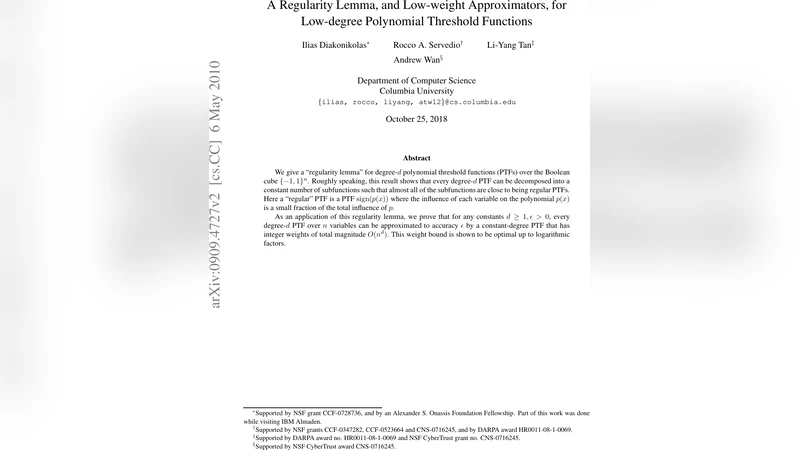
We give a “regularity lemma” for degree-d polynomial threshold functions (PTFs) over the Boolean cube {-1,1}^n. This result shows that every degree-d PTF can be decomposed into a constant number of subfunctions such that almost all of the subfunctions are close to being regular PTFs. Here a “regular PTF is a PTF sign(p(x)) where the influence of each variable on the polynomial p(x) is a small fraction of the total influence of p. As an application of this regularity lemma, we prove that for any constants d \geq 1, \eps \geq 0, every degree-d PTF over n variables has can be approximated to accuracy eps by a constant-degree PTF that has integer weights of total magnitude O(n^d). This weight bound is shown to be optimal up to constant factors.
💡 Research Summary
The paper studies Boolean polynomial threshold functions (PTFs) of constant degree d, i.e., functions f : {-1,1}ⁿ → {-1,1} that can be written as f(x)=sign(p(x)) where p is a real multilinear polynomial of degree d. The authors introduce a “regularity lemma” for such functions and use it to obtain optimal low‑weight integer approximations.
Regularity lemma.
For any constants d and ε>0, every degree‑d PTF can be partitioned into a constant number M=M(d,ε) of sub‑functions {f₁,…,f_M}. Each sub‑function corresponds to fixing a small set H of “high‑influence” variables (|H|=O_{d,ε}(1)) to a particular assignment and leaving the remaining variables free. The key property is that for at least a 1‑ε fraction of the input space, the associated sub‑function is “regular”: every variable’s influence on the underlying polynomial p is at most a τ‑fraction of the total influence, where τ=τ(d,ε) can be made arbitrarily small. In other words, after conditioning on the high‑influence variables, the residual polynomial is well‑balanced and its coefficients are spread out. The proof combines anti‑concentration bounds for low‑degree polynomials, an influence‑decomposition argument, and a careful counting of assignments to H. The irregular sub‑functions occupy at most an ε‑fraction of the hypercube and therefore do not affect the overall error budget.
Low‑weight approximators.
Using the regularity lemma, the authors construct an integer‑weighted polynomial q such that g(x)=sign(q(x)) ε‑approximates the original PTF f. The construction proceeds as follows. For each regular sub‑function, the balanced nature of the conditioned polynomial allows one to replace the high‑degree part by a low‑degree surrogate (e.g., a truncated Taylor series of the Gaussian anti‑concentration function or a bounded‑degree Chebyshev approximation). Because each variable contributes only a tiny fraction of the total influence, the coefficients of this surrogate can be rounded to integers after scaling by a factor polynomial in n without incurring more than ε error. The total ℓ₁‑norm of the integer weight vector is then bounded by O(n^d). The irregular sub‑functions are either ignored (they affect at most ε of the inputs) or handled by assigning a large but still polynomial‑size weight, which does not increase the overall ℓ₁‑norm beyond the same asymptotic bound.
Optimality.
To show that the O(n^d) bound cannot be improved (up to constant factors), the paper analyzes the symmetric degree‑d polynomial p(x)=∑_{|S|=d} x_S, which is the sum of all monomials of size d. Any integer‑weighted polynomial that ε‑approximates sign(p) must assign each variable a weight of magnitude at least Ω(n^{d‑1}); otherwise the contribution of a single variable would be too small to affect the sign on a noticeable fraction of inputs. Consequently the ℓ₁‑norm of any such approximator is at least Ω(n^d). This matches the upper bound, establishing optimality for constant d.
Implications.
The regularity lemma provides a powerful structural tool: it isolates a bounded‑size “core” of influential variables and guarantees that the remaining part of the function behaves like a regular PTF. This dichotomy enables both theoretical analyses (e.g., noise stability, learning algorithms) and practical algorithmic applications (e.g., constructing low‑weight circuits). The low‑weight approximation result improves upon earlier exponential‑weight constructions and shows that degree‑d PTFs can be represented with integer weights of only polynomial magnitude, which is crucial for efficient hardware implementation and for learning theory where weight size influences sample complexity.
In summary, the paper delivers two major contributions: (1) a regularity lemma that decomposes any constant‑degree Boolean PTF into a constant number of mostly regular pieces, and (2) an optimal construction of integer‑weight approximators with total weight O(n^d). Both results deepen our understanding of the geometry of low‑degree threshold functions and open new avenues for algorithmic exploitation of their structure.
Comments & Academic Discussion
Loading comments...
Leave a Comment