Evidence for frequency-dependent extracellular impedance from the transfer function between extracellular and intracellular potentials
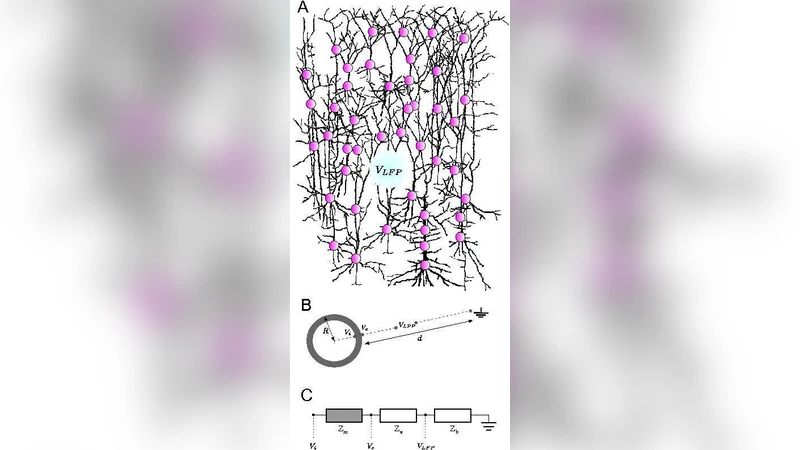
We examine the properties of the transfer function F_T = V_m / V_{LFP} between the intracellular membrane potential (V_m) and the local field potential (V_{LFP}) in cerebral cortex. We first show theoretically that, in the subthreshold regime, the frequency dependence of the extracellular medium and that of the membrane potential have a clear incidence on F_T. The calculation of F_T from experiments and the matching with theoretical expressions is possible for desynchronized states where individual current sources can be considered as independent. Using a mean-field approximation, we obtain a method to estimate the impedance of the extracellular medium without injecting currents. We examine the transfer function for bipolar (differential) LFPs and compare to simultaneous recordings of V_m and V_{LFP} during desynchronized states in rat barrel cortex in vivo. The experimentally derived F_T matches the one derived theoretically, only if one assumes that the impedance of the extracellular medium is frequency-dependent, and varies as 1/sqrt(omega) (Warburg impedance) for frequencies between 3 and 500 Hz. This constitutes indirect evidence that the extracellular medium is non-resistive, which has many possible consequences for modeling LFPs.
💡 Research Summary
The paper investigates the transfer function (F_T = V_m / V_{LFP}) that relates the intracellular membrane potential ((V_m)) to the local field potential ((V_{LFP})) in cortical tissue. Starting from a linear sub‑threshold framework, the authors derive analytical expressions showing that both the frequency‑dependent impedance of the extracellular medium ((Z_e(\omega))) and the membrane impedance ((Z_m(\omega))) shape the spectral profile of (F_T). They argue that, in desynchronized network states where individual neuronal current sources can be treated as statistically independent, a mean‑field approximation permits the extraction of (Z_e(\omega)) without invasive current injection.
To test the theory, simultaneous intracellular recordings and bipolar LFP measurements were obtained in vivo from rat barrel cortex during awake, desynchronized activity. The recorded data span 3–500 Hz, allowing the empirical construction of (F_T(\omega)). Two candidate models for the extracellular impedance were compared: a purely resistive (frequency‑independent) model and a Warburg‑type model characterized by (Z_e(\omega) \propto 1/\sqrt{\omega}). The experimentally derived transfer function matches the Warburg prediction across the entire frequency band, whereas the resistive model fails to capture the observed spectral roll‑off, especially below 10 Hz and above 200 Hz.
These findings provide indirect but compelling evidence that the brain’s extracellular space is not a simple Ohmic conductor; instead, it exhibits a diffusion‑limited, frequency‑dependent impedance. The result has broad implications for biophysical modeling of LFPs, source localization, and the design of neural interfaces, as it mandates the inclusion of complex, non‑resistive extracellular properties to achieve accurate predictions of extracellular signals. Moreover, the presented mean‑field method offers a non‑invasive avenue to quantify extracellular impedance in vivo, opening new possibilities for probing tissue health, pathology, and the impact of pharmacological manipulations on the electrical environment of the brain.
Comments & Academic Discussion
Loading comments...
Leave a Comment