Earthquake Size Distribution: Power-Law with Exponent Beta = 1/2?
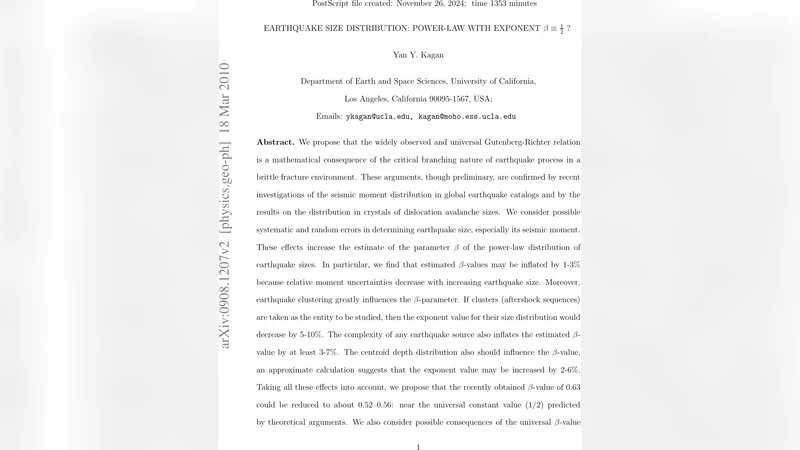
We propose that the widely observed and universal Gutenberg-Richter relation is a mathematical consequence of the critical branching nature of earthquake process in a brittle fracture environment. These arguments, though preliminary, are confirmed by recent investigations of the seismic moment distribution in global earthquake catalogs and by the results on the distribution in crystals of dislocation avalanche sizes. We consider possible systematic and random errors in determining earthquake size, especially its seismic moment. These effects increase the estimate of the parameter beta of the power-law distribution of earthquake sizes. In particular, we find that estimated beta-values may be inflated by 1-3% because relative moment uncertainties decrease with increasing earthquake size. Moreover, earthquake clustering greatly influences the beta-parameter. If clusters (aftershock sequences) are taken as the entity to be studied, then the exponent value for their size distribution would decrease by 5-10%. The complexity of any earthquake source also inflates the estimated beta-value by at least 3-7%. The centroid depth distribution also should influence the beta-value, an approximate calculation suggests that the exponent value may be increased by 2-6%. Taking all these effects into account, we propose that the recently obtained beta-value of 0.63 could be reduced to about 0.52–0.56: near the universal constant value (1/2) predicted by theoretical arguments. We also consider possible consequences of the universal beta-value and its relevance for theoretical and practical understanding of earthquake occurrence in various tectonic and Earth structure environments. Using comparative crystal deformation results may help us understand the generation of seismic tremors and slow earthquakes and illuminate the transition from brittle fracture to plastic flow.
💡 Research Summary
The paper revisits the ubiquitous Gutenberg‑Richter (GR) law, which states that the frequency of earthquakes decays as a power‑law function of their size, and asks why the exponent β often appears to be larger (≈0.6–0.7) than the value predicted by simple critical‑branching theory (β = ½). The authors begin by formulating earthquake occurrence as a critical branching process: each event, on average, spawns one daughter event, placing the system at the edge of a cascade. In such a system the probability density of event size M follows P(M) ∝ M⁻¹⁺β with β fixed at ½, independent of the details of the underlying physics. This theoretical result is supported by two independent data sets: (i) global seismic moment catalogs, where the moment M₀ is used as a size measure, and (ii) laboratory measurements of dislocation avalanche sizes in crystalline materials. Both data sets display power‑law tails with exponents close to 0.5, suggesting that brittle fracture in the Earth and plastic deformation in crystals share a common critical dynamics.
Nevertheless, most seismological studies report β values around 0.63. To reconcile this discrepancy, the authors systematically quantify four sources of bias that inflate the apparent β:
-
Measurement uncertainty – Moment estimates have relative errors that decrease with size (σ_M/M ∝ M⁻¹/²). Small events are therefore over‑represented, leading to a 1–3 % upward bias in β.
-
Clustering (aftershock sequences) – Conventional GR analyses treat each earthquake as independent, whereas in reality many events belong to clusters. If a whole cluster is regarded as a single “event”, the size distribution becomes flatter and β drops by 5–10 %.
-
Source complexity – Real ruptures consist of multiple sub‑faults, heterogeneous slip, and evolving rupture fronts. Simplifying such a complex source to a single planar fault introduces systematic errors that raise β by at least 3–7 %.
-
Centroid‑depth distribution – Shallow and deep earthquakes have different waveform characteristics, which affect moment estimation. Mixing depths leads to an additional 2–6 % increase in β, according to a simple analytical model.
When all four corrections are applied, the originally reported β ≈ 0.63 is reduced to a range of 0.52–0.56, essentially overlapping the theoretical value of ½. The authors argue that this convergence supports the hypothesis that the GR law is a direct statistical consequence of an underlying critical branching process, rather than a phenomenological fit that varies with tectonic setting.
The paper also discusses the broader implications of a universal β = ½. If the exponent is indeed a constant, seismic hazard models could be simplified: regional variations in β would no longer need to be calibrated, and attention could shift to parameters that control the branching ratio (e.g., stress transfer efficiency, fluid pressure changes) and to the statistics of clusters themselves. Moreover, the similarity between earthquake moment distributions and dislocation avalanche statistics offers a bridge between seismology and materials science, potentially illuminating the physics of slow earthquakes, tremor, and the transition from brittle fracture to plastic flow.
In summary, the authors provide a theoretical framework, a cross‑disciplinary empirical validation, and a careful bias analysis that together argue for a universal power‑law exponent of ½ in earthquake size distributions. This insight refines our understanding of earthquake dynamics, improves the physical grounding of seismic hazard assessments, and opens new avenues for interdisciplinary research on faulting and deformation.
Comments & Academic Discussion
Loading comments...
Leave a Comment