How Ordinary Elimination Became Gaussian Elimination
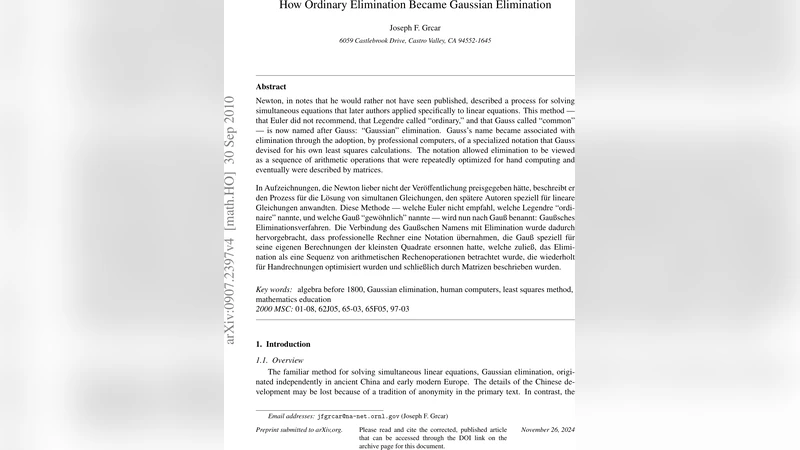
Newton, in notes that he would rather not have seen published, described a process for solving simultaneous equations that later authors applied specifically to linear equations. This method that Euler did not recommend, that Legendre called “ordinary,” and that Gauss called “common” - is now named after Gauss: “Gaussian” elimination. Gauss’s name became associated with elimination through the adoption, by professional computers, of a specialized notation that Gauss devised for his own least squares calculations. The notation allowed elimination to be viewed as a sequence of arithmetic operations that were repeatedly optimized for hand computing and eventually were described by matrices.
💡 Research Summary
The paper traces the historical evolution of what is now universally known as Gaussian elimination, revealing that the method’s roots lie in a much older “ordinary elimination” described in unpublished notes by Isaac Newton. Newton’s procedure was a general technique for solving systems of simultaneous equations, not limited to linear cases, and he referred to it as “ordinary” simply because it represented the standard, unremarkable approach of his time. Despite this, the method attracted criticism: Leonhard Euler dismissed it as inefficient, and Adrien-Marie Legendre (through his student Legendre) labeled it “ordinary” in a pejorative sense, while Joseph-Louis Lagrange’s contemporary, Legendre, called it “common.”
The turning point arrived in the early nineteenth century when Carl Friedrich Gauss, while performing least‑squares adjustments on astronomical observations, needed a reliable, repeatable process for eliminating variables. Gauss did not merely adopt Newton’s steps; he refined them for hand computation. He introduced a specialized notation—a tabular layout of coefficients that mirrors today’s augmented matrix—and a set of arithmetic rules designed to minimize the number of multiplications, divisions, and subtractions required at each stage. Gauss’s “pivot” strategy selected the most convenient leading coefficient, scaled rows only when necessary, and systematically eliminated lower rows before performing back‑substitution. This notation allowed professional “human computers”—the mathematicians and clerks who performed large‑scale calculations before electronic computers—to execute the algorithm with reduced error risk and greater speed.
Gauss’s notation spread rapidly among European observatories and surveying offices because it translated directly into a workflow that could be taught, memorized, and executed on desk calculators. The method became known in Gauss’s own publications as “common elimination,” and his distinctive symbols were eventually associated with his name by the community of professional calculators who adopted his hand‑optimized procedures.
With the advent of matrix theory in the late nineteenth and early twentieth centuries, the algorithm was abstracted from its concrete tabular form into the language of linear algebra. The augmented matrix, row operations, and the concept of an inverse matrix provided a compact, coordinate‑free description of Gauss’s stepwise elimination. Consequently, the term “Gaussian elimination” entered textbooks, cementing the association of the algorithm with Gauss rather than with its earlier, more generic origins.
The paper argues that Gaussian elimination is less a pure mathematical discovery than a historical amalgam of practical necessity, computational ergonomics, and the branding effect of a prominent scientist’s notation. Newton’s original “ordinary elimination” provided the conceptual seed; Euler’s and Legendre’s criticisms highlighted its perceived shortcomings; Gauss’s systematic notation and optimization for hand calculation transformed it into a repeatable, teachable procedure; and the later formalism of matrix algebra gave it a universal, abstract representation. This trajectory illustrates how scientific methods can acquire eponymous status not solely through originality but through the convergence of utility, dissemination, and the prestige of the individuals who refine and popularize them.