Interacting Quantum Observables: Categorical Algebra and Diagrammatics
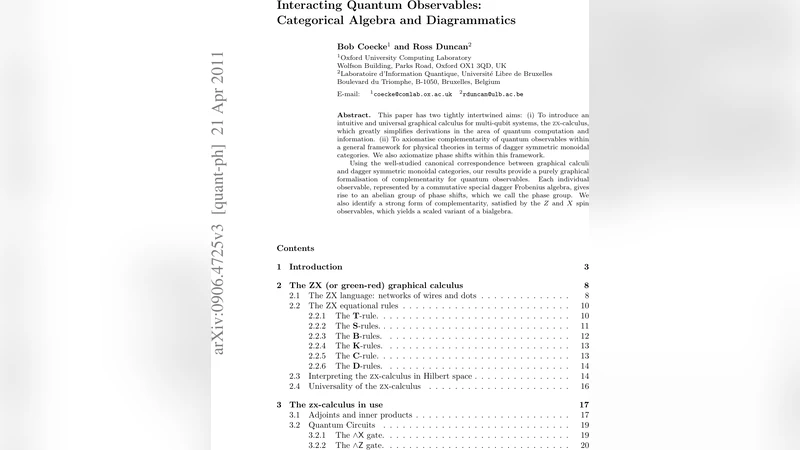
This paper has two tightly intertwined aims: (i) To introduce an intuitive and universal graphical calculus for multi-qubit systems, the ZX-calculus, which greatly simplifies derivations in the area of quantum computation and information. (ii) To axiomatise complementarity of quantum observables within a general framework for physical theories in terms of dagger symmetric monoidal categories. We also axiomatize phase shifts within this framework. Using the well-studied canonical correspondence between graphical calculi and symmetric monoidal categories, our results provide a purely graphical formalisation of complementarity for quantum observables. Each individual observable, represented by a commutative special dagger Frobenius algebra, gives rise to an abelian group of phase shifts, which we call the phase group. We also identify a strong form of complementarity, satisfied by the Z and X spin observables, which yields a scaled variant of a bialgebra.
💡 Research Summary
The paper pursues two tightly coupled objectives: to introduce a universal graphical language for multi‑qubit quantum systems—the ZX‑calculus—and to formalise the notion of complementary observables within the abstract setting of dagger symmetric monoidal categories (†SMCs). The authors begin by presenting the ZX‑calculus, a diagrammatic framework in which two families of nodes—green (Z) and red (X)—represent the copying and deleting maps of two mutually unbiased bases. Each node type corresponds to a commutative special †‑Frobenius algebra, and the composition of diagrams mirrors the tensor product and sequential composition of linear maps. By interpreting quantum circuits as ZX‑diagrams, the authors demonstrate that many standard constructions (teleportation, error‑correcting codes, measurement‑based computation) admit dramatically simpler derivations, often collapsing long algebraic manipulations into a handful of topological rewrites.
The second, more foundational, contribution is a categorical axiomatization of complementarity. Within any †SMC, an observable is modelled as a commutative special †‑Frobenius algebra. Such an algebra automatically carries an abelian group of phase transformations—the phase group—whose elements are unitary endomorphisms that commute with the copying map. Diagrammatically, phases appear as coloured rotations attached to the corresponding node. The authors show that the phase group of a given observable is precisely the set of unitary scalars that preserve the Frobenius structure, and they give an explicit construction of this group for qubit observables (the circle group U(1) modulo global phase).
A central novelty is the definition of “strong complementarity”. Two observables (e.g., Z and X) are strongly complementary when their associated Frobenius algebras satisfy a scaled bialgebra law: the multiplication of one algebra distributes over the comultiplication of the other up to a non‑zero scalar λ. This condition is stronger than the usual notion of mutual unbiasedness and captures the algebraic essence of the Pauli Z and X operators. The scaled bialgebra law ensures that the two algebras interact in a way that preserves both the copying structure and the phase group actions, leading to a rich interplay between the two phase groups.
The paper proceeds to explore the consequences of this structure. First, it proves that any strongly complementary pair generates a Hopf algebra structure after normalising the scalar λ, and that the antipode coincides with the Hadamard transformation in the qubit case. Second, it shows that phase gates for one observable can be rewritten in terms of the other observable’s basis using the bialgebra law, providing a systematic method for translating between Z‑ and X‑phase rotations. This translation underlies many of the diagrammatic simplifications used in quantum circuit optimisation.
In the applied part, the authors illustrate how the ZX‑calculus, equipped with the strong complementarity axioms, can be employed to optimise quantum circuits. By repeatedly applying rewrite rules derived from the Frobenius, bialgebra, and phase group equations, they reduce the depth of circuits containing alternating CNOT and phase gates, eliminate redundant spiders, and expose hidden symmetries that lead to more efficient implementations. The methodology is demonstrated on concrete examples such as the synthesis of Clifford+T circuits and the simplification of measurement‑based quantum computation patterns.
Finally, the authors discuss the broader significance of their framework. Because †SMCs abstract away from the concrete Hilbert‑space formalism, the same graphical and algebraic machinery can be transplanted to other physical theories that admit a categorical description (e.g., Spekkens’ toy model, generalized probabilistic theories). The categorical notion of complementarity thus becomes a universal structural feature, not limited to standard quantum mechanics.
In summary, the paper delivers a powerful synthesis: it provides a fully diagrammatic calculus that captures the algebraic essence of complementary observables, formalises the associated phase groups, introduces a robust notion of strong complementarity via a scaled bialgebra law, and demonstrates concrete advantages for quantum circuit design and optimisation. This work bridges the gap between high‑level categorical theory and practical quantum information processing, offering both deep conceptual insight and tangible computational tools.