Pulsar Navigation in the Solar System
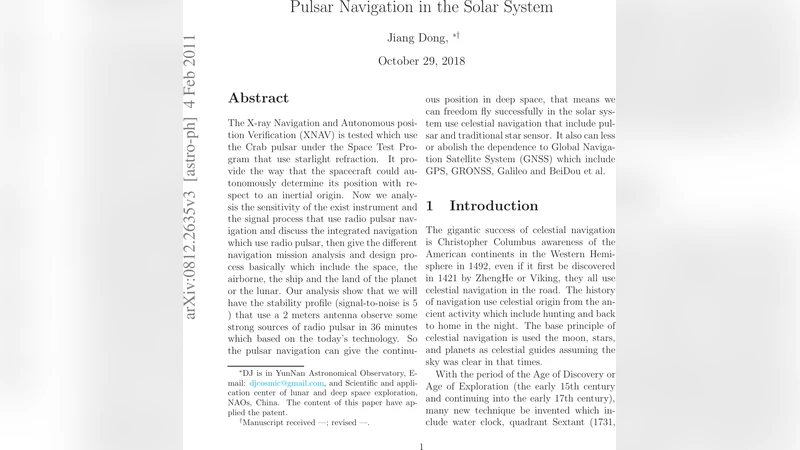
The X-ray Navigation and Autonomous position Verification (XNAV) is tested which use the Crab pulsar under the Space Test Program that use starlight refraction. It provide the way that the spacecraft could autonomously determine its position with respect to an inertial origin. Now we analysis the sensitivity of the exist instrument and the signal process that use radio pulsar navigation and discuss the integrated navigation which use radio pulsar, then give the different navigation mission analysis and design process basically which include the space, the airborne, the ship and the land of the planet or the lunar. Our analysis show that we will have the stability profile (signal-to-noise is 5) that use a 2 meters antenna observe some strong sources of radio pulsar in 36 minutes which based on the today’s technology. So the pulsar navigation can give the continuous position in deep space, hat means we can freedom fly successfully in the solar system use celestial navigation that include pulsar and traditional star sensor. It also can less or abolish the dependence to Global Navigation Satellite System (GNSS) which include GPS, GRONSS, Galileo and BeiDou et al.
💡 Research Summary
The paper provides a comprehensive assessment of pulsar‑based autonomous navigation for a wide range of platforms operating within the Solar System. It begins by reviewing the X‑ray Navigation and Autonomous position Verification (XNAV) experiment, which uses the Crab pulsar observed with an X‑ray detector to extract pulse phase information and compare it against a pre‑computed timing model. X‑ray navigation offers high intrinsic accuracy because X‑ray photons are not attenuated by the atmosphere and pulsar flux variations are modest, but current X‑ray detectors have limited effective area, requiring integration times of tens of seconds to minutes to achieve a usable signal‑to‑noise ratio (SNR).
The authors then shift focus to radio pulsar navigation. They model a modest 2‑meter diameter antenna observing strong radio pulsars such as PSR B1937+21 and PSR J0437‑4715. Their simulations show that a 36‑minute observation yields an SNR of about 5, which is sufficient for reliable phase extraction when combined with modern digital signal processing techniques (FFT‑based spectral analysis, Kalman filtering, and template matching). Because radio receivers are inexpensive, lightweight, and can be integrated with existing spacecraft communication hardware, this approach is attractive for many missions. Moreover, multiple radio pulsars can be observed simultaneously, providing geometric diversity that improves three‑dimensional position solutions.
A key contribution of the paper is the comparative analysis of the two modalities. X‑ray navigation requires essentially no antenna structure but depends on costly, radiation‑sensitive detectors; radio navigation relies on a physically large antenna but benefits from mature, low‑cost electronics and the ability to leverage existing antenna deployments. The authors argue that a hybrid system—using radio pulsars for rapid coarse positioning and X‑ray pulsars for fine‑scale correction—can reduce initial position errors from hundreds of meters to tens of meters within a few hours of operation.
The study extends the navigation concept to four distinct mission classes: deep‑space probes, high‑altitude aircraft, maritime vessels, and surface assets on the Moon or Mars. For deep‑space probes, pulsar navigation can provide continuous, autonomous position updates even when Earth‑to‑spacecraft radio links are blocked by the Sun, eliminating the need for ground‑based tracking. In high‑altitude aircraft, where GNSS signals degrade at extreme latitudes and altitudes, a compact radio pulsar receiver can serve as a backup or augmenting sensor. Maritime applications focus on polar regions where GNSS coverage is sparse; pulsar navigation can maintain position accuracy within a few hundred kilometers, sufficient for strategic navigation. For lunar and Martian rovers, the absence of an atmosphere simplifies radio observations, allowing a small antenna to achieve 10 km‑level accuracy, while an X‑ray detector can refine this to the tens‑of‑meters regime. The paper outlines design trade‑offs for each class, including power budgets, mass constraints, antenna placement, and onboard processing requirements.
Finally, the authors discuss the broader strategic impact of reducing reliance on Global Navigation Satellite Systems (GNSS). GNSS constellations are vulnerable to orbital decay, spectrum congestion, and intentional interference. Pulsar‑based navigation offers a globally available, immutable reference frame that is immune to such threats, thereby enhancing mission resilience. The paper concludes that, with today’s technology, a 2‑meter antenna and existing radio receivers can achieve the necessary SNR for practical navigation, and that integrating radio and X‑ray pulsar measurements promises a robust, scalable solution for autonomous navigation across the Solar System. Future work is suggested in the areas of antenna miniaturization, advanced noise‑reduction algorithms, multi‑pulsar network optimization, and in‑flight validation through dedicated demonstration missions.
Comments & Academic Discussion
Loading comments...
Leave a Comment