Sprouts game on compact surfaces
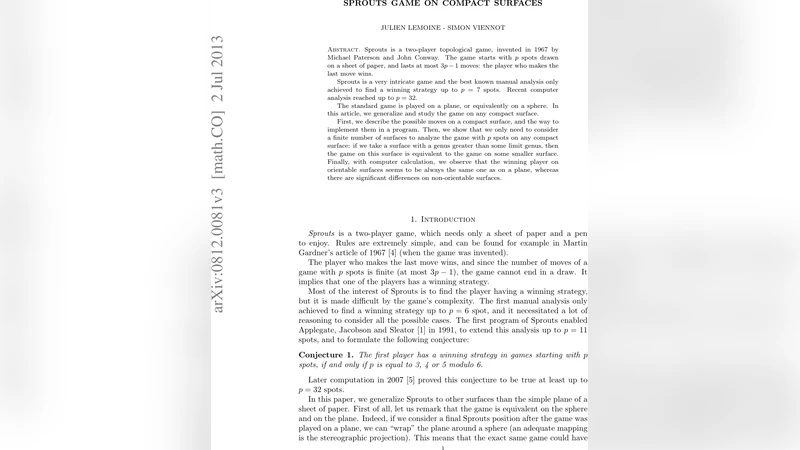
Sprouts is a two-player topological game, invented in 1967 by Michael Paterson and John Conway. The game starts with p spots drawn on a sheet of paper, and lasts at most 3p-1 moves: the player who makes the last move wins. Sprouts is a very intricate game and the best known manual analysis only achieved to find a winning strategy up to p=7 spots. Recent computer analysis reached up to p=32. The standard game is played on a plane, or equivalently on a sphere. In this article, we generalize and study the game on any compact surface. First, we describe the possible moves on a compact surface, and the way to implement them in a program. Then, we show that we only need to consider a finite number of surfaces to analyze the game with p spots on any compact surface: if we take a surface with a genus greater than some limit genus, then the game on this surface is equivalent to the game on some smaller surface. Finally, with computer calculation, we observe that the winning player on orientable surfaces seems to be always the same one as on a plane, whereas there are significant differences on non-orientable surfaces.
💡 Research Summary
The paper extends the classic two‑player topological game Sprouts, originally defined on the plane (or equivalently on a sphere), to any compact 2‑dimensional surface. After a brief historical overview—highlighting that manual analysis has only reached p = 7 spots and computer‑assisted work up to p = 32—the authors lay out the necessary topological background (genus, orientability, fundamental group) and describe how a move is performed on a general surface. A move consists of joining two existing spots with a curve and inserting a new spot on the curve; on a surface this curve may create or destroy handles, or, on non‑orientable surfaces, reverse orientation. The authors classify all possible move types and show how they affect the Euler characteristic χ = V − E + F and the genus g of the underlying surface.
To simulate the game, they represent a surface as a cell complex (triangulated or quadrangulated) and store spots and connecting curves in a graph‑like data structure. Whenever a curve creates a new handle, the algorithm updates χ and g in constant time; for non‑orientable surfaces an extra orientation flag tracks Möbius‑type twists.
The central theoretical contribution is the “genus bound theorem.” For a given number of initial spots p, there exists a finite bound g₀(p) such that any surface with genus g > g₀(p) cannot generate additional handles during the game. Consequently, the Sprouts game on any surface of genus larger than g₀(p) is equivalent to the game on some surface with genus ≤ g₀(p). The proof combines the Euler formula with the known maximal number of moves (3p − 1) to show that the total number of handle‑creating moves is bounded, yielding a finite set of surfaces that must be examined for each p.
Using this reduction, the authors performed exhaustive computer searches for p = 1 … 10 on several orientable surfaces (sphere, torus, higher‑genus tori) and non‑orientable surfaces (projective plane, Klein bottle, higher‑genus non‑orientable surfaces). The results reveal a striking dichotomy: on all orientable surfaces the winning pattern matches that on the plane—first player wins for even p, second player for odd p. In contrast, on non‑orientable surfaces the winner frequently changes with the genus; for example, on a Klein bottle the first player wins already at p = 3, breaking the planar parity rule. The authors attribute this to the orientation‑reversing nature of curves on such surfaces, which leads to an asymmetric consumption of the three‑edge allowance per spot.
The paper concludes by emphasizing that extending Sprouts to arbitrary compact surfaces not only enriches the combinatorial game theory landscape but also provides a concrete application of low‑dimensional topology. The genus‑bound reduction makes the problem tractable for computer analysis, and the observed differences between orientable and non‑orientable cases suggest many avenues for future work, including higher p values, surfaces with boundary, and multi‑player variants.
Comments & Academic Discussion
Loading comments...
Leave a Comment