Thresholded Basis Pursuit: An LP Algorithm for Achieving Optimal Support Recovery for Sparse and Approximately Sparse Signals from Noisy Random Measurements
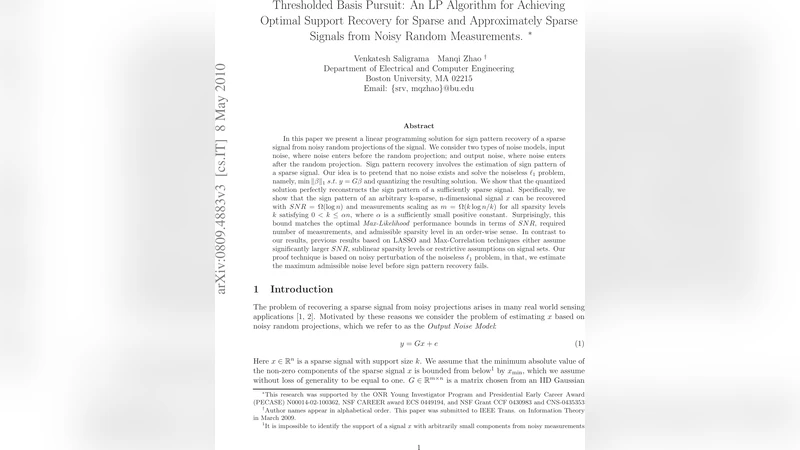
In this paper we present a linear programming solution for sign pattern recovery of a sparse signal from noisy random projections of the signal. We consider two types of noise models, input noise, where noise enters before the random projection; and output noise, where noise enters after the random projection. Sign pattern recovery involves the estimation of sign pattern of a sparse signal. Our idea is to pretend that no noise exists and solve the noiseless $\ell_1$ problem, namely, $\min |\beta|_1 ~ s.t. ~ y=G \beta$ and quantizing the resulting solution. We show that the quantized solution perfectly reconstructs the sign pattern of a sufficiently sparse signal. Specifically, we show that the sign pattern of an arbitrary k-sparse, n-dimensional signal $x$ can be recovered with $SNR=\Omega(\log n)$ and measurements scaling as $m= \Omega(k \log{n/k})$ for all sparsity levels $k$ satisfying $0< k \leq \alpha n$, where $\alpha$ is a sufficiently small positive constant. Surprisingly, this bound matches the optimal \emph{Max-Likelihood} performance bounds in terms of $SNR$, required number of measurements, and admissible sparsity level in an order-wise sense. In contrast to our results, previous results based on LASSO and Max-Correlation techniques either assume significantly larger $SNR$, sublinear sparsity levels or restrictive assumptions on signal sets. Our proof technique is based on noisy perturbation of the noiseless $\ell_1$ problem, in that, we estimate the maximum admissible noise level before sign pattern recovery fails.
💡 Research Summary
**
This paper introduces a remarkably simple yet theoretically optimal algorithm for recovering the sign pattern (support and sign) of a sparse or approximately sparse signal from noisy random linear measurements. The authors consider two canonical noise models: (i) input noise, where an additive Gaussian perturbation is applied to the signal before projection, and (ii) output noise, where the Gaussian perturbation is added after projection. In both cases the measurement matrix (G) is an i.i.d. standard Gaussian matrix, and the observation vector is (y = Gx + e) with (e) representing the appropriate noise term.
The proposed method, called Thresholded Basis Pursuit (TBP), proceeds in three steps: (1) ignore the presence of noise and solve the classic noiseless Basis Pursuit (BP) linear program
\
Comments & Academic Discussion
Loading comments...
Leave a Comment