Stability of the periodic Toda lattice under short range perturbations
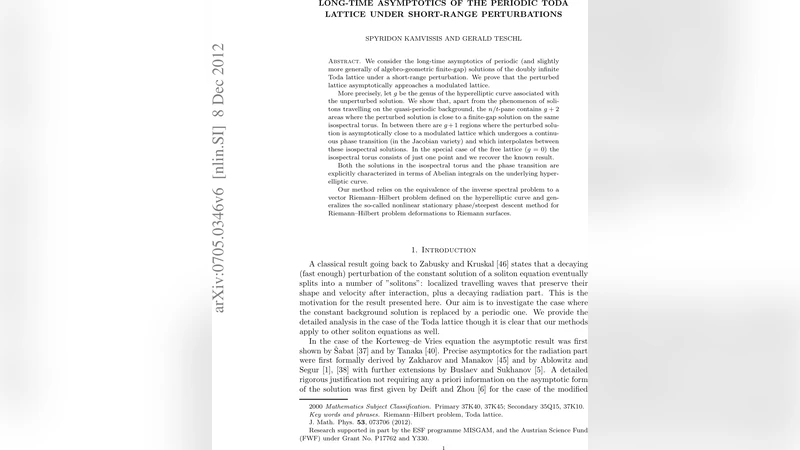
We consider the stability of the periodic Toda lattice (and slightly more generally of the algebro-geometric finite-gap lattice) under a short range perturbation. We prove that the perturbed lattice asymptotically approaches a modulated lattice. More precisely, let $g$ be the genus of the hyperelliptic curve associated with the unperturbed solution. We show that, apart from the phenomenon of the solitons travelling on the quasi-periodic background, the $n/t$-pane contains $g+2$ areas where the perturbed solution is close to a finite-gap solution in the same isospectral torus. In between there are $g+1$ regions where the perturbed solution is asymptotically close to a modulated lattice which undergoes a continuous phase transition (in the Jacobian variety) and which interpolates between these isospectral solutions. In the special case of the free lattice ($g=0$) the isospectral torus consists of just one point and we recover the known result. Both the solutions in the isospectral torus and the phase transition are explicitly characterized in terms of Abelian integrals on the underlying hyperelliptic curve. Our method relies on the equivalence of the inverse spectral problem to a matrix Riemann–Hilbert problem defined on the hyperelliptic curve and generalizes the so-called nonlinear stationary phase/steepest descent method for Riemann–Hilbert problem deformations to Riemann surfaces.
💡 Research Summary
The paper investigates the long‑time behavior of the periodic Toda lattice (and, more generally, the algebro‑geometric finite‑gap Toda lattice) when the initial data are perturbed by a short‑range disturbance. The authors prove that the perturbed solution does not disperse chaotically; instead, it asymptotically approaches a “modulated lattice” whose parameters evolve slowly in time. The central geometric object is the hyperelliptic Riemann surface (\mathcal{R}) associated with the unperturbed finite‑gap solution; its genus (g) determines the dimension of the isospectral torus (\mathrm{Jac}(\mathcal{R})).
The main theorem states that, in the space‑time cone defined by the ratio (n/t), the lattice decomposes into (g+2) distinct zones where the solution is exponentially close to a genuine finite‑gap solution belonging to the same isospectral torus, and (g+1) intermediate zones where the solution is close to a continuously varying finite‑gap state. In the latter zones the lattice undergoes a smooth phase transition on the Jacobian variety; the transition is described explicitly by Abelian integrals of the first kind on (\mathcal{R}). Solitons, if present, travel on top of the quasi‑periodic background without destroying this zone structure; each soliton corresponds to a discrete eigenvalue of the Lax operator and moves along a characteristic line in the (n/t) plane.
Methodologically, the authors recast the inverse spectral problem for the perturbed Toda lattice as a matrix Riemann–Hilbert (RH) problem defined on the hyperelliptic curve. They then adapt the nonlinear steepest‑descent (stationary‑phase) method, originally developed for RH problems on the complex plane, to the setting of a compact Riemann surface. The key steps are: (i) construction of a suitable (g)-function that encodes the stationary phase points on (\mathcal{R}); (ii) deformation of the original jump contour to regions where the jump matrices become either close to the identity or explicitly solvable; (iii) reduction of the remaining error to a (\bar{\partial})-problem whose solution can be estimated in (L^{2}) norms.
In the special case (g=0) (the free lattice), the isospectral torus collapses to a single point, and the theorem reduces to the classical result that a short‑range perturbation of a constant background evolves into a finite number of solitons plus a decaying radiation term. Thus the present work not only recovers known results but also provides a comprehensive generalization to arbitrary finite‑gap backgrounds.
Explicit formulas for the asymptotic states are given in terms of Riemann theta functions and Abelian integrals; the phase shift across each transition zone is expressed as a linear combination of periods of the normalized holomorphic differentials. Error estimates show that the difference between the true solution and the constructed asymptotic approximation is (O(t^{-1+\varepsilon})) for any (\varepsilon>0).
The paper concludes by emphasizing that the Riemann‑surface RH framework is robust and can be transferred to other integrable systems such as the Korteweg–de Vries and nonlinear Schrödinger equations. Potential extensions include multi‑soliton interactions on finite‑gap backgrounds, non‑decaying (long‑range) perturbations, and numerical verification of the predicted zone structure for higher genus ((g\ge 2)) cases.
Comments & Academic Discussion
Loading comments...
Leave a Comment