The ideal-valued index for a dihedral group action, and mass partition by two hyperplanes
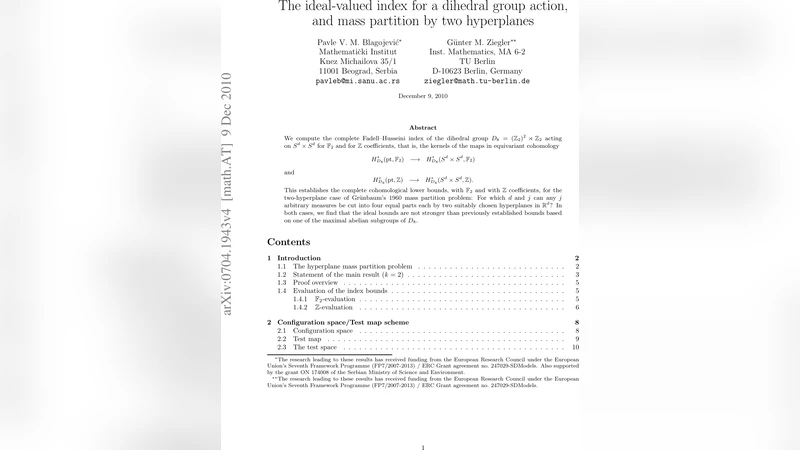
We compute the complete Fadell-Husseini index of the 8 element dihedral group D_8 acting on S^d \times S^d, both for F_2 and for integer coefficients. This establishes the complete goup cohomology lower bounds for the two hyperplane case of Gr"unbaum’s 1960 mass partition problem: For which d and j can any j arbitrary measures be cut into four equal parts each by two suitably-chosen hyperplanes in R^d? In both cases, we find that the ideal bounds are not stronger than previously established bounds based on one of the maximal abelian subgroups of D_8.
💡 Research Summary
The paper addresses the computation of the full Fadell‑Husseini index for the action of the eight‑element dihedral group D₈ on the product of two d‑dimensional spheres, S^d × S^d, with coefficients both in the field F₂ and in the integers ℤ. The authors begin by recalling the definition of the Fadell‑Husseini index: for a G‑space X and a coefficient ring R, the index Ind_G^R(X) is the kernel of the restriction map in equivariant cohomology H_G^(X;R) → H_G^(pt;R) ≅ H^*(BG;R). Because the action of D₈ on S^d × S^d is not free, the Borel construction EG ×_G(S^d × S^d) is used, and the equivariant cohomology is identified with the ordinary cohomology of this Borel space.
The structure of D₈ is analysed in detail. D₈ has a non‑trivial centre Z₂, two non‑conjugate maximal abelian subgroups (the Klein four group C₂ × C₂ and the cyclic group C₄), and a presentation ⟨r,s | r⁴ = s² = 1, srs = r⁻¹⟩. The cohomology ring H^(BD₈;F₂) is known to be a polynomial algebra modulo the relations x² = y² = xy = 0, where x and y are degree‑one generators corresponding to the two independent 1‑dimensional representations. For integer coefficients, H^(BD₈;ℤ) contains 2‑torsion and is described using Tate cohomology.
F₂‑coefficients.
The authors employ the Serre spectral sequence associated with the fibration S^d × S^d → EG ×G(S^d × S^d) → BG. The E₂‑page is H^(BG;F₂) ⊗ H^(S^d × S^d;F₂), and the only potentially non‑zero differentials are d{d+1} acting on the top‑dimensional classes of the sphere factors. By a careful analysis of the D₈‑action on the cohomology of the spheres, they show that d_{d+1} is non‑trivial and maps the generator of H^d(S^d) to the linear combination x^{d+1}+y^{d+1}+(x+y)^{d+1}. Consequently the kernel of the restriction map, i.e. the index, is the ideal generated by the three monomials x^{d+1}, y^{d+1}, and (x+y)^{d+1}. Symbolically,
\
Comments & Academic Discussion
Loading comments...
Leave a Comment