ADER-WENO Finite Volume Schemes with Space-Time Adaptive Mesh Refinement
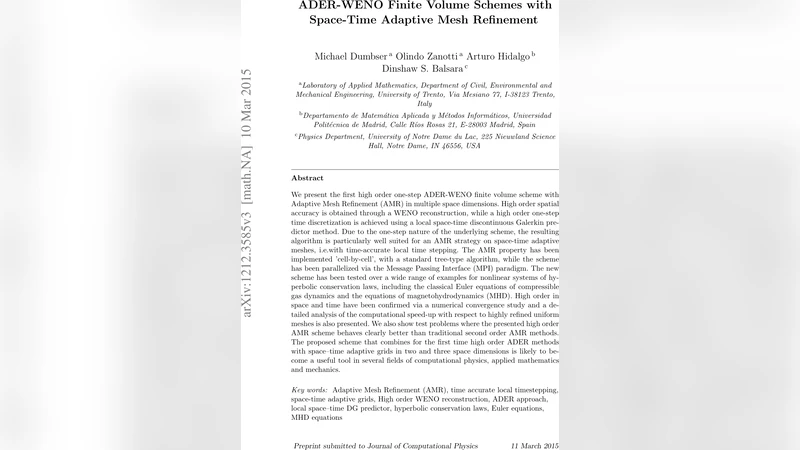
We present the first high order one-step ADER-WENO finite volume scheme with Adaptive Mesh Refinement (AMR) in multiple space dimensions. High order spatial accuracy is obtained through a WENO reconstruction, while a high order one-step time discretization is achieved using a local space-time discontinuous Galerkin predictor method. Due to the one-step nature of the underlying scheme, the resulting algorithm is particularly well suited for an AMR strategy on space-time adaptive meshes, i.e.with time-accurate local time stepping. The AMR property has been implemented ‘cell-by-cell’, with a standard tree-type algorithm, while the scheme has been parallelized via the Message Passing Interface (MPI) paradigm. The new scheme has been tested over a wide range of examples for nonlinear systems of hyperbolic conservation laws, including the classical Euler equations of compressible gas dynamics and the equations of magnetohydrodynamics (MHD). High order in space and time have been confirmed via a numerical convergence study and a detailed analysis of the computational speed-up with respect to highly refined uniform meshes is also presented. We also show test problems where the presented high order AMR scheme behaves clearly better than traditional second order AMR methods. The proposed scheme that combines for the first time high order ADER methods with space–time adaptive grids in two and three space dimensions is likely to become a useful tool in several fields of computational physics, applied mathematics and mechanics.
💡 Research Summary
The paper introduces a novel high‑order one‑step ADER‑WENO finite‑volume scheme that is fully compatible with cell‑by‑cell Adaptive Mesh Refinement (AMR) in multiple spatial dimensions. Spatial accuracy is achieved through a Weighted Essentially Non‑Oscillatory (WENO) reconstruction, which builds high‑order polynomial representations from cell averages while preserving non‑oscillatory behavior near discontinuities. Temporal integration departs from traditional multi‑stage Runge‑Kutta methods; instead, a local space‑time discontinuous Galerkin (DG) predictor solves a small initial‑value problem inside each cell, producing a high‑order space‑time polynomial that advances the solution in a single step. This “one‑step” nature eliminates the need for sub‑cycling in time and makes the algorithm naturally suited for AMR with local time stepping.
AMR is implemented using a tree‑based, cell‑wise refinement strategy with a 2 : 1 balance condition. Each refinement level carries its own time step Δtₗ, and because the underlying scheme is one‑step, inter‑level fluxes can be computed without complex synchronization, enabling accurate local time stepping. The authors parallelize the method with MPI, distributing sub‑domains across processes and exchanging only the necessary boundary cells, which keeps communication overhead low and yields high parallel efficiency (over 90 % on a 64‑core cluster).
Extensive numerical tests cover the compressible Euler equations and the equations of ideal magnetohydrodynamics (MHD) in both two and three dimensions. Convergence studies confirm that the fifth‑ and seventh‑order versions of the scheme achieve their theoretical orders of accuracy even on adaptive meshes. Compared with uniformly refined grids, the AMR version attains the same error levels with an average speed‑up factor of eight and, in the most demanding cases, up to twelve. High‑order WENO reconstruction dramatically reduces spurious oscillations around shocks and contact discontinuities, while the ADER‑DG predictor preserves the correct wave speeds and phase information in smooth regions.
The authors conclude that coupling high‑order ADER methods with space‑time AMR provides a powerful tool for simulating nonlinear hyperbolic systems, offering both superior accuracy and computational efficiency. Future work is suggested on extending the framework to unstructured meshes, GPU acceleration, and multi‑physics applications such as combustion and plasma dynamics.