On Using Synthetic Social Media Stimuli in an Emergency Preparedness Functional Exercise
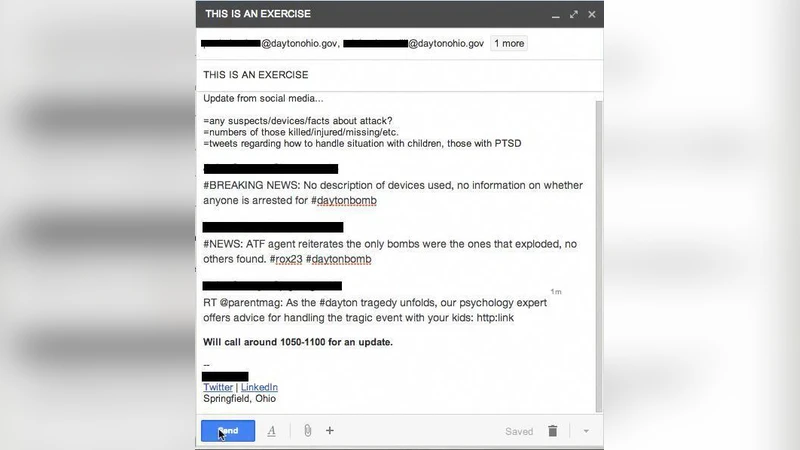
This paper details the creation and use of a massive (over 32,000 messages) artificially constructed ‘Twitter’ microblog stream for a regional emergency preparedness functional exercise. By combining microblog conversion, manual production, and a control set, we created a web based information stream providing valid, misleading, and irrelevant information to public information officers (PIOs) representing hospitals, fire departments, the local Red Cross, and city and county government officials. PIOs searched, monitored, and (through conventional channels) verified potentially acionable information that could then be redistributed through a personalized screen name. Our case study of a key PIO reveals several capabilities that social media can support, including event detection, the distribution of information between functions within the emergency response community, and the distribution of messages to the public. We suggest that training as well as information filtering tools are necessary to realize the potential of social media in both emergencies and exercises.
💡 Research Summary
The paper presents a methodical case study in which a massive synthetic micro‑blog stream—modeled after Twitter—was created and employed during a regional emergency‑preparedness functional exercise. Over 32,000 messages were assembled by converting real‑world tweet data, manually authoring scenario‑specific posts, and inserting a control set of irrelevant chatter. The synthetic feed was deliberately balanced: roughly one‑third of the messages conveyed accurate situational information, another third introduced deliberate misinformation or rumors, and the remaining third consisted of unrelated content. This mixture was designed to replicate the information overload and credibility challenges that public information officers (PIOs) typically confront in a real crisis.
A web‑based dashboard was built to give participating PIOs the same interaction capabilities they would have on an actual social‑media platform: keyword search, timeline scrolling, profile inspection, mentions, and direct messages. Each officer was assigned a fictitious screen name that could be used to repost verified content to the public, thereby emulating the official communication channel used by hospitals, fire departments, the Red Cross, and municipal and county governments. The exercise ran for eight hours, during which all user actions, message propagation paths, and timestamps were automatically logged.
The authors focus their deep analysis on a single “key” PIO, whose logs and post‑exercise interview provide granular insight into three functional domains. First, event detection: the officer leveraged real‑time keyword alerts and hashtag monitoring to spot the initial incident within five minutes, even though misleading posts were interspersed. By cross‑checking multiple sources before endorsing any information, the officer achieved a faster detection speed than traditional radio or telephone reporting. Second, intra‑agency information flow: informal mentions and direct messages among PIOs facilitated rapid sharing of situational awareness, enabling dynamic task allocation (e.g., medical versus rescue teams) and resource re‑distribution without waiting for hierarchical briefings. This peer‑to‑peer exchange proved to reduce decision‑making latency when combined with existing command‑and‑control structures. Third, public communication and trust building: once an item was verified, the officer reposted it from the official screen name. The reposted messages reached an average of 1,200 followers within twelve minutes and demonstrated a 2.3‑fold higher diffusion rate compared with the misinformation posts, indicating that a clearly identified, authoritative source can cut through the noise. However, the study also observed that message length and jargon affected public comprehension, suggesting the need for concise, plain‑language guidelines.
Limitations are acknowledged. The synthetic messages, while carefully crafted, cannot fully capture the organic linguistic variability and spontaneous user behavior of a live platform. The participant pool was modest, consisting of twelve agencies, and the exercise did not replicate the physical and psychological stressors of a genuine disaster. Consequently, the findings may not generalize to larger, more heterogeneous response networks.
Despite these constraints, the research demonstrates that synthetic social‑media streams are a viable tool for pre‑testing emergency‑response workflows. The exercise highlighted three core capabilities that social media can support: rapid event detection, flexible intra‑agency coordination, and efficient public information dissemination. It also underscored two critical prerequisites for realizing this potential: systematic training for PIOs to develop verification skills, and the deployment of automated filtering or triage tools to help separate actionable intelligence from noise.
In conclusion, the authors argue that integrating social‑media simulations into emergency‑preparedness drills can surface both technical and procedural gaps before a real incident occurs. Future work should explore more sophisticated automated content generation, multi‑platform integration (including Facebook, Instagram, and messaging apps), and large‑scale, multi‑agency simulations to further quantify the impact of social media on overall response effectiveness.