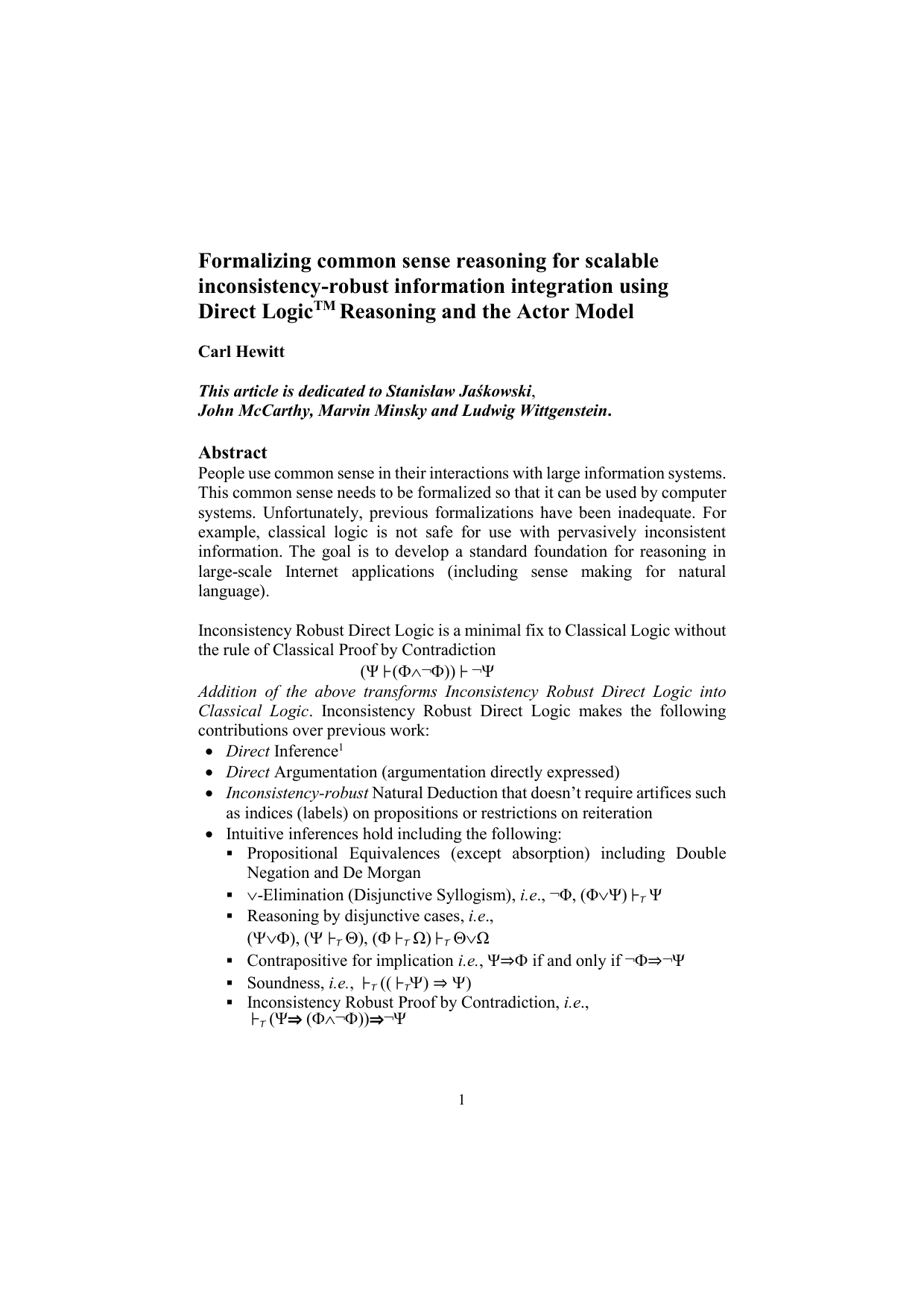
Because contemporary large software systems are pervasively inconsistent, it is not safe to reason about them using classical logic. The goal of Direct Logic is to be a minimal fix to classical mathematical logic that meets the requirements of large-scale Internet applications (including sense making for natural language) by addressing the following issues: inconsistency robustness, contrapositive inference bug, and direct argumentation. Direct Logic makes the following contributions over previous work: * Direct Inference (no contrapositive bug for inference) * Direct Argumentation (inference directly expressed) * Inconsistency-robust deduction without artifices such as indices (labels) on propositions or restrictions on reiteration * Intuitive inferences hold including the following: * Boolean Equivalences * Reasoning by splitting for disjunctive cases * Soundness * Inconsistency-robust Proof by Contradiction Since the global state model of computation (first formalized by Turing) is inadequate to the needs of modern large-scale Internet applications the Actor Model was developed to meet this need. Using, the Actor Model, this paper proves that Logic Programming is not computationally universal in that there are computations that cannot be implemented using logical inference. Consequently the Logic Programming paradigm is strictly less general than the Procedural Embedding of Knowledge paradigm.
Deep Dive into Formalizing common sense for scalable inconsistency-robust information integration using Direct Logic(TM) reasoning and the Actor Model.
Because contemporary large software systems are pervasively inconsistent, it is not safe to reason about them using classical logic. The goal of Direct Logic is to be a minimal fix to classical mathematical logic that meets the requirements of large-scale Internet applications (including sense making for natural language) by addressing the following issues: inconsistency robustness, contrapositive inference bug, and direct argumentation. Direct Logic makes the following contributions over previous work: * Direct Inference (no contrapositive bug for inference) * Direct Argumentation (inference directly expressed) * Inconsistency-robust deduction without artifices such as indices (labels) on propositions or restrictions on reiteration * Intuitive inferences hold including the following: * Boolean Equivalences * Reasoning by splitting for disjunctive cases * Soundness * Inconsistency-robust Proof by Contradiction Since the global state model of computation (first forma
Beneath the surface of the world are the rules of science. But beneath them there is a far deeper set of rules: a matrix of pure mathematics, which explains the nature of the rules of science and how it is that we can understand them in the first place. Malone [2007] Our lives are changing: soon we will always be online. People use their common sense interacting with large information systems. This common sense needs to be formalized. i Large-scale Internet software systems present the following challenges:
- Pervasive inconsistency is the norm and consequently classical logic infers too much, i.e., anything and everything. Inconsistencies (e.g. that can be derived from implementations, documentation, and use cases) in large software systems are pervasive and despite enormous expense have not been eliminated. 2. Concurrency is the norm. Logic Programs based on the inference rules of mathematical logic are not computationally universal because the message order reception indeterminate computations of concurrent programs in open systems cannot be deduced using mathematical logic from propositions about pre-existing conditions. The fact that computation is not reducible to logical inference has important practical consequences. For example, reasoning used in Information Integration cannot be implemented using logical inference [Hewitt 2008a].
This paper suggests some principles and practices formalizing common sense approaches to addressing the above issues.
Interaction creates Reality 2
[We] cannot think of any object apart from the possibility of its connection with other things.
i Eventually, computer systems need to be able to address issues like the following: What will be the effects of increasing greenhouse gasses? What is the future of mass cyber surveillance? What can done about the increasing prevalence of metabolic syndrome?
According to [Rovelli 2008]: a pen on my table has information because it points in this or that direction.
We do not need a human being, a cat, or a computer, to make use of this notion of information. i
Relational physics takes the following view [Laudisa and Rovelli 2008]:
• Relational physics discards the notions of absolute state of a system and absolute properties and values of its physical quantities. • State and physical quantities refer always to the interaction, or the relation, among multiple systems. ii • Nevertheless, relational physics is a complete description of reality. iii According to this view, Interaction creates reality. 3
Information, as used in this article, is a generalization of the physical information of Relational Physics. iv Information systems participate in reality and thus are both consequence and cause. Science is a large information system that investigates and theorizes about interactions. So how does Science work?
i Rovelli added: This [concept of information] is very weak; it does not require [consideration of] information storage, thermodynamics, complex systems, meaning, or anything of the sort. In particular: i.
Information can be lost dynamically ([correlated systems can become uncorrelated]); ii.
[It does] not distinguish between correlation obtained on purpose and accidental correlation; iii.
Most important: any physical system may contain information about another physical system. Also, Information is exchanged via physical interactions. and furthermore, It is always possible to acquire new information about a system. ii In place of the notion of state, which refers solely to the system, [use] the notion of the information that a system has about another system. iii Furthermore, according to [Rovelli 2008], quantum mechanics indicates that the notion of a universal description of the state of the world, shared by all observers, is a concept which is physically untenable, on experimental grounds. In this regard, [Feynman 1965] offered the following advice: Do not keep saying to yourself, if you can possibly avoid it, “But how can it be like that?” because you will go “down the drain,” into a blind alley from which nobody has yet escaped. iv Unlike physical information in Relational Physics [Rovelli 2008, page 10], this paper does not make the assumption that information is necessarily a discrete quantity or that it must be consistent.
According to [Law 2004, emphasis added]: … scientific routinisation, produced with immense difficulty and at immense cost, that secures the general continued stability of natural (and social) scientific reality. Elements within [this routinisation] may be overturned… But overall and most of the time, … it is the expense [and other difficulties] of doing otherwise that allows [scientific routinisation] to achieve relative stability. So it is that a scientific reality is produced that holds together more or less. 4 He added that we can respond as follows:
That we refuse the distinction between the literal and the metaphorical (as various philosophers of science have noted, the lit
…(Full text truncated)…
This content is AI-processed based on ArXiv data.