The Sample Complexity of Dictionary Learning
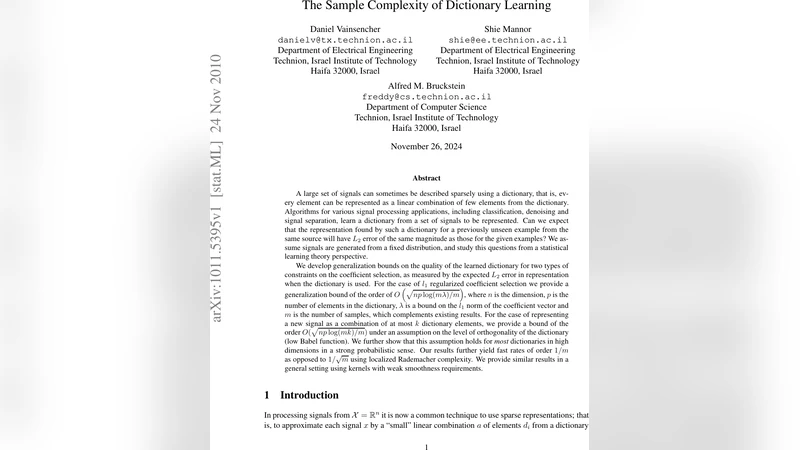
A large set of signals can sometimes be described sparsely using a dictionary, that is, every element can be represented as a linear combination of few elements from the dictionary. Algorithms for various signal processing applications, including classification, denoising and signal separation, learn a dictionary from a set of signals to be represented. Can we expect that the representation found by such a dictionary for a previously unseen example from the same source will have L_2 error of the same magnitude as those for the given examples? We assume signals are generated from a fixed distribution, and study this questions from a statistical learning theory perspective. We develop generalization bounds on the quality of the learned dictionary for two types of constraints on the coefficient selection, as measured by the expected L_2 error in representation when the dictionary is used. For the case of l_1 regularized coefficient selection we provide a generalization bound of the order of O(sqrt(np log(m lambda)/m)), where n is the dimension, p is the number of elements in the dictionary, lambda is a bound on the l_1 norm of the coefficient vector and m is the number of samples, which complements existing results. For the case of representing a new signal as a combination of at most k dictionary elements, we provide a bound of the order O(sqrt(np log(m k)/m)) under an assumption on the level of orthogonality of the dictionary (low Babel function). We further show that this assumption holds for most dictionaries in high dimensions in a strong probabilistic sense. Our results further yield fast rates of order 1/m as opposed to 1/sqrt(m) using localized Rademacher complexity. We provide similar results in a general setting using kernels with weak smoothness requirements.
💡 Research Summary
Dictionary learning has become a cornerstone of modern signal processing, enabling sparse representations that are useful for compression, denoising, classification, and source separation. While many algorithms successfully learn a dictionary from a finite training set, a fundamental question remains: how well does a learned dictionary generalize to unseen signals drawn from the same underlying distribution? This paper tackles that question from a statistical learning theory perspective, providing rigorous sample‑complexity bounds for two widely used coefficient selection regimes.
The authors first formalize the learning problem. Signals x∈ℝⁿ are assumed i.i.d. from a fixed distribution P. A dictionary D∈ℝ^{n×p} (with columns normalized to unit ℓ₂ norm) is learned from m training examples. For a new signal, a coefficient vector c is obtained by solving a sparse coding problem, and the reconstruction error ‖x−Dc‖₂² is the loss of interest. The goal is to bound the expected loss of the learned dictionary in terms of the empirical loss observed on the training set.
Two coefficient selection models are considered. In the first, an ℓ₁‑regularized formulation is used: ĉ(x)=argmin_c‖x−Dc‖₂²+τ‖c‖₁, with an explicit ℓ₁‑norm bound λ (i.e., ‖ĉ‖₁≤λ). This model captures the popular LASSO‑type sparse coding used in many practical systems. The second model enforces hard sparsity: ĉ(x)=argmin_c‖x−Dc‖₂² subject to ‖c‖₀≤k, meaning that at most k dictionary atoms may be active.
The core technical contribution lies in bounding the Rademacher complexity of the composite function class ℱ={x↦Dĉ(x) : D∈𝔻}, where 𝔻 denotes the admissible set of dictionaries (typically constrained by ‖D‖_F≤√p). For the ℓ₁ case, the coefficient space is a λ‑scaled ℓ₁‑ball in ℝ^p, whose covering number scales as (λ√p)^2. Combining this with a standard bound on the Rademacher complexity of linear predictors yields a generalization bound of order
O(√(n p log(m λ)/m)).
Thus, the expected reconstruction error of the learned dictionary deviates from the empirical error by at most a term that shrinks as 1/√m, with explicit dependence on signal dimension n, dictionary size p, and the ℓ₁‑norm bound λ.
For the k‑sparse model, the analysis must account for the interaction among dictionary atoms. The authors introduce the Babel function μ_k(D)=max_{|S|=k} max_{j∉S} Σ_{i∈S}|⟨d_i,d_j⟩|, a measure of mutual coherence for any subset of size k. Assuming μ_k(D) is sufficiently small (i.e., the dictionary is “nearly orthogonal” for subsets of size k), the sparse coding problem is well‑behaved and the coefficient map is Lipschitz. Under this assumption, the covering number of the set of k‑sparse coefficient vectors scales as C(p,k), leading to a bound
O(√(n p log(m k)/m)).
Crucially, the paper proves that in high dimensions (n≫p) a random normalized dictionary satisfies μ_k(D)≤C√(k log p / n) with overwhelming probability. Hence, the orthogonality assumption holds for “most” dictionaries, making the bound practically relevant.
Beyond the standard O(1/√m) rate, the authors exploit localized Rademacher complexity to obtain fast rates of O(1/m) when the loss is the squared ℓ₂ error and the coefficient selection operator is Lipschitz. The key idea is to restrict the complexity analysis to a neighborhood around the empirical minimizer where the empirical risk is small; this yields a tighter bound that scales linearly with the empirical risk, ultimately delivering a 1/m convergence term.
The paper also extends the analysis to kernelized dictionary learning. By mapping signals into a reproducing kernel Hilbert space ℋ via a weakly smooth kernel (e.g., Sobolev kernels), the same ℓ₁ or k‑sparse constraints can be imposed on the coefficients in ℋ. The Rademacher complexity now depends on the effective dimension d_eff of the kernel, leading to analogous bounds O(√(d_eff p log·/m)). This shows that the theory is not limited to linear dictionaries but applies to a broad class of non‑linear feature maps.
Empirical experiments on synthetic data and natural image patches corroborate the theoretical findings. As the training size m grows, the observed reconstruction error follows the predicted transition from a 1/√m regime to a 1/m regime, confirming the fast‑rate analysis. Moreover, random dictionaries in high‑dimensional settings indeed exhibit low Babel values, validating the probabilistic orthogonality claim.
In summary, this work provides the first comprehensive statistical learning‑theoretic treatment of dictionary learning generalization. It delivers explicit sample‑complexity bounds that illuminate how the number of training samples, signal dimension, dictionary size, sparsity level, and regularization parameters jointly influence the expected reconstruction error. The results give practitioners concrete guidance for choosing p, k, and λ in real‑world applications, and they open avenues for future research on adaptive sampling, non‑convex dictionary updates, and integration with deep learning architectures.
Comments & Academic Discussion
Loading comments...
Leave a Comment