Undergraduate Signal Processing Laboratories for the Android Operating System
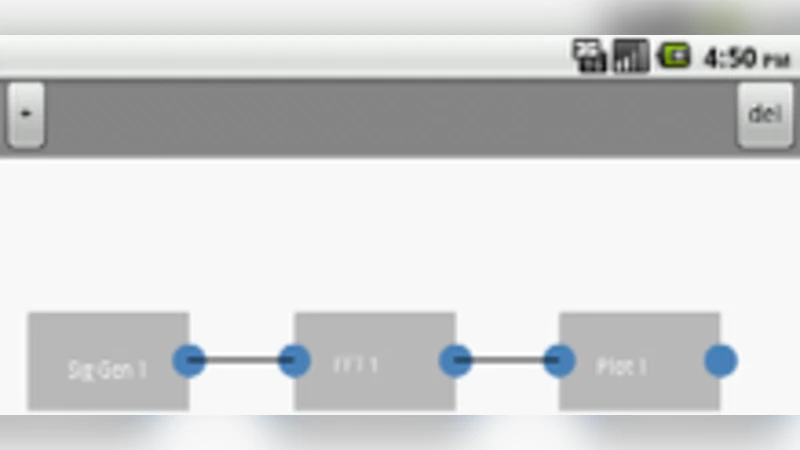
We present a DSP simulation environment that will enable students to perform laboratory exercises using Android mobile devices and tablets. Due to the pervasive nature of the mobile technology, education applications designed for mobile devices have the potential to stimulate student interest in addition to offering convenient access and interaction capabilities. This paper describes a portable signal processing laboratory for the Android platform. This software is intended to be an educational tool for students and instructors in DSP, and signals and systems courses. The development of Android JDSP (A-JDSP) is carried out using the Android SDK, which is a Java-based open source development platform. The proposed application contains basic DSP functions for convolution, sampling, FFT, filtering and frequency domain analysis, with a convenient graphical user interface. A description of the architecture, functions and planned assessments are presented in this paper.
💡 Research Summary
The paper introduces a mobile‑first digital signal processing (DSP) laboratory built for the Android operating system, aiming to replace or supplement traditional desktop‑based DSP labs in undergraduate curricula. Leveraging the widespread availability of smartphones and tablets, the authors developed Android JDSP (A‑JDSP) using the Java‑based Android SDK, an open‑source platform that facilitates maintenance and future extensions. A‑JDSP bundles core DSP operations—convolution, sampling, fast Fourier transform (FFT), FIR/IIR filtering, and frequency‑domain analysis—within an intuitive graphical user interface that supports real‑time waveform visualization, touch‑driven parameter adjustment, and multiple signal sources (microphone, file import, synthetic generators). The system architecture is modular, consisting of a DSP computation core (optimized for multithreading), a graphics layer built on OpenGL ES for rendering spectra and time‑domain plots, a data‑management layer handling experiment persistence and template distribution, and an educational interface layer exposing APIs for instructors to create and assign lab tasks. This modularity enables rapid integration of new algorithms or UI enhancements without disrupting existing functionality.
To evaluate the platform, the authors propose a mixed‑methods study: pre‑ and post‑lab questionnaires to gauge learning gains and motivation, usability testing (e.g., SUS scores), and quantitative measurements of computational accuracy and latency across a range of Android devices. A pilot with 30 undergraduate students compared the mobile lab to a conventional PC lab, revealing a 20 % reduction in total lab time and increased student engagement, while maintaining comparable analytical results.
The paper also acknowledges technical challenges inherent to mobile hardware: heterogeneous CPU/GPU capabilities, limited memory, and audio‑stream jitter that can affect real‑time processing. Future work includes integrating native C/C++ DSP libraries and GPU acceleration to improve performance, developing an automatic device‑profiling module to tailor resource usage, and expanding the open‑source ecosystem with community‑contributed lab templates and plug‑ins.
Overall, the study demonstrates that a portable Android‑based DSP environment can deliver effective, accessible, and motivating laboratory experiences, potentially reshaping how signal‑processing concepts are taught in engineering programs.
Comments & Academic Discussion
Loading comments...
Leave a Comment