Measuring Organizational Consciousness Through E-Mail Based Social Network Analysis
This paper describes first experiments measuring organizational consciousness by comparing six “honest signals” of interpersonal communication within organizations with organizational metrics of performance.
💡 Research Summary
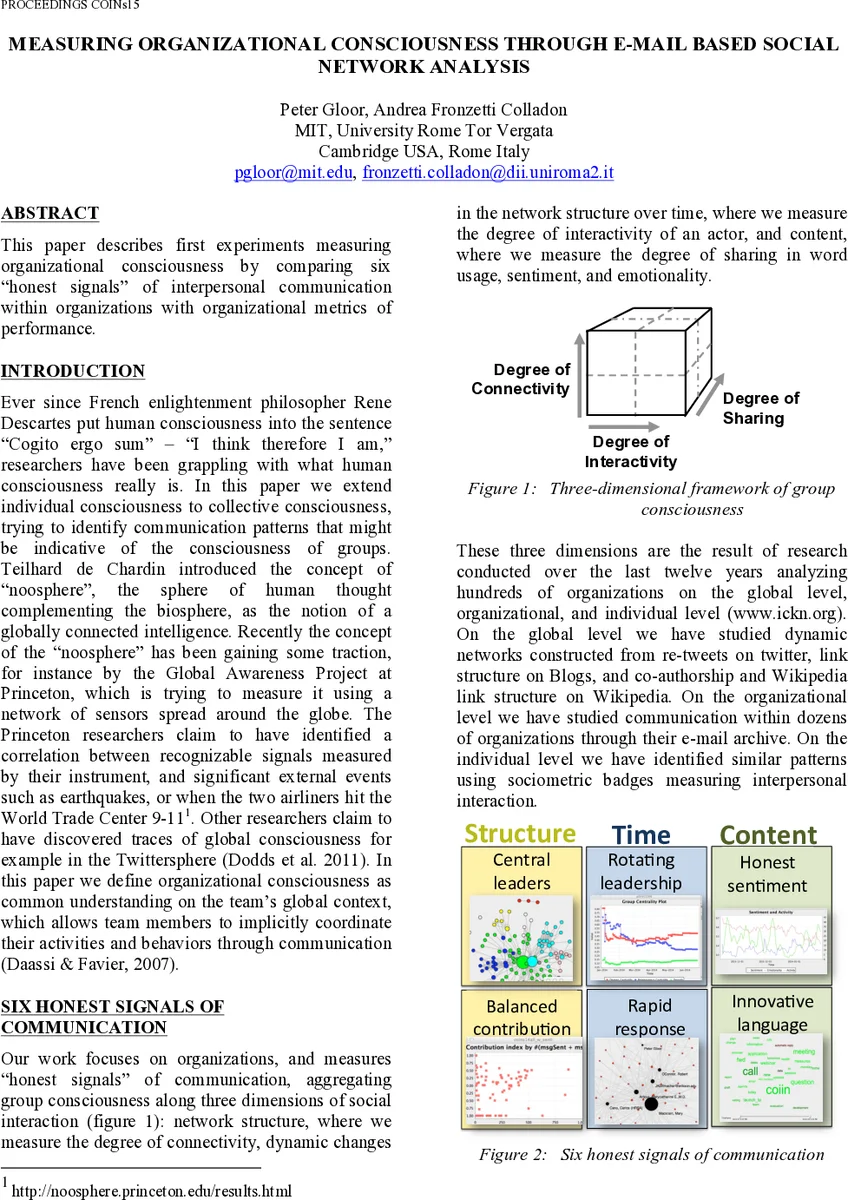
The paper proposes a novel framework for quantifying “organizational consciousness” by analyzing internal email communications and linking six derived “honest signals” to organizational performance metrics. The authors define organizational consciousness as a shared understanding of the broader context that enables team members to coordinate implicitly through communication. To operationalize this concept, they identify three dimensions of social interaction—network structure, temporal dynamics, and content—and extract six measurable signals: (1) Central leadership (group degree and betweenness centrality), (2) Balanced contribution (variance of a contribution index defined as the ratio of sent to received messages), (3) Rotating leadership (oscillations in betweenness centrality and contribution index), (4) Rapid response (average response time and number of nudges required), (5) Honest sentiment (standard deviation of emotionality scores), and (6) Innovative language (deviation from a standardized dictionary).
Methodologically, the study first constructs an email‑based social network for the organization, then computes the six signals for each actor or unit. In a second phase, the signals are aggregated at the business‑unit level and regressed against an exogenously measured performance variable (e.g., revenue growth, project success). The empirical test uses data from a large multinational corporation, covering 16 independently operating business units.
Regression results reveal that higher emotionality and faster responsiveness are positively associated with performance, while a more hierarchical or tightly clustered network structure is negatively associated. Specifically, emotionality shows a coefficient around 0.14, responsiveness around 0.05, and structure around –0.07, all statistically significant. The model’s adjusted R² improves across three specifications (0.26, 0.52, 0.69), indicating that the six signals together explain a substantial portion of performance variance.
The authors interpret these findings as evidence that organizations exhibiting “higher consciousness” tend to have open, emotionally expressive, and quickly reacting communication patterns, rather than rigid, top‑down structures. They argue that the six signals provide a practical proxy for an otherwise elusive construct, enabling continuous monitoring and targeted interventions (e.g., leadership development, communication policy changes) to boost effectiveness and creativity.
Critical appraisal highlights several strengths: the integration of social network analysis with linguistic sentiment measures, and the clear operationalization of abstract concepts into observable metrics. However, limitations are notable. The sample size (16 units) restricts statistical power and external validity. Reliance solely on email excludes other prevalent channels such as instant messaging, video calls, and face‑to‑face interactions, potentially biasing the measurement of “true” communication dynamics. The sentiment and innovative‑language algorithms are not fully disclosed, limiting reproducibility. Moreover, the explained variance, while respectable, leaves a sizable portion of performance variance unexplained, suggesting omitted variables or non‑linear effects.
Future research directions proposed include expanding the data collection to multi‑modal communication streams, employing longitudinal designs to capture causal dynamics, and conducting experimental interventions to test whether deliberately altering the honest signals leads to measurable improvements in performance and perceived consciousness. Overall, the paper makes a valuable contribution by offering a concrete, data‑driven approach to a traditionally philosophical construct, while also opening avenues for refinement and broader application.
Comments & Academic Discussion
Loading comments...
Leave a Comment