$P$-persistent homology of finite topological spaces
Let $P$ be a finite poset. We will show that for any reasonable $P$-persistent object $X$ in the category of finite topological spaces, there is a $P-$ weighted graph, whose clique complex has the same $P$-persistent homology as $X$.
💡 Research Summary
The paper develops a categorical framework for P‑persistent homology on finite topological spaces, where P is a finite partially ordered set (poset). The authors first recall the notion of a P‑persistent object as a functor ϕ : P → A into an arbitrary category A, and denote the category of such objects by A^P. They then focus on the category Tf₀ of finite T₀ topological spaces. By equipping each point x with the smallest closed set Uₓ containing it, they define an order relation x ≤ y iff Uₓ ⊆ U_y, turning any finite T₀ space into a poset. This yields a categorical equivalence Tf₀ ≅ P, which extends to all finite spaces via the Kolmogorov quotient (identifying indistinguishable points).
Next, the paper connects posets, simplicial complexes, and graphs. For a poset P, the order complex O(P) is the simplicial complex whose simplices are chains in P. Conversely, any simplicial complex Σ has a barycentric subdivision O(Σ), which is a flag (clique) complex. The authors introduce the category G of reflexive graphs (allowing self‑loops) and the clique functor Cl : G → F, where F is the subcategory of flag complexes. The 1‑skeleton functor k₁ : S → G extracts the underlying graph of a simplicial complex.
A central object is a P‑weighted graph (G, ω), where ω : G → P is a monotone map (continuous in the Alexandrov topology) assigning a poset value to each vertex and edge. For each v ∈ P, the subgraph G_v = { x ∈ G | ω(x) ≤ v } is defined, and the assignment ϕ_G(v) = G_v produces a P‑persistent object in the category G^P.
Two functors are constructed:
* Φ_P : GP → GP maps a P‑weighted graph to its associated P‑persistent object ϕ_G.
* Ψ_P : GP → GP maps a P‑persistent object ϕ to a P‑weighted graph whose underlying set is the disjoint union of the ϕ(v) and whose weight function records the minimal v at which each element appears.
The authors single out “one‑critical” P‑persistent objects (each edge appears at a unique minimal poset value) and denote their subcategory by GP₁. They prove that Φ_P and Ψ_P restrict to give an equivalence of categories GP₁ ≅ \bar{G}_P, where \bar{G}_P is the subcategory of P‑weighted graphs with weight‑preserving morphisms. The equivalence is established by showing Φ_P is essentially surjective, full, and faithful (Theorem 3.6).
Moreover, adjunctions are exhibited: Φ̄_P is left adjoint to Ψ_P (Theorem 3.7), and Ψ_ιP is left adjoint to Φ_P (Theorem 3.8). These adjunctions formalize the universal properties of the constructions and guarantee that the passage between weighted graphs and persistent objects is canonical.
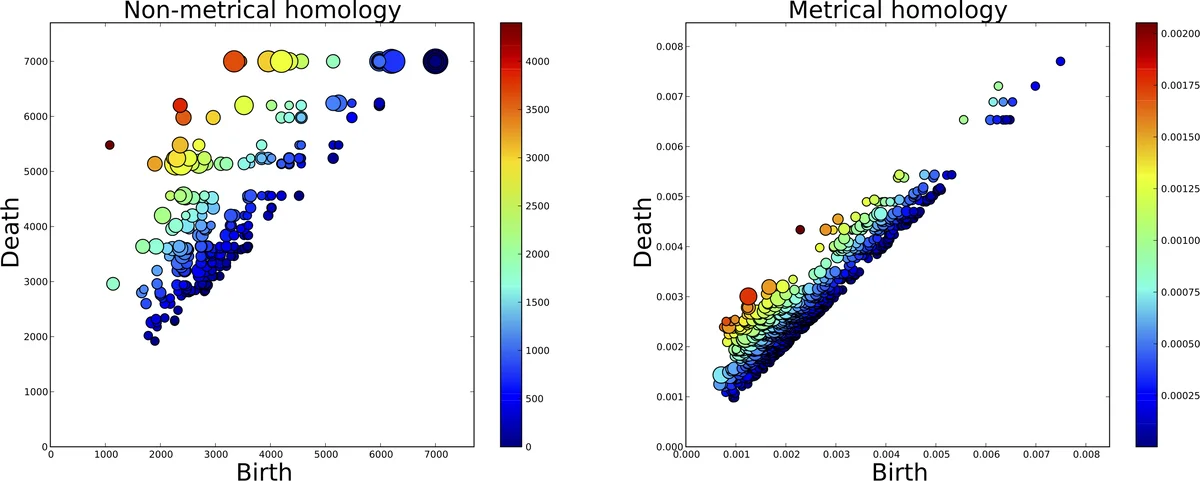
To illustrate the practical relevance, the authors compare two filtrations on a real‑world contact network (children’s face‑to‑face interactions). A metric‑based Rips filtration yields persistence diagrams concentrated near the diagonal (short lifetimes), whereas a filtration derived from descending edge‑weight thresholds on the weighted graph produces diagrams with long‑lived features, highlighting heterogeneities in the network structure. This demonstrates that P‑persistent homology on weighted graphs captures information that metric filtrations may obscure.
In conclusion, the paper shows that any reasonable P‑persistent object in the category of finite topological spaces can be represented by a P‑weighted graph whose clique complex reproduces the same persistent homology. This bridges topological data analysis with graph‑theoretic representations, removes the need for metric embeddings, and provides a flexible, computationally tractable framework for analyzing weighted network data.
Comments & Academic Discussion
Loading comments...
Leave a Comment