Inconsistency Robustness in Foundations: Mathematics self proves its own Consistency and Other Matters
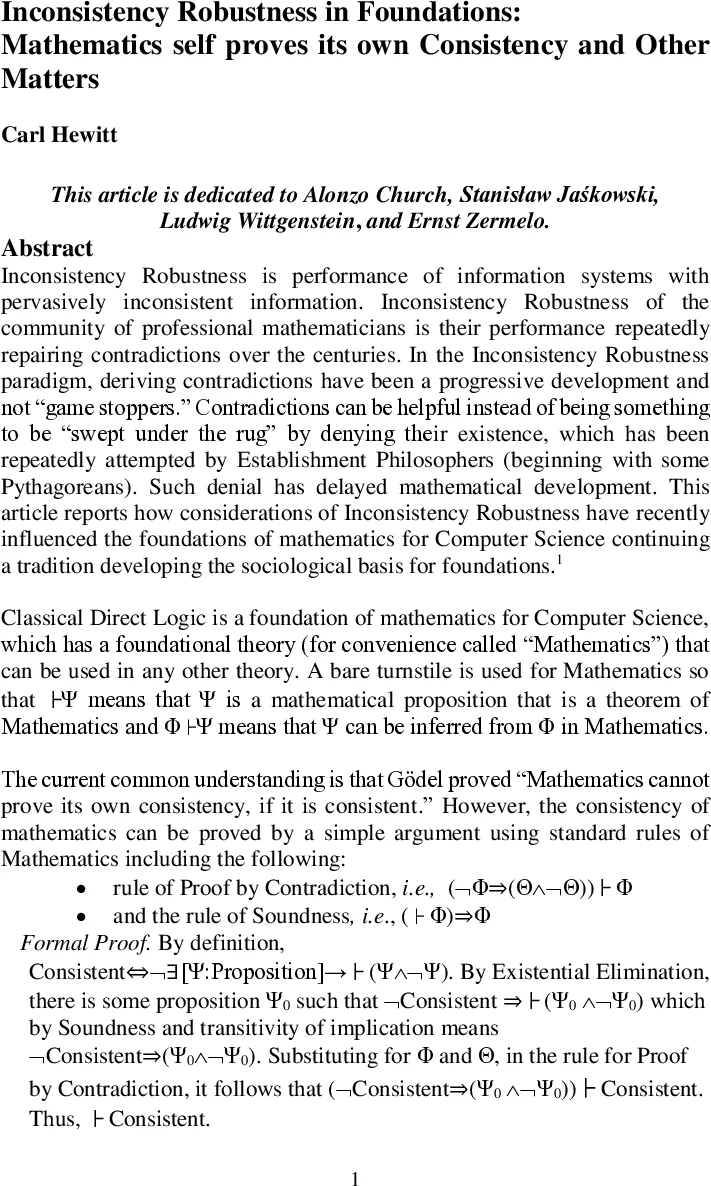
Inconsistency Robustness is performance of information systems with pervasively inconsistent information. Inconsistency Robustness of the community of professional mathematicians is their performance repeatedly repairing contradictions over the centuries. In the Inconsistency Robustness paradigm, deriving contradictions have been a progressive development and not “game stoppers.” Contradictions can be helpful instead of being something to be “swept under the rug” by denying their existence, which has been repeatedly attempted by Establishment Philosophers (beginning with some Pythagoreans). Such denial has delayed mathematical development. This article reports how considerations of Inconsistency Robustness have recently influenced the foundations of mathematics for Computer Science continuing a tradition developing the sociological basis for foundations. The current common understanding is that G"odel proved “Mathematics cannot prove its own consistency, if it is consistent.” However, the consistency of mathematics is proved by a simple argument in this article. Consequently, the current common understanding that G"odel proved “Mathematics cannot prove its own consistency, if it is consistent” is inaccurate. Wittgenstein long ago showed that contradiction in mathematics results from the kind of “self-referential” sentence that G"odel used in his argument that mathematics cannot prove its own consistency. However, using a typed grammar for mathematical sentences, it can be proved that the kind “self-referential” sentence that G"odel used in his argument cannot be constructed because required the fixed point that G"odel used to the construct the “self-referential” sentence does not exist. In this way, consistency of mathematics is preserved without giving up power.
💡 Research Summary
The paper introduces the notion of “Inconsistency Robustness” – the capacity of an information system to continue functioning correctly even when it contains pervasive contradictions – and applies this concept to the foundations of mathematics. The author argues that the mathematical community has historically demonstrated inconsistency robustness by repeatedly repairing contradictions over centuries, treating contradictions not as fatal flaws but as catalysts for progress.
The central claim challenges the widely accepted interpretation of Gödel’s incompleteness theorems, which state that a sufficiently strong, consistent formal system cannot prove its own consistency. Gödel’s argument relies on constructing a self‑referential sentence G via a fixed‑point (diagonalization) lemma. The paper revisits Wittgenstein’s early criticism that such self‑reference is ill‑formed, and formalizes this intuition by introducing a “typed grammar” for mathematical statements. In this grammar every expression carries a type level, and lower‑level objects are prohibited from directly referring to higher‑level ones. Consequently, the fixed‑point operator required to generate Gödel’s self‑referential sentence does not exist in the typed setting, and the sentence G cannot be formed.
Because the paradoxical self‑reference is blocked, the Gödelian obstacle to proving consistency evaporates. The author presents a concise proof that, within the typed framework, mathematics can indeed prove its own consistency. This does not undermine the power of the system; rather, it preserves consistency while still allowing the rich expressive capacity needed for ordinary mathematics.
From a computer‑science perspective, the paper highlights that typed systems already serve as practical mechanisms for preventing contradictions in programming languages, static analysis tools, and formal verification frameworks. The author points out that these existing implementations embody the principle of inconsistency robustness, suggesting that the theoretical results have immediate relevance for software verification, database integrity, and fault‑tolerant AI systems.
Philosophically, the work argues against the traditional “purge‑the‑contradiction” stance of many foundational philosophers, beginning with early Pythagoreans and continuing through modern formalists. Instead, it proposes a sociological and methodological shift: acknowledge contradictions, manage them through robust type discipline, and thereby enable a more flexible, resilient foundation for mathematics and its computational applications.
In summary, the paper (1) defines inconsistency robustness as a guiding paradigm, (2) demonstrates that Gödel’s fixed‑point construction fails in a suitably typed grammar, (3) provides a simple argument that mathematics can prove its own consistency within this framework, and (4) connects these insights to practical computer‑science tools and a broader philosophical re‑evaluation of how contradictions are treated in the development of scientific knowledge.
Comments & Academic Discussion
Loading comments...
Leave a Comment