Randomness and Earth climate variability
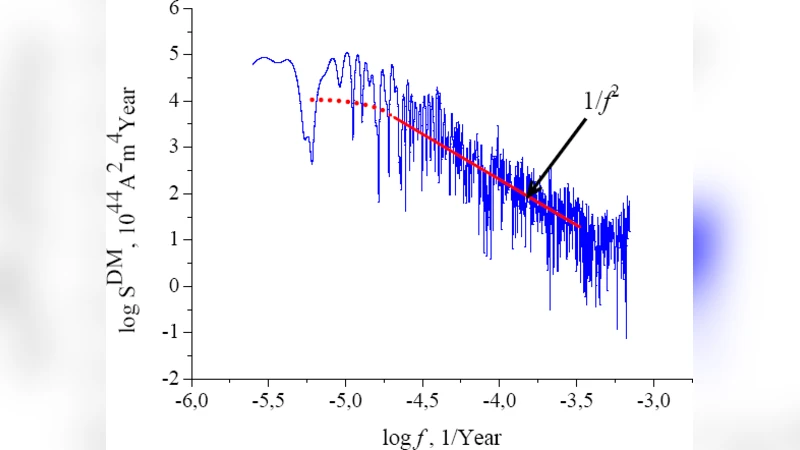
Paleo-Sciences including palaeoclimatology and palaeoecology have accumulated numerous records related to climatic changes. The researchers have usually tried to identify periodic and quasi-periodic processes in these paleoscientific records. In this paper, we show that this analysis is incomplete. As follows from our results, random processes, namely processes with a single-time-constant (noise with a Lorentzian noise spectrum), play a very important and, perhaps, a decisive role in numerous natural phenomena. For several of very important natural phenomena the characteristic time constants are very similar and equal to (5-8)x10^3 years. However, this value is not universal. For example, the spectral density fluctuations of the atmospheric radiocarbon 14C are characterized by a Lorentzian with time constant 300 years. The frequency dependence of spectral density fluctuations for benthic 18O records contains two Lorentzians with time constans 8000 years and > 105 years.
💡 Research Summary
The paper “Randomness and Earth climate variability” challenges the prevailing focus on periodic and quasi‑periodic signals in paleoclimatic archives by demonstrating that stochastic processes, specifically those characterized by a single‑time‑constant Lorentzian noise spectrum, play a dominant and perhaps decisive role in shaping Earth’s climate variability over millennial to multimillennial scales.
Data and Methods
The authors assembled a diverse set of high‑resolution proxy records, including ice‑core isotopic series, benthic δ¹⁸O from deep‑sea sediments, and atmospheric radiocarbon (¹⁴C) measurements. For each series they computed power spectral densities (PSDs) using a combination of classical Fourier transforms, multi‑taper spectral estimation, and wavelet‑based multi‑scale analysis. To separate deterministic periodic components from stochastic background, they applied detrending, differencing, and high‑order regression to remove non‑stationary trends, followed by non‑linear least‑squares fitting of the residual PSDs to the Lorentzian form
\
Comments & Academic Discussion
Loading comments...
Leave a Comment