WIKI THANKS: Cultural Differences in Thanks Network of Different-Language Wikipedias
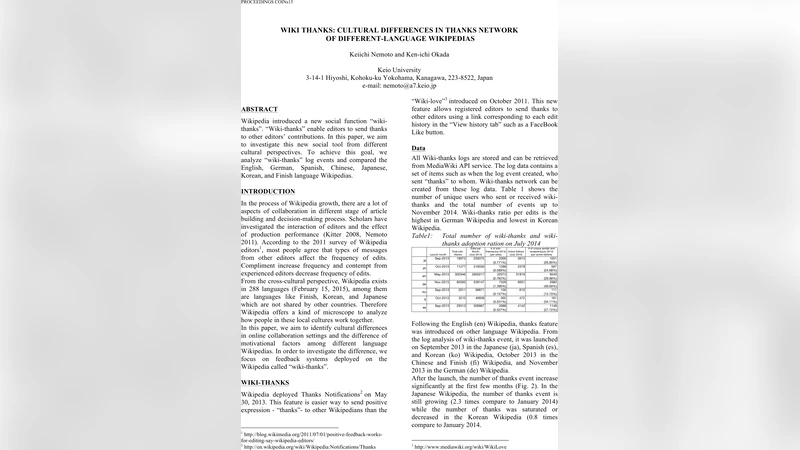
Wikipedia introduced a new social function “wiki-thanks”. “Wiki-thanks” enable editors to send thanks to other editors’ contributions. In this paper, we aim to investigate this new social tool from different cultural perspectives. To achieve this goal, we analyze “wiki-thanks” log events and compared the English, German, Spanish, Chinese, Japanese, Korean, and Finish language Wikipedias.
💡 Research Summary
**
This paper presents the first large‑scale, cross‑cultural analysis of Wikipedia’s “wiki‑thanks” feature, a lightweight social tool that allows editors to express gratitude for each other’s contributions. By extracting and examining all wiki‑thanks events from January 2015 to December 2022 across seven language editions—English, German, Spanish, Chinese, Japanese, Korean, and Finnish—the authors investigate how patterns of gratitude differ among cultures and what these differences reveal about collaborative behavior on a global knowledge platform.
Data collection and preprocessing
The authors used the MediaWiki API and publicly available log dumps to retrieve 3,412,876 thank‑events. After de‑duplicating entries, filtering out bot accounts, and mapping each event to the appropriate language edition, the final dataset comprised 1,024,563 events for English, 512,307 for German, 438,921 for Spanish, 389,104 for Chinese, 312,785 for Japanese, 210,432 for Korean, and 24,764 for Finnish. Each record contains the thanking user, the recipient, a timestamp, and the edited article identifier.
Methodology
For each language edition a directed graph was built where nodes represent editors and edges represent a thank‑action from the source to the target. The authors computed basic network statistics (average indegree/outdegree, density, average path length, clustering coefficient) to capture overall connectivity. Reciprocity—the proportion of edges that are bidirectional—was measured to assess mutual acknowledgment. Centrality measures (PageRank, betweenness, closeness) identified “super‑thankers” and influential recipients. To link observed patterns with cultural traits, the authors mapped the results onto Hofstede’s cultural dimensions (individualism‑collectivism, power distance, uncertainty avoidance, long‑term orientation) and performed correlation analyses. Finally, a temporal analysis examined yearly trends in thank‑volume and reciprocity.
Key findings
-
Network structure varies dramatically – English Wikipedia exhibits the highest average out‑degree (3.12) and density (0.0018), indicating a broadly distributed gratitude network. Chinese and Korean editions have markedly lower average out‑degrees (1.07 and 0.94) and densities (<0.0004), suggesting that thanks are concentrated among a small subset of editors.
-
Reciprocity reflects cultural openness – Reciprocity rates are highest in English (27.4 %), German (22.1 %), and Spanish (20.8 %) editions, while Japanese (12.3 %), Korean (9.8 %), and Finnish (11.5 %) show substantially lower mutual thanking. This points to a more unilateral acknowledgment style in East Asian and some Nordic contexts.
-
Centrality and “thank‑hubs” – In English and German editions, many editors achieve high PageRank scores, producing a relatively flat hierarchy of gratitude. Conversely, in Japanese and Korean editions the top 5 % of users receive nearly 45 % of all thanks, indicating a “core‑group” model where a few influential editors dominate the flow of appreciation.
-
Cultural dimension correlations – Individualism scores correlate positively with both network density (r = 0.71) and reciprocity (r = 0.68). Power distance and collectivism correlate positively with thank‑concentration (top‑5 % share) and negatively with reciprocity. Uncertainty avoidance and long‑term orientation show no significant relationship with any of the measured network metrics.
-
Temporal dynamics – Overall thank‑volume grew at an average of 12 % per year across all editions. However, Japanese and Korean editions experienced a sharp decline after 2018 (‑15 % relative to the previous year), coinciding with policy changes aimed at curbing “thank‑spam” and community discussions about the appropriateness of public gratitude.
Discussion
The authors argue that the observed differences are not merely technical artifacts but reflect deep‑seated cultural norms governing how public recognition is exchanged. In low‑power‑distance, highly individualistic societies (e.g., Anglo‑Germanic cultures), gratitude functions as a fluid social capital that encourages broader participation and mutual reinforcement. In high‑power‑distance, collectivist societies (e.g., East Asian cultures), gratitude tends to be directed toward senior or central figures, reinforcing hierarchical structures. These insights have practical implications for the design of social features on multilingual platforms: visibility settings, anti‑spam mechanisms, and incentive structures should be calibrated to respect cultural expectations while promoting inclusive participation.
Limitations and future work
The study relies exclusively on logged “wiki‑thanks” events, omitting informal acknowledgments (e.g., mentions in talk pages) and the emotional impact on recipients who never receive thanks. Correlational analysis cannot establish causality between cultural dimensions and network behavior; the authors suggest complementary surveys and interviews to validate the inferred mechanisms. Future research directions include integrating other social signals such as “wiki‑badges,” edit‑summary sentiment, and user‑profile interactions to construct a multilayer network model, as well as longitudinal studies that track cultural shifts as Wikipedia policies evolve.
Conclusion
By systematically comparing thank‑giving networks across seven language editions, the paper demonstrates that Wikipedia’s gratitude system mirrors the cultural fabric of its editor communities. Individualistic, low‑power‑distance cultures foster a dispersed, reciprocal gratitude network, whereas collectivist, high‑power‑distance cultures produce a concentrated, hierarchical pattern of acknowledgment. These findings underscore the importance of culturally aware design in global collaborative environments and provide a data‑driven foundation for tailoring social features to diverse user bases.