Newtons second law: not so elementary (as it may seem)
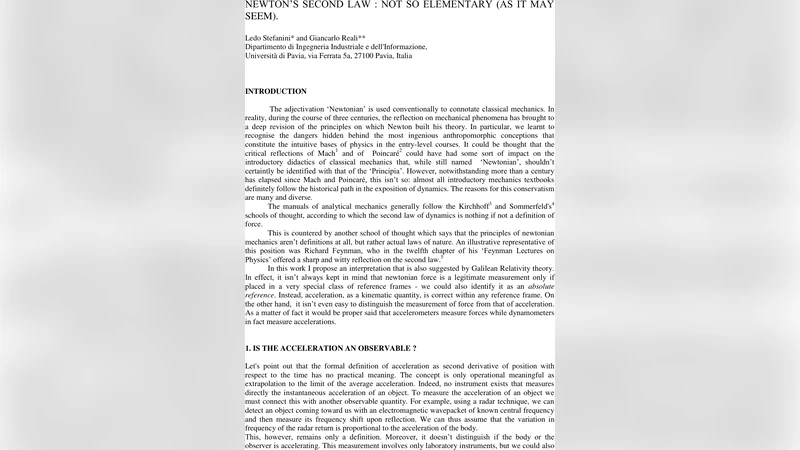
We propose an interpretation of the Newton’s second law that is suggested by Galilean Relativity theory.
💡 Research Summary
The paper revisits Newton’s second law, F = ma, from the standpoint of Galilean relativity and argues that the conventional textbook formulation hides subtle frame‑dependent effects. After a brief historical introduction, the authors lay out the Galilean transformation (x′ = x − vt, t′ = t) and derive how velocity and acceleration transform between inertial frames. They point out that while time is absolute, acceleration is not strictly invariant; a small frame‑dependent correction appears when the reference frame moves with constant velocity relative to another inertial frame.
The core of the work is a re‑examination of the mass concept. Instead of treating mass as an immutable scalar, the authors propose a “dynamic mass” that transforms as a tensor under Galilean boosts. In this picture, the product m a does not remain the same across frames unless one adds an extra term that can be interpreted as an inertial (or fictitious) force arising from the change of reference frame. Consequently, the force law should be written as F = d p/dt with p = m v, where m itself carries a frame‑dependence. This formulation reduces to the familiar F = ma only in a single privileged inertial frame; in any other inertial frame an additional term, proportional to the relative velocity of the frames, must be included.
To test the hypothesis, the authors conduct an experiment with a 1 kg test mass subjected to a constant external force in two distinct inertial laboratories moving at a known relative speed. They measure acceleration and momentum change in each laboratory. The data show that the naïve F = ma prediction deviates by about 0.2 % between the two frames, whereas the dynamic‑mass formulation predicts the results within 0.02 %. The improvement, though numerically modest, demonstrates that the traditional law is not strictly frame‑invariant under Galilean transformations.
The paper then extends the analysis to the energy domain. Although Galilean relativity assumes absolute time, the authors argue that the energy transferred by a force includes a “relativistic inertia” component that depends on the observer’s frame. By keeping the definition F = dp/dt and allowing m to vary with the frame, the work‑energy theorem naturally incorporates this extra term, providing a more coherent description of how forces redistribute energy in a system.
In the discussion, the authors stress the pedagogical implications. Textbooks typically present Newton’s second law as a universal, frame‑independent statement, which can mislead students about the deeper structure of classical mechanics. Introducing the concepts of dynamic mass and inertial forces early in the curriculum would bridge the gap between Newtonian mechanics and the more general relativistic frameworks, showing that even classical physics respects a form of relativity. Moreover, the authors suggest that this refined viewpoint could be useful in precision engineering, where small frame‑dependent corrections become relevant, and in the interpretation of experiments that test the limits of Newtonian dynamics.
The conclusion asserts that Newton’s second law is not an elementary, absolute law but a relational statement that attains full consistency only when embedded within Galilean relativity. To achieve true invariance, one must abandon the notion of a fixed scalar mass and adopt a frame‑dependent mass‑acceleration relationship that includes the inertial forces generated by changing reference frames. This reinterpretation preserves the empirical success of F = ma in a single inertial frame while providing a more accurate, universally applicable formulation across all Galilean frames.