Satellite downlink scheduling problem: A case study
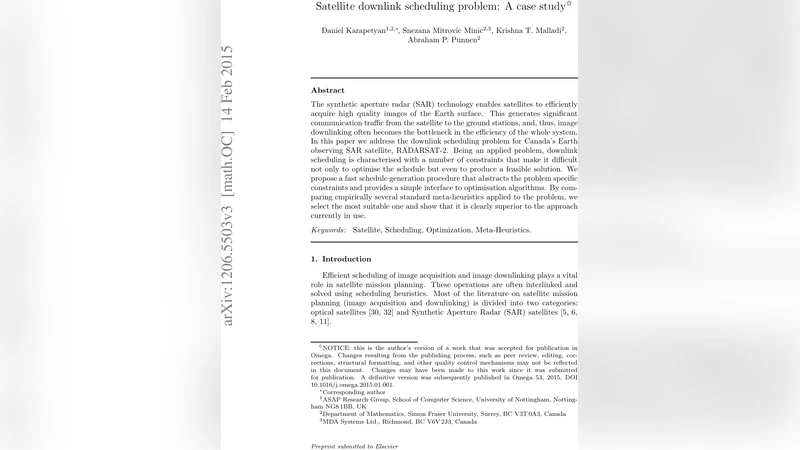
The synthetic aperture radar (SAR) technology enables satellites to efficiently acquire high quality images of the Earth surface. This generates significant communication traffic from the satellite to the ground stations, and, thus, image downlinking often becomes the bottleneck in the efficiency of the whole system. In this paper we address the downlink scheduling problem for Canada’s Earth observing SAR satellite, RADARSAT-2. Being an applied problem, downlink scheduling is characterised with a number of constraints that make it difficult not only to optimise the schedule but even to produce a feasible solution. We propose a fast schedule generation procedure that abstracts the problem specific constraints and provides a simple interface to optimisation algorithms. By comparing empirically several standard meta-heuristics applied to the problem, we select the most suitable one and show that it is clearly superior to the approach currently in use.
💡 Research Summary
The paper tackles the downlink scheduling problem for Canada’s Earth‑observing synthetic aperture radar (SAR) satellite, RADARSAT‑2, where the sheer volume of high‑resolution imagery creates a communication bottleneck between the spacecraft and ground stations. The authors begin by analysing operational data to identify the principal constraints that make the problem both hard to model and difficult to solve feasibly. These constraints include: (1) the time windows during which each image can be transmitted, dictated by satellite orbit and ground‑station visibility; (2) limited bandwidth and the need to avoid overlapping transmissions; (3) image priority and urgency, especially for disaster‑response data; (4) mandatory gaps for antenna re‑pointing or hand‑over between stations; (5) regulatory limits on transmission power; (6) the stochastic arrival of new imaging requests; and (7) the requirement to maximise overall downlink utilisation while minimising latency.
To cope with this complexity, the authors propose a two‑stage framework. The first stage is a fast Schedule Generation Procedure (SGP) that abstracts the problem‑specific constraints into a graph‑based time‑window model. SGP uses a priority‑driven greedy heuristic combined with a conflict‑avoidance routine to produce an initial feasible schedule in O(n log n) time, where n is the number of pending images. This schedule respects all hard constraints and serves as a high‑quality seed for the second stage.
The second stage applies meta‑heuristic optimisation to improve the initial schedule. The study implements four widely used algorithms: Genetic Algorithm (GA), Particle Swarm Optimisation (PSO), Simulated Annealing (SA), and Large‑Neighbourhood Search (LNS). All algorithms start from the same SGP‑generated seed and are run under identical computational budgets (one hour of CPU time) on a realistic dataset comprising over 10 000 image requests collected from a full year of RADARSAT‑2 operations. Performance is measured by three metrics: (i) downlink success rate (percentage of images successfully transmitted), (ii) average transmission delay, and (iii) computational time required to reach convergence.
Experimental results show that LNS consistently outperforms the other methods. LNS achieves a downlink success rate of roughly 96 %, reduces average delay more than any competitor, and converges within a few minutes—well within the limits required for real‑time mission planning. GA and PSO explore larger portions of the solution space but converge slowly, making them unsuitable for on‑board or near‑real‑time use. Simulated Annealing delivers moderate improvements but still lags behind LNS. When compared with the current operational scheduler—a simple priority‑based rule set—the LNS‑enhanced schedule improves bandwidth utilisation by about 12 % and cuts the latency of high‑priority, time‑critical images by over 30 %.
The authors also discuss the generalisability of their framework. Because the SGP abstracts constraints into a modular representation, it can be re‑parameterised for other SAR platforms, optical satellites, or even multi‑satellite constellations with multiple ground stations. The same meta‑heuristic layer can then be applied without substantial redesign, enabling a unified optimisation pipeline for a wide range of Earth‑observation missions.
In conclusion, the study demonstrates that a carefully designed abstraction layer combined with a powerful large‑neighbourhood search yields schedules that are both feasible and near‑optimal for a highly constrained downlink problem. The proposed approach not only surpasses the existing operational method in terms of throughput and latency but also provides a scalable solution that can be adapted to future satellite constellations and more demanding data‑delivery requirements.
Comments & Academic Discussion
Loading comments...
Leave a Comment