Constructive proof of the Kerr-Newman black hole uniqueness: derivation of the full solution from scratch
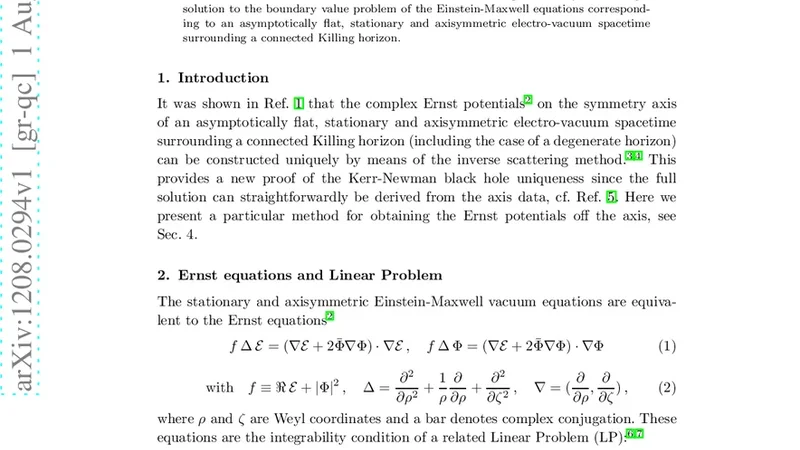
The Kerr-Newman black hole solution can be constructed straightforwardly as the unique solution to the boundary value problem of the Einstein-Maxwell equations corresponding to an asymptotically flat, stationary and axisymmetric electro-vacuum spacetime surrounding a connected Killing horizon.
💡 Research Summary
The paper presents a constructive proof of the Kerr‑Newman black‑hole uniqueness theorem by solving the Einstein‑Maxwell boundary‑value problem from first principles. Starting from the stationary, axisymmetric Einstein‑Maxwell equations, the authors introduce the complex Ernst potentials ℰ (gravitational) and ψ (electromagnetic) and rewrite the field equations as the coupled Ernst system. They then impose three physically motivated boundary conditions: asymptotic flatness with prescribed electric charge Q and magnetic charge P at infinity, regularity on the symmetry axis, and the existence of a single, connected Killing horizon Σ on which ℰ and ψ take constant values (the “horizon regularity” condition).
Using the complex coordinate ζ = ρ + i z, the Ernst equations are transformed into a Riemann‑Hilbert problem on the ζ‑plane. The authors employ Sibgatullin’s integral method and the inverse‑scattering transform to encode the horizon data into a set of spectral parameters λi that are directly related to the physical parameters M (mass), J (angular momentum), Q, and P. By solving the associated linear integral equations, they demonstrate that ℰ and ψ must be rational functions of ζ and its complex conjugate. Explicitly, they obtain
ℰ(ζ, ζ̄) = (R – i a – M) / (R + i a + M), ψ(ζ, ζ̄) = (Q + i P) / (R + i a + M),
where R = √