Paradox of Peroxy Defects and Positive Holes in Rocks Part II: Outflow of Electric Currents from Stressed Rocks
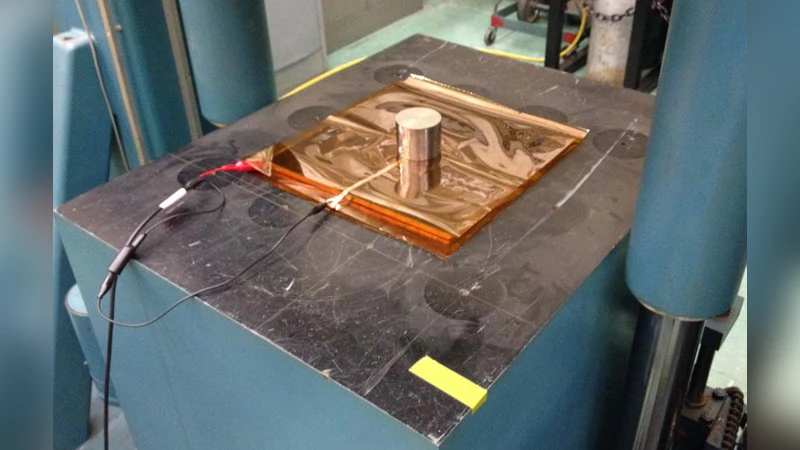
Understanding the electrical properties of rocks is of fundamental interest. We report on currents generated when stresses are applied. Loading the center of gabbro tiles, 30x30x0.9 cm$^3$, across a 5 cm diameter piston, leads to positive currents flowing from the center to the unstressed edges. Changing the constant rate of loading over 5 orders of magnitude from 0.2 kPa/s to 20 MPa/s produces positive currents, which start to flow already at low stress levels, <5 MPa. The currents increase as long as stresses increase. At constant load they flow for hours, days, even weeks and months, slowly decreasing with time. When stresses are removed, they rapidly disappear but can be made to reappear upon reloading. These currents are consistent with the stress-activation of peroxy defects, such as O$_3$Si-OO-SiO$_3$, in the matrix of rock-forming minerals. The peroxy break-up leads to positive holes h$^{\bullet}$, i.e. electronic states associated with O$^-$ in a matrix of O$^{2-}$, plus electrons, e’. Propagating along the upper edge of the valence band, the holes are able to flow from stressed to unstressed rock, traveling fast and far by way of a phonon-assisted electron hopping mechanism using energy levels at the upper edge of the valence band. Impacting the tile center leads to h$^{\bullet}$ pulses, 4-6 ms long, flowing outward at ~100 m/sec at a current equivalent to 1-2 x 10$^9$ A/km$^3$. Electrons, trapped in the broken peroxy bonds, are also mobile, but only within the stressed volume.
💡 Research Summary
The paper investigates the generation of electric currents in rocks when mechanical stress is applied, focusing on the role of peroxy defects and the associated positive hole (h•) charge carriers. Using gabbro tiles (30 × 30 × 0.9 cm³) with a 5 cm diameter piston pressing at the centre, the authors varied the loading rate over five orders of magnitude—from 0.2 kPa s⁻¹ to 20 MPa s⁻¹—and measured currents at the tile edges and centre with sensitive electrodes.
Key observations are: (1) Positive currents appear at very low stresses (<5 MPa) and increase as stress rises, regardless of the loading rate. (2) Once a constant stress is maintained, the currents persist for extended periods—hours, days, weeks, and even months—gradually decaying. (3) Upon unloading, the currents drop abruptly, but they re‑emerge when the same region is re‑loaded, demonstrating a reversible, stress‑activated process. (4) Impact‑type loading generates short (4–6 ms) h• pulses that travel outward at roughly 100 m s⁻¹, corresponding to a current density of 1–2 × 10⁹ A km⁻³. (5) Electrons (e′) released from broken peroxy bonds remain trapped within the stressed volume, whereas h• propagate through the unstressed surrounding rock.
The authors interpret these results through the peroxy‑defect model. In silicate minerals, peroxy bonds (O₃Si‑OO‑SiO₃) are normally electrically inactive. Under stress, the O–O bond ruptures, producing a localized electron (e′) and a positively charged hole (h•), which is essentially an O⁻ ion embedded in an O²⁻ lattice. The h• occupies the top of the valence band and moves via a phonon‑assisted hopping mechanism, allowing rapid, long‑range transport without the need for a conventional conduction band. This explains the observed outward flow of charge from the stressed core to the unstressed edges.
Quantitative analysis shows that the h• pulses carry a charge equivalent to 10⁹ A per cubic kilometre of rock, a magnitude that, when scaled to geological volumes, could account for the electromagnetic anomalies reported before earthquakes. The slow decay of the sustained currents under constant load is attributed to gradual recombination of h• with trapped electrons or with other defects, a process governed by trap depth distribution and temperature.
The paper’s broader implications are significant for geophysics. It provides a concrete physical mechanism linking mechanical deformation to electromagnetic emissions, supporting the hypothesis that pre‑seismic electric signals arise from stress‑induced charge carriers in the crust. Moreover, the reversible nature of the currents suggests that monitoring h•‑related electromagnetic activity could serve as a real‑time proxy for stress accumulation in fault zones. The work also opens avenues for laboratory‑based stress monitoring using current measurements, and for refining models of earthquake precursors that incorporate solid‑state defect physics.
In summary, the study demonstrates experimentally that (i) peroxy defects in silicate rocks are stress‑sensitive, (ii) their rupture generates mobile positive holes and trapped electrons, (iii) positive holes can travel rapidly from stressed to unstressed regions, producing measurable currents, (iv) these currents persist for long periods under constant stress and vanish upon unloading, and (v) the observed phenomena provide a plausible explanation for a range of geophysical electromagnetic observations associated with tectonic stress.