The Complexity of Computing Minimal Unidirectional Covering Sets
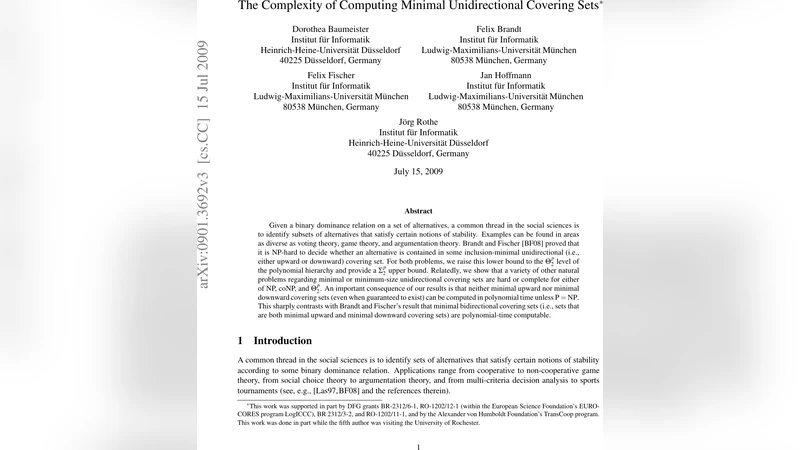
Given a binary dominance relation on a set of alternatives, a common thread in the social sciences is to identify subsets of alternatives that satisfy certain notions of stability. Examples can be found in areas as diverse as voting theory, game theory, and argumentation theory. Brandt and Fischer [BF08] proved that it is NP-hard to decide whether an alternative is contained in some inclusion-minimal upward or downward covering set. For both problems, we raise this lower bound to the Theta_{2}^{p} level of the polynomial hierarchy and provide a Sigma_{2}^{p} upper bound. Relatedly, we show that a variety of other natural problems regarding minimal or minimum-size covering sets are hard or complete for either of NP, coNP, and Theta_{2}^{p}. An important consequence of our results is that neither minimal upward nor minimal downward covering sets (even when guaranteed to exist) can be computed in polynomial time unless P=NP. This sharply contrasts with Brandt and Fischer’s result that minimal bidirectional covering sets (i.e., sets that are both minimal upward and minimal downward covering sets) are polynomial-time computable.
💡 Research Summary
The paper investigates the computational complexity of finding minimal unidirectional covering sets—sets of alternatives that are stable under a binary dominance relation when only upward or only downward covering conditions are required. This line of research is motivated by applications in voting theory, cooperative game theory, and argumentation frameworks, where such sets are used to identify “reasonable” outcomes.
Brandt and Fischer (2008) previously showed that deciding whether a given alternative belongs to some inclusion‑minimal upward (or downward) covering set is NP‑hard. The authors of the present work sharpen this lower bound by proving Θ₂^p‑hardness, where Θ₂^p = P^NP
Comments & Academic Discussion
Loading comments...
Leave a Comment