Recognizing Members of the Tournament Equilibrium Set is NP-hard
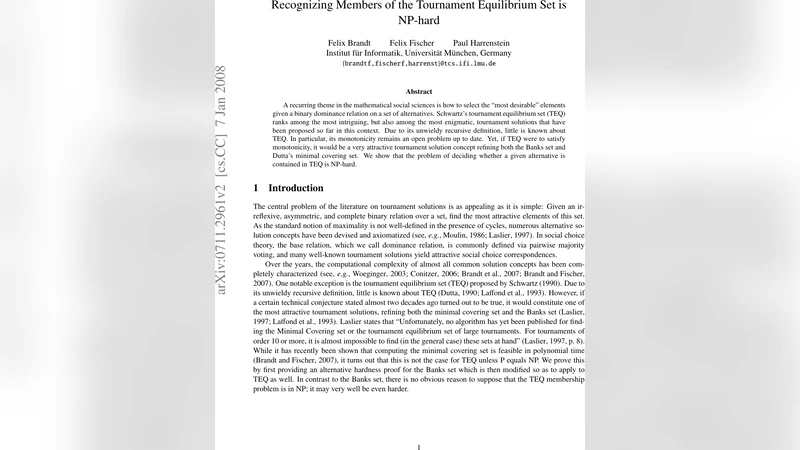
A recurring theme in the mathematical social sciences is how to select the “most desirable” elements given a binary dominance relation on a set of alternatives. Schwartz’s tournament equilibrium set (TEQ) ranks among the most intriguing, but also among the most enigmatic, tournament solutions that have been proposed so far in this context. Due to its unwieldy recursive definition, little is known about TEQ. In particular, its monotonicity remains an open problem up to date. Yet, if TEQ were to satisfy monotonicity, it would be a very attractive tournament solution concept refining both the Banks set and Dutta’s minimal covering set. We show that the problem of deciding whether a given alternative is contained in TEQ is NP-hard.
💡 Research Summary
The paper investigates the computational complexity of recognizing members of the Tournament Equilibrium Set (TEQ), a prominent solution concept in the theory of tournaments—a model where every pair of alternatives is linked by a directed dominance relation. TEQ, introduced by Schwartz, is defined recursively: for a given tournament T, one first identifies its minimal strongly connected components (SCCs); the TEQ of T is then the union of the TEQ of each of these SCCs, applied recursively until a fixed point is reached. This elegant definition makes TEQ a natural refinement of several classic tournament solutions, notably the Banks set and Dutta’s minimal covering set, and it would be especially attractive if it satisfied the monotonicity property. However, the recursive nature of TEQ has left many of its algorithmic properties unexplored, and its monotonicity remains an open question.
The central contribution of the paper is a proof that the decision problem “given a tournament T and an alternative a, is a ∈ TEQ(T)?” is NP‑hard. To establish this result, the authors construct a polynomial‑time many‑one reduction from the classic NP‑complete problem Exact‑3‑Cover (X3C). An X3C instance consists of a ground set U of 3q elements and a collection C of 3‑element subsets; the question is whether there exists a sub‑collection C′ ⊆ C that partitions U. The reduction proceeds by encoding each element of U and each subset in C as small, carefully designed “gadgets” (sub‑tournaments). These gadgets have internal dominance structures that enforce a binary choice: a gadget corresponding to a subset may either be “selected” (its vertices become part of TEQ) or “rejected” (its vertices are excluded). The construction also includes “conflict‑avoidance” edges that ensure that selecting two subsets that share an element creates a cycle that prevents both from entering TEQ simultaneously.
All gadgets are then assembled into a single tournament T together with a distinguished vertex a. The connections are arranged so that a can belong to TEQ(T) if and only if the original X3C instance admits an exact cover. Intuitively, a can survive the recursive elimination process only when a set of non‑overlapping subset‑gadgets is chosen, which precisely corresponds to a valid exact cover. The authors verify that the size of T is polynomial in the size of the X3C instance and that the construction can be carried out deterministically in polynomial time.
Because X3C is NP‑complete, the reduction shows that TEQ‑membership is at least as hard, establishing NP‑hardness. This result has several important implications. First, unless P = NP, there is no polynomial‑time algorithm that can decide TEQ membership for arbitrary tournaments. Second, the difficulty of the problem casts doubt on the feasibility of proving monotonicity for TEQ via constructive methods, since many monotonicity proofs for other tournament solutions rely on the ability to compute the solution efficiently. Third, the finding suggests that practical applications of TEQ will need to rely on approximation, heuristics, or restriction to special classes of tournaments (e.g., transitive, nearly transitive, or bounded‑feedback‑arc‑set tournaments) where the problem may become tractable.
The paper concludes by outlining future research directions. One line of work is to develop approximation algorithms or fixed‑parameter tractable (FPT) algorithms for TEQ membership, perhaps parameterized by the number of SCCs or the feedback arc set size. Another direction is to identify subclasses of tournaments for which TEQ can be computed in polynomial time, thereby providing useful domains for practical implementation. Finally, the authors stress that resolving the monotonicity question—either by proving it holds or by constructing a counterexample—remains a central open problem, and any progress will likely need to grapple with the NP‑hardness barrier demonstrated in this work.
Comments & Academic Discussion
Loading comments...
Leave a Comment