Epigenetics: What it is about?
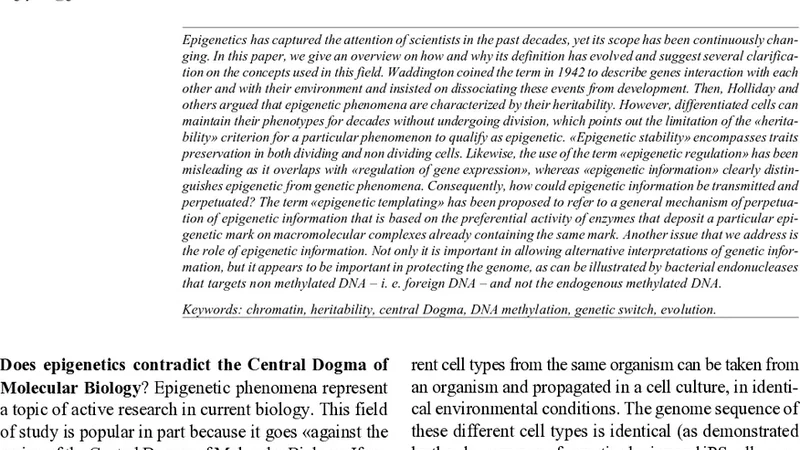
Epigenetics has captured the attention of scientists in the past decades, yet its scope has been continuously changing. In this paper, we give an overview on how and why its definition has evolved and suggest several clarification on the concepts used in this field, in particular, on the notions of epigenetic information, epigenetic stability and epigenetic templating. Another issue that we address is the role of epigenetic information. Not only it is important in allowing alternative interpretations of genetic information, but it appears to be important in protecting the genetic information, moreover, we suggest that this function appeared first in evolution and only later on the epigenetic mechanisms were recruited to play a role in cell differentiation.
💡 Research Summary
The paper provides a comprehensive historical and conceptual overview of epigenetics, tracing how its definition has broadened from a simple “extra layer of information beyond the DNA sequence” to a complex network of chemical and structural modifications that regulate gene expression, maintain cellular identity, and protect the genome. The authors begin by highlighting the early use of the term to describe phenomena such as DNA methylation and histone modification, and they note that the rapid discovery of additional mechanisms—including non‑coding RNAs, chromatin remodeling complexes, and higher‑order nuclear architecture—has led to a proliferation of loosely defined concepts. To bring order to this expanding field, the authors propose three core terms that should serve as a conceptual scaffold for future work.
First, “epigenetic information” is defined as any heritable, non‑sequence‑based modification that can modulate the transcriptional output of a given DNA segment. This includes covalent marks on DNA (e.g., 5‑methylcytosine), post‑translational modifications of histones (acetylation, methylation, phosphorylation, ubiquitination), and the actions of regulatory RNAs that affect mRNA stability, translation, or chromatin state. By emphasizing that the information resides in the pattern of modifications rather than the underlying nucleotide code, the authors underscore the multilayered nature of genetic regulation.
Second, “epigenetic stability” refers to the ability of these modification patterns to persist through cell division and other cellular processes. The paper details the molecular mechanisms that underpin stability, such as maintenance DNA methyltransferases that copy methylation patterns onto nascent strands during replication, and histone‑modifying enzymes that recognize pre‑existing marks on parental nucleosomes and re‑establish them on newly assembled chromatin. These processes constitute a “template” system that ensures the faithful propagation of epigenetic states, analogous to the way DNA replication copies the genetic code.
Third, the authors introduce the concept of an “epigenetic template,” a unifying framework that integrates DNA‑based and histone‑based templating mechanisms. This concept moves beyond treating DNA methylation and histone modification as separate phenomena, proposing instead that they function together as a coordinated system that can transmit epigenetic information across generations of cells.
Beyond terminology, the paper advances a provocative evolutionary hypothesis: epigenetic mechanisms originally evolved as protective strategies for the genome, rather than primarily as regulators of gene expression. The authors argue that early life forms, exposed to harsh environmental stresses such as radiation and chemical mutagens, may have adopted reversible chemical modifications (e.g., transient methylation or histone deacetylation) to shield vulnerable DNA regions, to mask lesions, or to recruit repair factors. Over evolutionary time, these protective modifications became co‑opted for more sophisticated roles in cell differentiation and tissue‑specific gene regulation. The authors support this view with examples from bacterial spore formation, where DNA methylation confers resistance to desiccation and UV, and from early mammalian embryogenesis, where global histone deacetylation prevents premature transcription and stabilizes the genome.
The paper concludes by emphasizing the need for a standardized vocabulary based on the three proposed concepts. Consistent use of “epigenetic information,” “epigenetic stability,” and “epigenetic template” would reduce ambiguity in the literature, improve experimental design, and facilitate interdisciplinary communication. Moreover, recognizing the dual historical role of epigenetics—as both a genome‑protective mechanism and a regulator of cellular identity—offers a richer perspective for future research, encouraging investigators to explore how protective epigenetic pathways might be re‑activated in disease contexts, such as cancer or neurodegeneration, where genomic integrity is compromised.
Comments & Academic Discussion
Loading comments...
Leave a Comment