Practical and Legal Challenges of Cloud Investigations
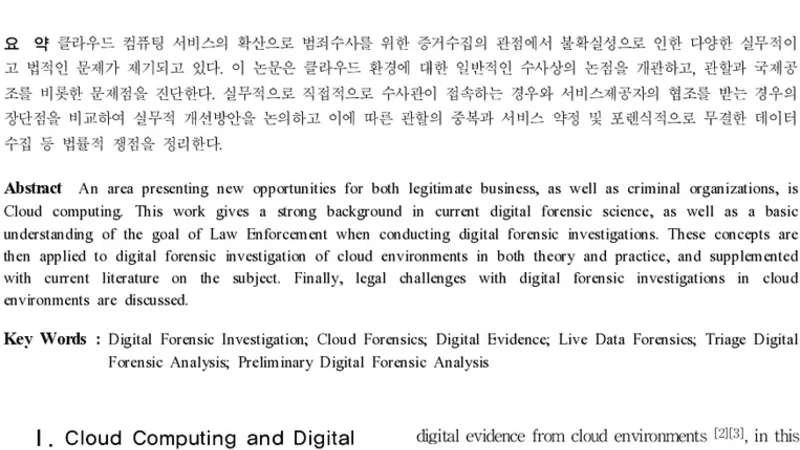
An area presenting new opportunities for both legitimate business, as well as criminal organizations, is Cloud computing. This work gives a strong background in current digital forensic science, as well as a basic understanding of the goal of Law Enforcement when conducting digital forensic investigations. These concepts are then applied to digital forensic investigation of cloud environments in both theory and practice, and supplemented with current literature on the subject. Finally, legal challenges with digital forensic investigations in cloud environments are discussed.
💡 Research Summary
The paper “Practical and Legal Challenges of Cloud Investigations” provides a comprehensive examination of how cloud computing reshapes digital forensic investigations, outlining both technical obstacles and legal complexities that law‑enforcement agencies must navigate. It begins by highlighting the rapid adoption of cloud services by legitimate enterprises and criminal actors alike, emphasizing that traditional forensic methods—designed for physical devices—are insufficient for the distributed, virtualized nature of modern cloud infrastructures.
A foundational section reviews core principles of digital forensic science, including the four‑stage investigative model of identification, preservation, analysis, and reporting, and aligns these goals with the specific needs of law‑enforcement. The authors then dissect the three primary cloud service models—Infrastructure as a Service (IaaS), Platform as a Service (PaaS), and Software as a Service (SaaS)—to illustrate how evidence sources differ across layers. In IaaS, forensic practitioners focus on virtual machine images, disk snapshots, and hypervisor logs; in PaaS, the emphasis shifts to application‑level logs, API call records, and database transaction logs; in SaaS, user‑interface logs, service‑level metadata, and API usage data become the principal artifacts.
The paper proposes a practical workflow that begins with a “preservation request” to the cloud provider, leveraging built‑in replication, backup, and snapshot capabilities to lock down data before it changes or is deleted. It stresses the importance of Service Level Agreements (SLAs) that explicitly define log‑retention periods, data‑preservation obligations, and the availability of forensic‑oriented APIs. Without such contractual clarity, investigators risk losing critical evidence due to automatic data purging or provider‑initiated encryption key rotation.
Technical challenges are explored in depth. Multi‑tenancy and data dispersion across geographically distributed data centers raise concerns about evidence integrity and chain‑of‑custody. The authors recommend generating cryptographic hashes, recording immutable timestamps, and preserving comprehensive metadata for every seized artifact. They also discuss the volatility introduced by elastic scaling and automated provisioning, which can create or destroy virtual instances in minutes, making timely evidence capture essential.
Legal challenges dominate the latter half of the study. The authors analyze jurisdictional conflicts that arise when data resides in multiple sovereign territories, each governed by distinct privacy and investigative statutes. They compare the European Union’s General Data Protection Regulation (GDPR), the United States’ CLOUD Act, and South Korea’s Personal Information Protection Act, illustrating how overlapping obligations can impede evidence collection and admissibility. To mitigate these conflicts, the paper advocates for multi‑jurisdictional agreements, mutual legal assistance treaties (MLATs) that specifically address cloud data, and the adoption of international standards such as ISO/IEC 27037 for evidence handling.
A literature review synthesizes recent case studies and academic contributions, revealing a consensus that successful cloud forensics requires pre‑emptive collaboration between law‑enforcement, cloud service providers, and legal experts. The authors conclude with actionable recommendations: (1) negotiate forensic‑ready clauses in contracts with cloud vendors; (2) develop model APIs that allow secure, auditable extraction of logs and snapshots; (3) establish dedicated legal‑technical teams to assess jurisdictional implications before initiating investigations; (4) maintain rigorous documentation of hash values, timestamps, and provenance metadata to preserve chain‑of‑custody; and (5) continuously update investigative protocols to keep pace with evolving cloud architectures.
Overall, the paper argues that the convergence of technical rigor and legal foresight is essential for preserving the credibility of digital evidence in cloud environments, ensuring that investigations remain both effective and compliant with global regulatory frameworks.
Comments & Academic Discussion
Loading comments...
Leave a Comment