Big Data: Opportunities and Privacy Challenges
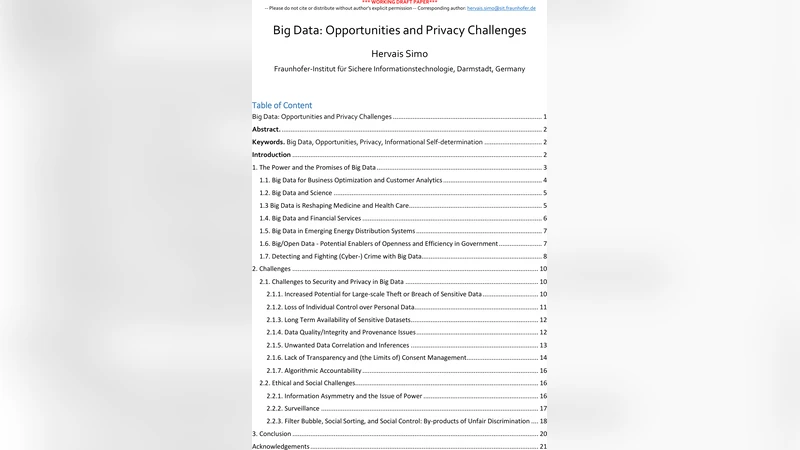
Recent advances in data collection and computational statistics coupled with increases in computer processing power, along with the plunging costs of storage are making technologies to effectively analyze large sets of heterogeneous data ubiquitous. Applying such technologies (often referred to as big data technologies) to an ever growing number and variety of internal and external data sources, businesses and institutions can discover hidden correlations between data items, and extract actionable insights needed for innovation and economic growth. While on one hand big data technologies yield great promises, on the other hand, they raise critical security, privacy, and ethical issues, which if left unaddressed may become significant barriers to the fulfillment of expected opportunities and long-term success of big data. In this paper, we discuss the benefits of big data to individuals and society at large, focusing on seven key use cases: Big data for business optimization and customer analytics, big data and science, big data and health care, big data and finance, big data and the emerging energy distribution systems, big/open data as enablers of openness and efficiency in government, and big data security. In addition to benefits and opportunities, we discuss the security, privacy, and ethical issues at stake.
💡 Research Summary
The paper provides a comprehensive overview of the rapid evolution of big‑data technologies and the dual nature of the opportunities and challenges they present. Recent advances in data acquisition, storage, and processing—driven by falling storage costs, the proliferation of cloud and distributed file systems, and the rise of NoSQL and graph databases—have made it feasible to collect, store, and analyze petabyte‑scale heterogeneous data sets in near‑real time. Coupled with powerful statistical, machine‑learning, and deep‑learning frameworks such as Apache Spark, TensorFlow, and PyTorch, these infrastructures enable automated pipelines that span data ingestion, feature engineering, model training, and deployment. The authors identify seven high‑impact use cases that illustrate how big data can generate economic and societal value:
-
Business Optimization and Customer Analytics – Integration of transaction logs, click‑stream data, and social‑media signals allows for fine‑grained customer segmentation, predictive demand forecasting, and supply‑chain optimization, leading to revenue growth and cost reduction.
-
Scientific Research – Large‑scale simulations and observational data in fields such as astronomy, climate science, and genomics are combined using high‑performance computing and distributed analytics, enabling discovery of new phenomena and validation of complex models.
-
Healthcare – Merging electronic health records, genomic sequences, wearable sensor streams, and medical imaging creates a foundation for precision medicine, early disease detection, and personalized treatment pathways, while also offering potential cost savings for health systems.
-
Finance – Real‑time transaction data fused with unstructured sources (news, social sentiment) enhances risk management, fraud detection, and credit‑scoring models. Anomaly‑detection algorithms can pre‑empt financial crimes and improve regulatory compliance.
-
Energy Distribution Systems – Smart‑meter readings, IoT sensor data, and weather forecasts are leveraged to predict electricity demand, balance distributed renewable generation, and minimize losses, thereby increasing grid efficiency and sustainability.
-
Open Government and Public Services – Open‑data portals and citizen‑participation platforms increase transparency, enable data‑driven policymaking, and improve service delivery, fostering trust between governments and the public.
-
Big‑Data Security – The paper also treats security as a domain of its own, describing how massive log streams and network telemetry can be mined for threat intelligence and automated incident response.
While emphasizing these benefits, the authors devote substantial attention to three overarching risk categories. First, privacy concerns arise because de‑identification techniques are often insufficient; re‑identification attacks can expose sensitive personal information, especially when location, genomic, or biometric data are involved. The paper recommends differential privacy, k‑anonymity extensions, and rigorous data‑minimization policies to mitigate these threats.
Second, security vulnerabilities are amplified by the sheer scale of data repositories. Attack surfaces expand to include data‑at‑rest encryption failures, compromised data pipelines, ransomware targeting backup stores, and model‑extraction attacks that reverse‑engineer proprietary algorithms. A layered defense strategy—encompassing strong access controls, zero‑trust networking, homomorphic encryption for computation on encrypted data, and continuous anomaly detection—is advocated.
Third, ethical and bias issues stem from the fact that machine‑learning models inherit biases present in training data, potentially leading to discriminatory outcomes in credit scoring, hiring, law‑enforcement risk assessment, or medical diagnosis. The authors call for systematic bias audits, explainable‑AI techniques, diverse data collection practices, and the adoption of AI ethics guidelines to ensure fairness and accountability.
To address these challenges, the paper proposes an integrated governance framework that combines technical safeguards (differential privacy, federated learning, blockchain‑based data provenance), regulatory compliance (GDPR, CCPA, sector‑specific standards), and organizational measures (appointing data stewards, conducting regular privacy‑impact assessments, and fostering a culture of data ethics). Collaboration among academia, industry, and policymakers is highlighted as essential for establishing standards, sharing best practices, and developing education programs that keep pace with rapid technological change.
In conclusion, the authors argue that big data holds transformative potential across business, science, health, finance, energy, and government, but its success hinges on proactive management of privacy, security, and ethical risks. By implementing multi‑layered technical controls, robust policy frameworks, and continuous stakeholder engagement, societies can unlock the promised economic growth and societal benefits while safeguarding individual rights and public trust.
Comments & Academic Discussion
Loading comments...
Leave a Comment