Review of Considerations for Mobile Device based Secure Access to Financial Services and Risk Handling Strategy for CIOs, CISOs and CTOs
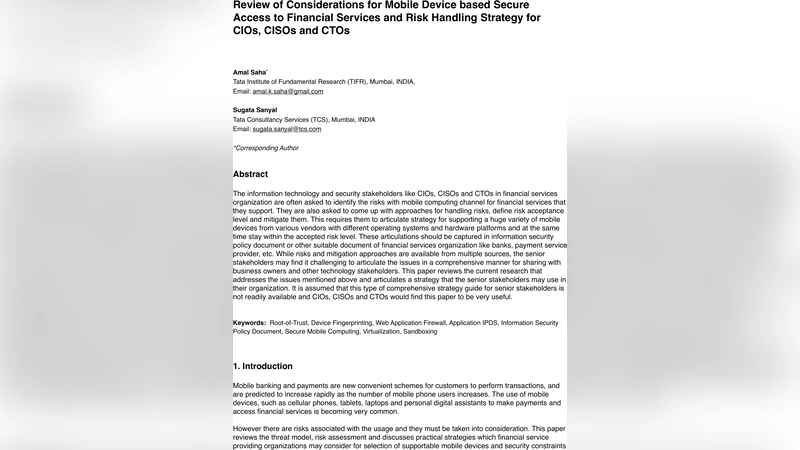
The information technology and security stakeholders like CIOs, CISOs and CTOs in financial services organization are often asked to identify the risks with mobile computing channel for financial services that they support. They are also asked to come up with approaches for handling risks, define risk acceptance level and mitigate them. This requires them to articulate strategy for supporting a huge variety of mobile devices from various vendors with different operating systems and hardware platforms and at the same time stay within the accepted risk level. These articulations should be captured in information security policy document or other suitable document of financial services organization like banks, payment service provider, etc. While risks and mitigation approaches are available from multiple sources, the senior stakeholders may find it challenging to articulate the issues in a comprehensive manner for sharing with business owners and other technology stakeholders. This paper reviews the current research that addresses the issues mentioned above and articulates a strategy that the senior stakeholders may use in their organization. It is assumed that this type of comprehensive strategy guide for senior stakeholders is not readily available and CIOs, CISOs and CTOs would find this paper to be very useful.
💡 Research Summary
The paper addresses the growing challenge faced by senior technology leaders—chief information officers (CIOs), chief information security officers (CISOs), and chief technology officers (CTOs)—in financial‑service organizations that must support a wide variety of mobile devices while keeping risk within acceptable limits. It begins by outlining the business drivers that have made mobile channels indispensable for banking, payments, wealth management, and other financial services, and it points out that the diversity of devices, operating systems, and vendors dramatically expands the attack surface.
A comprehensive risk taxonomy is introduced, dividing mobile‑related threats into seven categories: device‑diversity risk, platform‑vulnerability risk, network‑transmission risk, data‑at‑rest/processing risk, authentication‑and‑authorization risk, application‑ecosystem risk, and regulatory‑compliance risk. For each category the authors enumerate concrete threat scenarios—such as malicious code injection, rooting/jail‑breaking, man‑in‑the‑middle attacks, data exfiltration, session hijacking, malicious app distribution, and violations of PCI‑DSS, GDPR, or local banking regulations. A combined qualitative‑quantitative scoring model (likelihood × impact) is applied to prioritize risks.
The core of the paper proposes a multi‑layered mitigation strategy anchored in a Zero‑Trust Architecture (ZTA) adapted for mobile. Device management is achieved through Mobile Device Management (MDM) or Enterprise Mobility Management (EMM) platforms that enforce enrollment, remote wipe, policy compliance, and integrity verification of OS and firmware. Identity and access controls rely on strong multi‑factor authentication, dynamic policy engines, and the principle of least privilege, with continuous risk‑based session evaluation.
Application security is reinforced at every stage of the software development lifecycle: static and dynamic code analysis (SAST/DAST), mobile‑specific security testing (MAST), code signing, obfuscation, runtime protection (sandboxing, anti‑debugging), and the use of secure containers to isolate corporate data from personal apps in BYOD scenarios. Network security mandates TLS 1.3 or higher for all mobile traffic, supplemented by corporate VPN or SD‑WAN solutions that provide micro‑segmentation and traffic monitoring. Data protection combines on‑device encryption (AES‑256 within a Trusted Execution Environment) with backend encryption managed by dedicated Key Management Services (KMS) and Hardware Security Modules (HSM), ensuring end‑to‑end confidentiality.
Risk acceptance is formalized through a matrix that aligns business impact, regulatory requirements, and stakeholder tolerance. For each identified risk the organization selects one of four response options—Accept, Treat, Transfer, or Terminate—and documents the rationale in a mobile‑security policy. Continuous monitoring integrates mobile logs (device health, app events, authentication attempts) into a Security Information and Event Management (SIEM) platform, with Security Orchestration, Automation and Response (SOAR) playbooks automating detection, containment, and remediation. Supply‑chain risk is addressed by rigorous vendor security assessments, contractual security clauses, and verification of third‑party SDKs.
The paper also outlines a governance framework that includes policy creation (defining scope, roles, responsibilities, procedures, and review cycles), regular training for employees, customers, and partners, and a set of key performance indicators (KPIs) such as risk‑score reduction, policy‑compliance rate, and mean time to resolve incidents. An implementation roadmap is presented in four phases—Preparation, Design, Deployment, and Operations—detailing deliverables (risk assessment report, policy draft, solution selection, pilot, enterprise rollout) and milestones.
In conclusion, the authors argue that the proposed strategy provides a practical, end‑to‑end guide for senior technology leaders to articulate, document, and execute a secure mobile access program that balances innovation with risk, satisfies regulatory demands, and preserves business continuity in the financial services sector.
Comments & Academic Discussion
Loading comments...
Leave a Comment