Everyday the Same Picture: Popularity and Content Diversity
Facebook is flooded by diverse and heterogeneous content, from kittens up to music and news, passing through satirical and funny stories. Each piece of that corpus reflects the heterogeneity of the underlying social background. In the Italian Facebook we have found an interesting case: a page having more than $40K$ followers that every day posts the same picture of a popular Italian singer. In this work, we use such a page as a control to study and model the relationship between content heterogeneity on popularity. In particular, we use that page for a comparative analysis of information consumption patterns with respect to pages posting science and conspiracy news. In total, we analyze about $2M$ likes and $190K$ comments, made by approximately $340K$ and $65K$ users, respectively. We conclude the paper by introducing a model mimicking users selection preferences accounting for the heterogeneity of contents.
💡 Research Summary
**
The paper investigates how the heterogeneity of content influences popularity on Facebook by using a unique natural experiment: a popular Italian Facebook page that posts the exact same picture of singer Toto Cutugno every day. This “baseline” page, with over 40 K followers, serves as a control against which the authors compare 73 other public pages that publish heterogeneous content—34 science‑related pages and 39 conspiracy‑related pages. Data were collected for a four‑month period (August 22 to December 31, 2014 for the baseline page; the same calendar dates in 2013 for the other pages). In total the dataset comprises roughly 2 million likes, 190 K comments, 34 K unique likers, and 65 K unique commenters, distributed across 49 354 science posts, 13 028 conspiracy posts, and 36 169 baseline posts.
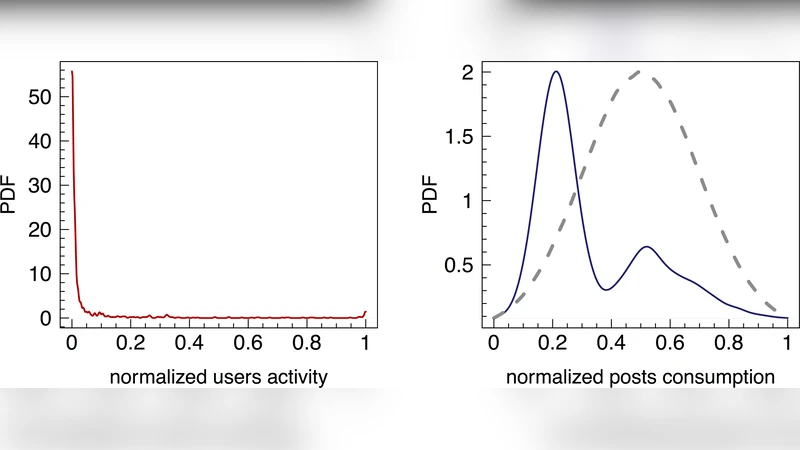
The authors first examine user‑level activity. They compute the normalized number of likes per user and the “lifetime” of a user (the time between the first and last like on a given page). All three groups display heavy‑tailed distributions for both metrics, indicating that a small fraction of users generate most of the engagement while the majority are occasional participants. The baseline users show a slightly shorter lifetime, but the differences are not statistically significant. Thus, the heterogeneity of the content does not noticeably affect how intensely individual users interact with a page.
The second, more striking analysis concerns post‑level consumption. For the heterogeneous pages (science and conspiracy), the distribution of likes per post is also heavy‑tailed: a few posts attract a very large number of likes while most receive few. In contrast, the baseline page’s posts follow an approximately Gaussian distribution centered around the mean number of likes, reflecting that each identical post receives roughly the same amount of attention. Therefore, while user activity patterns are robust to content diversity, the diversity of the content itself determines the variance of post popularity.
To explain these empirical findings, the authors propose a parsimonious stochastic model. Each post is assigned an “attractiveness” value v drawn from a Beta distribution B(1, β). When β = 1 the Beta collapses to a uniform distribution, meaning all posts have equal attractiveness (the homogeneous case). As β grows large, the Beta becomes right‑skewed, producing a few highly attractive posts and many low‑attractiveness ones (the heterogeneous case). Each user i is characterized by two parameters drawn from power‑law distributions (exponent = 1.5): an activity budget a_i (the maximum number of likes the user can give) and a fixed preference threshold b_i. A user likes a post only if b_i < v and if she still has remaining activity budget. The model ignores the underlying friendship network, assuming that Facebook’s dense connectivity makes peer influence negligible for the aggregate consumption patterns studied.
Simulations were run with 10 000 posts and 20 000 users, varying β from 1 to 1 000 000 and averaging over 100 runs. When β = 1 000 000 (extremely heterogeneous), the simulated distribution of likes per post is heavily right‑skewed, matching the empirical heavy‑tailed pattern observed for science and conspiracy pages. When β = 1 (homogeneous), the simulated likes‑per‑post distribution is close to Gaussian, reproducing the baseline page’s behavior. In both regimes, the simulated user activity (likes per user) remains heavy‑tailed, consistent with the data. Thus, the model captures the essential mechanism: content heterogeneity alone, combined with heterogeneous user preferences and limited activity budgets, can generate the observed divergence between user‑level and post‑level popularity distributions.
The paper contributes to the literature on online information diffusion by isolating content diversity as a driver of popularity variance, independent of sentiment, quality, or network structure. It supports the “attention economy” view that users allocate a scarce resource (attention) preferentially toward a small set of highly attractive items when such items exist. Practically, the findings suggest that marketers or public communicators aiming for uniform engagement might benefit from delivering highly repetitive or homogeneous content, whereas those seeking viral spikes should diversify content to increase the chance of producing highly attractive posts.
In conclusion, the study demonstrates that while user activity patterns are robust to the heterogeneity of the material they consume, the distribution of post popularity is highly sensitive to it. The proposed Beta‑based attractiveness model, coupled with power‑law user preferences, successfully reproduces the empirical patterns and offers a simple yet powerful framework for understanding and predicting how content diversity shapes popularity on large‑scale social platforms.
Comments & Academic Discussion
Loading comments...
Leave a Comment