Using the Galileoscope in astronomical observations
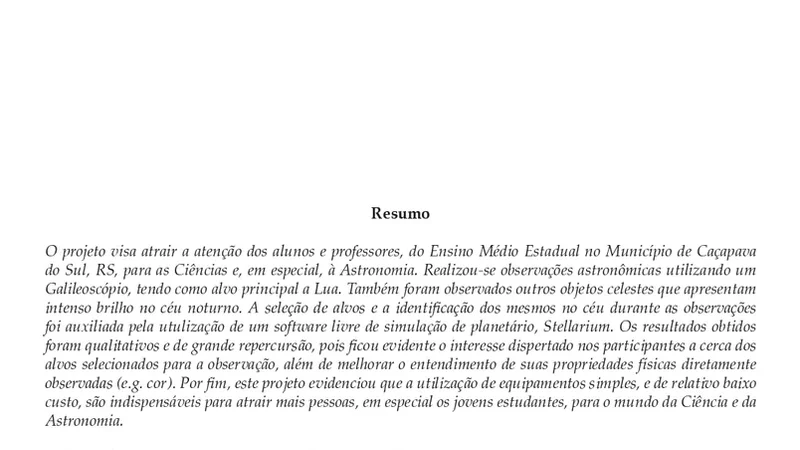
This project aims to attract school students and teachers from the state education system from Ca\c{c}apava do Sul - RS to Sciences and specially to Astronomy. We made astronomical observations using a Galileoscope choosing the Moon as a primary target. We also observed others objects that present high brightness in the night sky. The selection of targets, and their identification during the observations were carried out by a free software of planetary simulation, Stellarium. The results were in qualitative form and they show the great interest demonstrated by those participating in the project. Furthermore, this project helped to improve the understanding of the physical proprieties of the night sky objects (e.g. color). Finally, the project has showed that using a simple equipment and of relatively low cost it is possible to bring more people, specially the young students, to the Science World and to Astronomy.
💡 Research Summary
This paper reports on a hands‑on astronomy outreach program conducted in the public school system of Caçapava do Sul, Rio Grande do Sul, Brazil. The central instrument was a Galileoscope, a low‑cost, 50 mm refracting telescope that can be assembled in minutes and operated without specialized training. The program’s primary observational target was the Moon, chosen for its easily recognizable surface features and frequent visibility, while bright planets (Venus, Jupiter, Saturn) and prominent stars were added to illustrate color perception and planetary characteristics.
Target selection and real‑time navigation were facilitated by Stellarium, a free, open‑source planetarium software. Prior to each observing session the team generated altitude‑azimuth charts for the chosen objects at the specific date, time, and location (a park on the outskirts of the city). These charts, together with printed star maps, allowed students to input coordinates into Stellarium and locate the objects themselves, thereby reinforcing digital literacy alongside astronomical concepts.
Four observing sessions were held between May and August 2023. Each session involved roughly 30–35 students (primary and secondary levels) and five teachers. The structure comprised a brief introduction and telescope assembly (10 min), target acquisition and focusing practice (20 min), actual sky observation (30 min), and a debriefing discussion (15 min). During observations students identified lunar craters, maria, and the terminator, and noted the distinct hues of the planets (e.g., Venus’s yellowish glow, Jupiter’s banded colors). Teachers highlighted relevant physical phenomena such as atmospheric refraction, light pollution, and the relationship between aperture size and resolution.
To evaluate impact, participants completed pre‑ and post‑session questionnaires measuring interest in astronomy, ability to distinguish colors in celestial objects, attitudes toward scientific inquiry, and confidence in using the telescope. Scores for interest rose from an average of 2.8 to 4.3 on a 5‑point scale; color‑discrimination ability showed statistically significant improvement, especially in recognizing the gray‑black contrast of lunar terrain and the subtle color differences among planets. Qualitative interviews revealed recurring statements such as “the universe feels close enough to touch” and “seeing it with my own eyes changes what I read in textbooks.” Teachers reported increased student questioning and a more experimental classroom atmosphere.
Technical challenges emerged. The Galileoscope’s modest aperture made it highly susceptible to cloud cover and urban light pollution; under suboptimal conditions image sharpness degraded rapidly. Novice students sometimes struggled with fine focus adjustments, leading to longer acquisition times. Logistical issues included transporting equipment to the observation site and ensuring safety in a public park. The authors recommend adding a pre‑session focus‑training workshop, employing a mobile app for real‑time seeing‑condition monitoring, and selecting darker sites when possible.
In conclusion, the study demonstrates that a combination of inexpensive optical hardware and freely available software can effectively stimulate interest in astronomy, improve visual perception of celestial colors, and foster inquiry‑based learning among young students. The model is scalable for education authorities facing budget constraints, offering a practical pathway to integrate authentic scientific experiences into standard curricula. Future work will track longer‑term academic outcomes, expand the program to diverse socio‑economic contexts, and develop a digital platform for recording and sharing student observations, thereby creating a sustainable community of practice around school‑based astronomy.
Comments & Academic Discussion
Loading comments...
Leave a Comment