Review of Magnetic Shark Deterrents: Hypothetical Mechanisms and Evidence for Selectivity
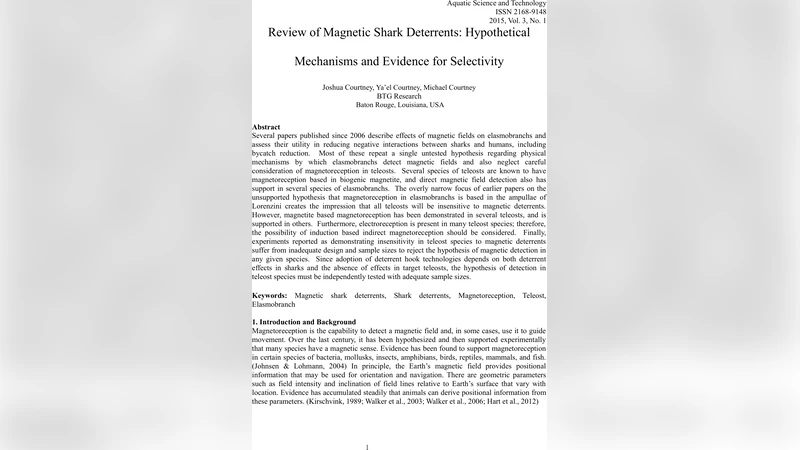
Several papers published since 2006 describe effects of magnetic fields on elasmobranchs and assess their utility in reducing negative interactions between sharks and humans, including bycatch reduction. Most of these repeat a single untested hypothesis regarding physical mechanisms by which elasmobranchs detect magnetic fields and also neglect careful consideration of magnetoreception in teleosts. Several species of teleosts are known to have magnetoreception based in biogenic magnetite, and direct magnetic field detection also has support in several species of elasmobranchs. The overly narrow focus of earlier papers on the unsupported hypothesis that magnetoreception in elasmobranchs is based in the ampullae of Lorenzini creates the impression that all teleosts will be insensitive to magnetic deterrents. However, magnetite based magnetoreception has been demonstrated in several teleosts, and is supported in others. Furthermore, electroreception is present in many teleost species; therefore, the possibility of induction based indirect magnetoreception should be considered. Finally, experiments reported as demonstrating insensitivity in teleost species to magnetic deterrents suffer from inadequate design and sample sizes to reject the hypothesis of magnetic detection in any given species. Since adoption of deterrent hook technologies depends on both deterrent effects in sharks and the absence of effects in target teleosts, the hypothesis of detection in teleost species must be independently tested with adequate sample sizes.
💡 Research Summary
The paper provides a critical review of the literature on magnetic shark deterrents published since 2006, focusing on the underlying assumptions about how elasmobranchs (sharks and rays) detect magnetic fields and on the often‑overlooked magnetoreceptive capabilities of teleost fish. The authors argue that the dominant hypothesis—that elasmobranchs sense magnetic fields solely via the ampullae of Lorenzini, an electroreceptive organ—has been repeatedly invoked without direct experimental validation. In contrast, a substantial body of work demonstrates that many teleosts possess magnetite‑based magnetoreception, and that some teleosts also have electroreceptive systems capable of indirect (induction‑based) magnetic detection. Consequently, the claim that magnetic deterrents will affect sharks while leaving all target teleost species untouched is scientifically unfounded.
The review systematically dissects methodological shortcomings in the existing deterrent studies. Sample sizes are typically very small (often fewer than 30 individuals), experiments are confined to laboratory tanks or a single field site, and key variables such as magnetic field strength, frequency, water temperature, and salinity are rarely controlled or reported. Control groups are inconsistently defined, and few studies attempt to separate the contributions of direct magnetite detection from indirect electro‑induction. As a result, “no effect” conclusions for teleosts lack sufficient statistical power and cannot reliably reject the hypothesis that these fish detect the magnetic field.
To address these gaps, the authors propose a set of rigorous experimental design principles. First, studies should employ large, statistically powered sample sizes (≥100 individuals) and be replicated across multiple geographic regions and habitats to capture ecological variability. Second, experiments must include both magnetic shielding (e.g., Helmholtz coils) and electrical shielding (e.g., copper mesh) to isolate magnetic versus electric cues. Third, prior to behavioral testing, researchers should verify the presence of magnetite in the species of interest using histology or magnetic resonance imaging, and confirm electroreceptive capability with electrophysiological recordings. Fourth, deterrent efficacy should be measured with a suite of metrics—capture reduction rates, avoidance distance, time‑to‑first‑capture, and by‑catch composition—rather than a single binary outcome. Finally, statistical analyses must incorporate a priori power calculations and appropriate corrections for multiple comparisons.
The paper concludes that two critical hypotheses must be independently validated before magnetic deterrents can be widely adopted in fisheries: (1) the device reliably interferes with elasmobranch sensory systems to reduce shark interactions, and (2) the same device does not produce significant behavioral or physiological effects in the target teleost species. Current evidence does not satisfy either condition convincingly. The authors call for large‑scale, multi‑factorial field trials that explicitly test magnetite‑based and electro‑induction pathways in both sharks and teleosts. Only with such robust data can the industry develop deterrents that are both effective against sharks and safe for commercially important fish, thereby advancing sustainable fishing practices and reducing human‑shark conflicts.
Comments & Academic Discussion
Loading comments...
Leave a Comment