(Self-)similar groups and the Farrell-Jones conjectures
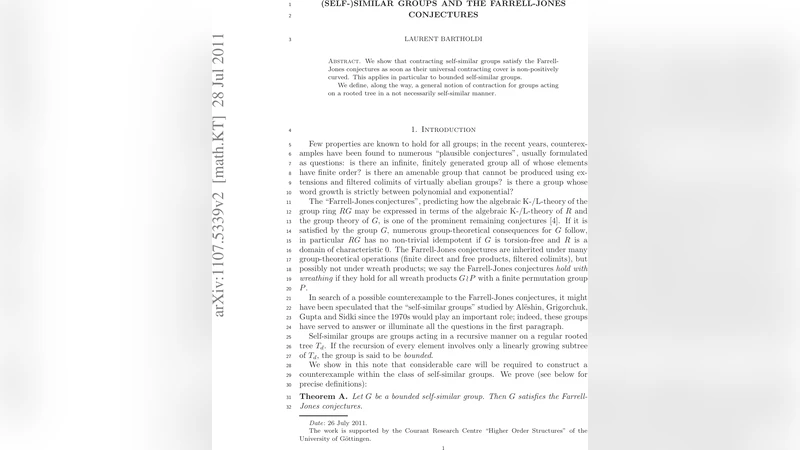
We show that contracting self-similar groups satisfy the Farrell-Jones conjectures as soon as their universal contracting cover is non-positively curved. This applies in particular to bounded self-similar groups. We define, along the way, a general notion of contraction for groups acting on a rooted tree in a not necessarily self-similar manner.
💡 Research Summary
The paper investigates the Farrell‑Jones conjectures (FJC) for a broad class of groups defined by recursive actions on rooted trees, namely contracting self‑similar groups and their generalization, similar groups. The central result is that any contracting self‑similar group G satisfies the FJC provided its universal contracting cover F is a CAT(0) group, i.e., it acts properly and cocompactly on a non‑positively curved (CAT(0)) space. Since the conjecture is known for CAT(0) groups, the authors reduce the problem for G to the well‑understood case of F.
The authors begin by recalling the formulation of the Farrell‑Jones conjecture in algebraic K‑ and L‑theory, emphasizing its inheritance properties: it is stable under taking subgroups, finite direct and free products, filtered colimits, and, crucially for this work, under finite wreath products (the “with wreathing” condition). These closure properties allow one to pass the conjecture from a covering group to its quotients and limits.
A self‑similar group is defined via a homomorphism φ: G → G ≀ d, where d is the degree of the rooted regular tree on which G acts recursively. The group is contracting if there exists a finite nucleus N⊂G such that for every g∈G, sufficiently deep iterates φⁿ(g) lie in N^{dⁿ}×S_{dⁿ}. From this data the authors construct the universal contracting cover F: start with the free group on N, impose the relations that make φ(N)⊂N^{d}×S_{d}, and then factor out a normal subgroup R generated by words of length ≤3 that become trivial in G. The resulting finitely presented group F carries a self‑similar structure extending that of G, and there is a natural surjection π: F→G whose kernel is the increasing union K_∞ of kernels of the iterates φⁿ. Consequently G≅F/K_∞.
The key technical proposition (Proposition 1) states that if every finite stage F/K_n satisfies the Farrell‑Jones conjecture with wreathing, then the limit group G does as well. The proof uses the contracting property to show any element in the kernel of π already lies in some K_n, and then applies the stability of the conjecture under colimits. Since each F/K_n embeds in a finite iterated wreath product F_n ≀ d₁⋯d_n, and each F_n is a finite extension of a free product of finite groups (hence CAT(0)), the conjecture holds for these wreath products by the known CAT(0) case and the wreathing stability.
The authors then apply this framework to several prominent families:
-
Alëshin–Grigorchuk groups: The universal cover F is a free product C₂ ∗ (C₂×C₂), a CAT(0) group. Hence the original groups, which are torsion, of intermediate growth, and amenable but not elementary amenable, satisfy the FJC.
-
Generalized Grigorchuk groups defined by infinite sequences of epimorphisms ω: (C₂×C₂)→C₂. All such groups share the same nucleus and universal cover, so they also satisfy the conjecture.
-
Gupta–Sidki groups: For a prime p≥3, the cover F is C_p ∗ C_p, again CAT(0). Thus these infinite, finitely generated p‑torsion groups satisfy the FJC.
-
Bounded self‑similar groups: By definition, each element has uniformly bounded non‑trivial sections in its recursive decomposition. Such groups are known to be contracting and amenable. Their universal cover can be taken as a free product S_d ∗ (S_d ≀ S_{d−1}), which is CAT(0). Consequently all bounded self‑similar groups satisfy the conjecture.
Finally, the paper extends the discussion to similar groups, where the degree and the group itself may vary along a sequence G₀, G₁, … with homomorphisms φ_n: G_n→G_{n+1}≀d_{n+1}. By adapting the construction of the universal cover and the contraction condition, the same argument shows that any such group whose universal cover is CAT(0) satisfies the Farrell‑Jones conjectures.
In summary, the authors provide a unified method to prove the Farrell‑Jones conjecture for a wide array of groups defined by recursive tree actions. By reducing to a CAT(0) universal cover and exploiting the conjecture’s stability under wreath products and colimits, they establish the conjecture for all contracting self‑similar groups with CAT(0) covers, including the classical Alëshin‑Grigorchuk, Gupta‑Sidki, and all bounded self‑similar groups. This significantly enlarges the class of groups known to satisfy the Farrell‑Jones conjecture, especially among torsion groups of intermediate growth and amenable but non‑elementary amenable groups.
Comments & Academic Discussion
Loading comments...
Leave a Comment