Motifs in Triadic Random Graphs based on Steiner Triple Systems
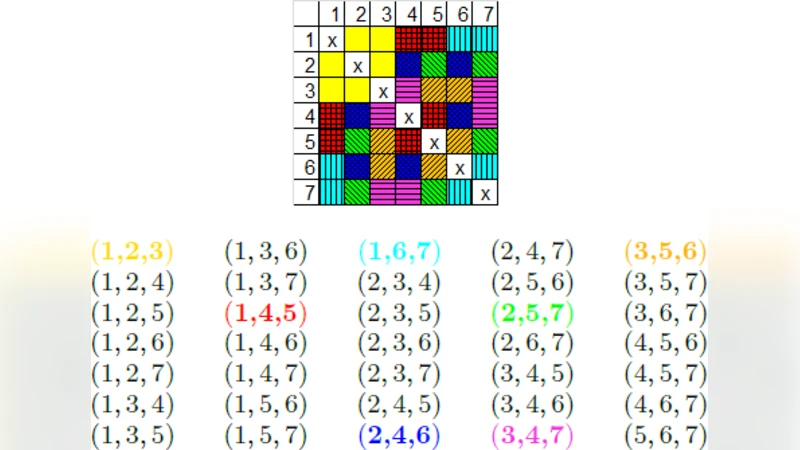
Conventionally, pairwise relationships between nodes are considered to be the fundamental building blocks of complex networks. However, over the last decade the overabundance of certain sub-network patterns, so called motifs, has attracted high attention. It has been hypothesized, these motifs, instead of links, serve as the building blocks of network structures. Although the relation between a network’s topology and the general properties of the system, such as its function, its robustness against perturbations, or its efficiency in spreading information is the central theme of network science, there is still a lack of sound generative models needed for testing the functional role of subgraph motifs. Our work aims to overcome this limitation. We employ the framework of exponential random graphs (ERGMs) to define novel models based on triadic substructures. The fact that only a small portion of triads can actually be set independently poses a challenge for the formulation of such models. To overcome this obstacle we use Steiner Triple Systems (STS). These are partitions of sets of nodes into pair-disjoint triads, which thus can be specified independently. Combining the concepts of ERGMs and STS, we suggest novel generative models capable of generating ensembles of networks with non-trivial triadic Z-score profiles. Further, we discover inevitable correlations between the abundance of triad patterns, which occur solely for statistical reasons and need to be taken into account when discussing the functional implications of motif statistics. Moreover, we calculate the degree distributions of our triadic random graphs analytically.
💡 Research Summary
The paper addresses a fundamental gap in network science: the lack of generative models that can explicitly control higher‑order subgraph frequencies, i.e., network motifs. Traditional random‑graph models, including exponential random graph models (ERGMs), treat dyads (pairwise links) as the elementary independent units. While this dyadic independence simplifies analysis, it fails to capture empirically observed triadic closure, clustering, and other third‑order dependencies that are central to many real‑world systems.
To overcome this limitation, the authors introduce Steiner Triple Systems (STS) as a combinatorial foundation for constructing networks where triads (three‑node subsets) can be specified independently. An STS of order N partitions the complete set of N(N‑1)/2 dyads into N(N‑1)/6 disjoint triples, each dyad belonging to exactly one triple. The necessary and sufficient conditions for the existence of an STS are N ≡ 1 (mod 2) and N(N‑1) ≡ 0 (mod 3). For small N (e.g., N=7) the paper demonstrates an explicit construction; for larger N, known recursive or merging techniques are referenced.
Building on this structure, the authors define a “triadic random graph” model, which is essentially an ERGM where the sufficient statistics are counts of the 16 non‑isomorphic directed triad patterns (Fig. 1). Each Steiner triple is assigned a pattern according to a multinomial distribution parameterized by a vector θ. The probability of a graph G given θ is
P(G|θ) ∝ exp(∑_{t∈STS} θ·f(t,G)),
where f(t,G) is the indicator vector of the pattern realized on triple t. Because triples are dyad‑disjoint, the assignments are statistically independent, making the model analytically tractable while still allowing for rich higher‑order structure.
The authors explore the model’s capacity to generate non‑trivial Z‑score profiles. By tuning θ, they can produce networks where specific triad motifs are over‑ or under‑represented relative to a dyad‑preserving null model. Importantly, they discover that altering the frequency of one motif inevitably induces systematic changes in the frequencies of other motifs, even when the model contains no explicit coupling between them. These “inevitable correlations” arise purely from the combinatorial constraints imposed by the STS partition and must be accounted for when interpreting motif significance in empirical data.
A further contribution is the analytical derivation of the degree distribution of triadic random graphs. Since each node participates in a fixed number of Steiner triples (approximately (N‑1)/2), its expected degree is determined by the expected number of directed edges contributed by the patterns assigned to those triples. By summing over the pattern probabilities, the authors obtain closed‑form expressions for the mean degree, variance, and, under certain θ choices, the full degree distribution. This demonstrates that the model can reproduce Poissonian, power‑law, or mixed degree profiles, depending on the chosen triad pattern probabilities.
The paper also discusses practical aspects: constructing an STS for arbitrary N may require adding up to three dummy nodes or discarding a few nodes, but this overhead is negligible for large systems. Limitations include the focus on directed three‑node motifs; extending the framework to four‑node or larger subgraphs would require more sophisticated combinatorial designs.
In summary, the work introduces a novel generative framework that treats triads, rather than dyads, as the elementary independent units of a network. By leveraging Steiner Triple Systems, the authors obtain a mathematically clean way to specify triadic subgraph configurations independently, enabling the generation of ensembles with prescribed motif Z‑score vectors and analytically tractable degree statistics. The discovery of intrinsic motif correlations highlights a subtle statistical pitfall in motif analysis and provides a new lens for interpreting over‑ and under‑represented substructures in real networks. This contribution opens avenues for more accurate modeling of higher‑order interactions in complex systems.
Comments & Academic Discussion
Loading comments...
Leave a Comment