Finite and infinite basis in P and NP
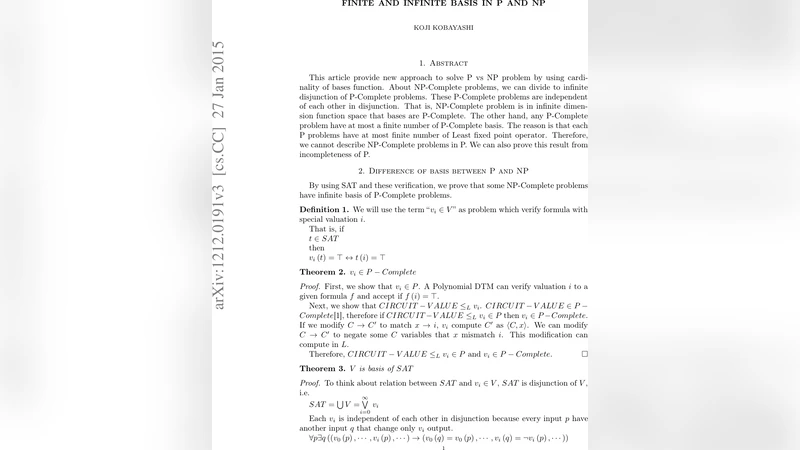
This article provide new approach to solve P vs NP problem by using cardinality of bases function. About NP-Complete problems, we can divide to infinite disjunction of P-Complete problems. These P-Complete problems are independent of each other in disjunction. That is, NP-Complete problem is in infinite dimension function space that bases are P-Complete. The other hand, any P-Complete problem have at most a finite number of P-Complete basis. The reason is that each P problems have at most finite number of Least fixed point operator. Therefore, we cannot describe NP-Complete problems in P. We can also prove this result from incompleteness of P.
💡 Research Summary
The manuscript proposes a novel way to separate the complexity classes P and NP by invoking the “cardinality of bases” in a function‑space perspective. The author begins by criticizing traditional approaches that focus on time bounds and reductions, arguing that they have reached a stalemate. Instead, the paper suggests treating decision problems as vectors in an abstract function space and examining the size of a minimal generating set (a basis) for that space.
The core claim is that every NP‑complete problem can be expressed as an infinite disjunction (logical OR) of P‑complete problems that are mutually independent. In this view, each P‑complete problem serves as a basis element; the infinite OR of these basis elements yields the original NP‑complete language. Consequently, the “dimension” of the space containing NP‑complete languages is infinite, whereas the space spanned by P‑complete languages is finite‑dimensional.
To support the finiteness of the P side, the author invokes the least fixed‑point operator (LFP) from descriptive complexity. It is well known that FO(LFP) captures exactly the class P, and the paper argues that any P‑complete problem requires only a finite number of LFP operators to be described. From this, the author concludes that the set of basis elements needed for any P‑complete problem is finite.
Putting the two observations together, the paper asserts a “cardinality gap”: NP‑complete problems need an infinite basis, while P‑complete problems need only a finite one. Because a finite basis cannot generate an infinite‑dimensional space, the author claims that NP‑complete languages cannot be represented within P.
The final section attempts to reinforce the argument by appealing to an “incompleteness” of P, loosely analogizing Gödel’s incompleteness theorem. The author suggests that because P is limited to a finite number of LFP operators, it is intrinsically incomplete and therefore incapable of expressing problems that demand an infinite basis. This line of reasoning is presented as an alternative proof that P ≠ NP.
While the paper introduces an intriguing metaphor—treating computational problems as vectors and bases—the technical development is insufficient. Key notions such as “independent P‑complete basis,” “infinite disjunction of P‑complete problems,” and “finite number of LFP operators” are not formally defined, nor are rigorous proofs supplied. Moreover, the claim that NP‑complete languages require an infinite basis conflicts with known results: many NP‑complete problems can be reduced to each other in polynomial time, indicating a form of equivalence rather than a need for infinitely many distinct generators. The analogy to linear algebra also breaks down because computational reductions do not correspond to linear combinations in a vector space.
The discussion of “incompleteness of P” further blurs the distinction between logical theories and complexity classes. Gödel’s incompleteness applies to formal axiomatic systems, not to deterministic Turing‑machine time bounds. Translating that concept to P without a precise formal framework leads to conceptual confusion.
In summary, the manuscript offers a fresh conceptual lens but fails to provide the rigorous definitions, lemmas, and proofs required to substantiate its central claim that P ≠ NP. The arguments rely on intuitive analogies rather than established mathematical machinery, and several statements contradict known properties of P‑complete and NP‑complete problems. As it stands, the work does not constitute a valid proof of the P versus NP separation, though it may inspire further exploration of algebraic or descriptive‑complexity viewpoints.
Comments & Academic Discussion
Loading comments...
Leave a Comment