Bragg grating rogue wave
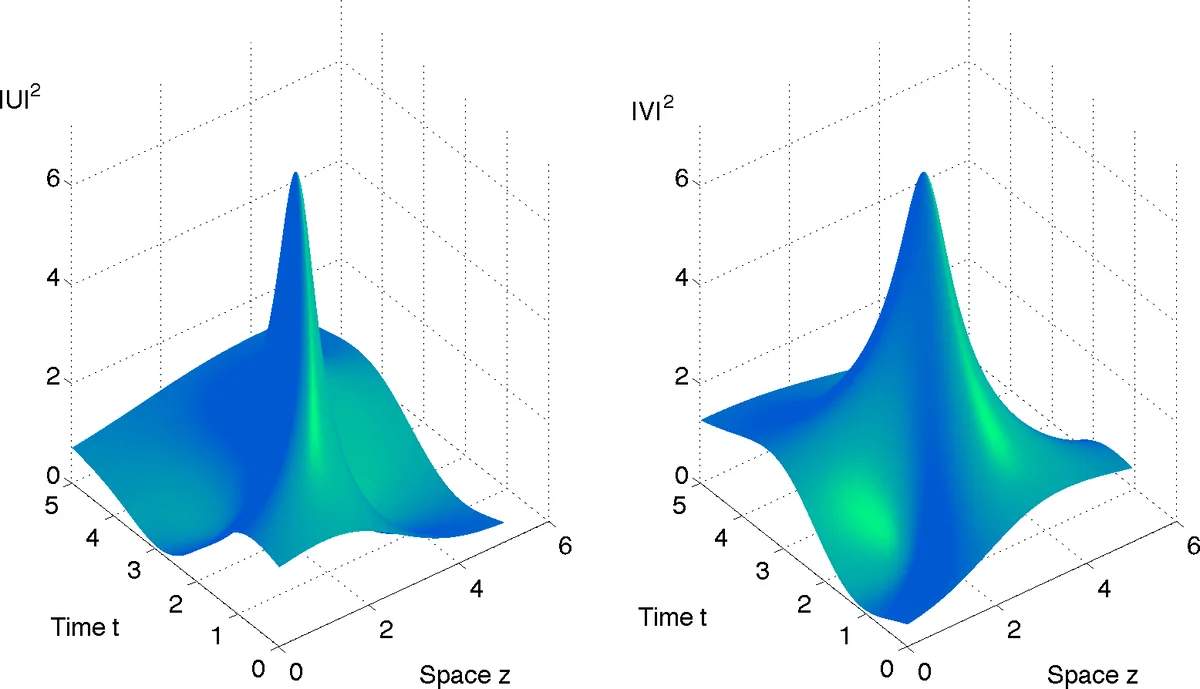
We derive the rogue wave solution of the classical massive Thirring model, that describes nonlinear optical pulse propagation in Bragg gratings. Combining electromagnetically induced transparency with Bragg scattering four-wave mixing, may lead to extreme waves at extremely low powers.
💡 Research Summary
**
This paper presents the first explicit rogue‑wave (or “rogue” or “extreme”) solution of the classical massive Thirring model (MTM), a two‑component integrable system that describes forward‑ and backward‑propagating optical envelopes in a Bragg grating. Starting from the MTM equations
(U_{\xi}= -i\nu V - i\nu |V|^{2}U,\qquad V_{\eta}= -i\nu U - i\nu |U|^{2}V,)
the authors introduce a continuous‑wave (CW) background (U_{0}=a e^{i\phi},; V_{0}=-b e^{i\phi}) with real amplitudes (a,b) and a common phase (\phi=\alpha\xi+\beta\eta). By a linear stability analysis they show that the background is modulationally unstable for long‑wavelength perturbations, a condition known as base‑band instability, and that rogue‑wave solutions exist only when the amplitudes satisfy the inequality (0<ab<\nu^{2}).
Using the Darboux transformation, the authors construct a closed‑form solution that is the direct analogue of the Peregrine soliton of the focusing nonlinear Schrödinger (NLS) equation. The solution depends on the background amplitudes, two complex parameters (\theta_{1},\theta_{2}) (which can be removed by translational invariance), and a real scaling parameter (p) defined by (p=r\nu^{2}ab-1>0). In a convenient reference frame where (a=b) (so that the background wave number (k=0)), the solution simplifies to
\
Comments & Academic Discussion
Loading comments...
Leave a Comment