Fermi Problem: Power developed at the eruption of the Puyehue-Cordon Caulle volcanic system in June 2011
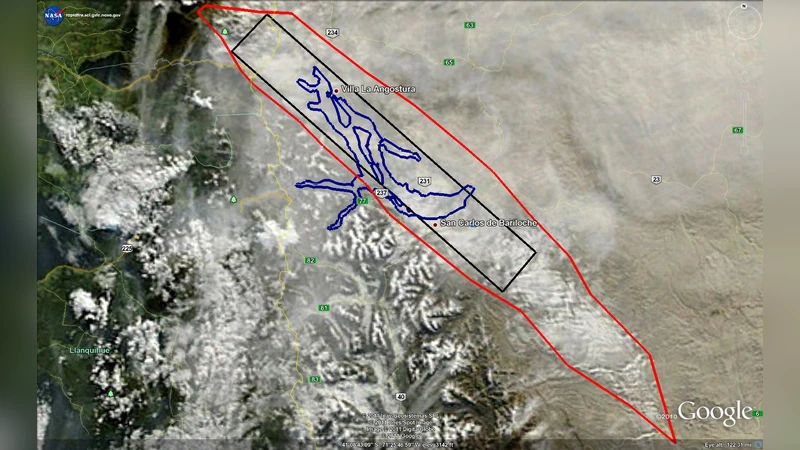
On June 4 2011 the Puyehue-Cord'{o}n Caulle volcanic system produced a pyroclastic subplinian eruption reaching level 3 in the volcanic explosivity index. The first stage of the eruption released sand and ashes that affected small towns and cities in the surrounding areas, including San Carlos de Bariloche, in Argentina, one of the largest cities in the North Patagonian andean region. By treating the eruption as a Fermi problem, we estimated the volume and mass of sand ejected as well as the energy and power released during the eruptive phase. We then put the results in context by comparing the obtained values with everyday quantities, like the load of a cargo truck or the electric power produced in Argentina. These calculations have been done as a pedagogic exercise, and after evaluation of the hypothesis was done in the classroom, the calculations have been performed by the students. These are students of the first physics course at the Physics and Chemistry Teacher Programs of the Universidad Nacional de R'{\i}o Negro.
💡 Research Summary
The paper presents a classroom‑based Fermi‑estimate exercise in which first‑year physics students quantify the energetic output of the June 4 2011 Puyehue‑Cordón Caulle eruption. Using only publicly available data and simple physical relations, the authors construct a chain of approximations: (1) the ash‑laden cloud covered an area roughly three times the surface of Nahuel Huapi lake (≈1.7 × 10⁹ m²); (2) the average thickness of the deposited material was taken as 0.1 m, based on field reports that ranged from 0.05 m to 0.4 m in different locations; (3) the bulk density of the sand‑ash mixture was measured with a kitchen scale and a measuring cup, yielding ρ ≈ 600 kg m⁻³. Multiplying area by thickness gives a volume V ≈ 1.7 × 10⁸ m³, which the authors compare to the capacity of a typical cargo truck (≈7 m³), finding an equivalent of about 2.4 × 10⁷ truckloads.
The mass follows from m = ρV, giving m ≈ 1.0 × 10¹¹ kg (≈100 Mt). To estimate the energy released, the authors assume the bulk of the material was lifted from the vent (≈2 km above sea level) to an average plume height of 5 km, i.e., a vertical rise Δh ≈ 5 000 m. The gravitational potential energy is then ΔE = m g Δh ≈ 5 × 10¹⁵ J, equivalent to roughly 1 200 kilotons of TNT. For context, this is many orders of magnitude smaller than the 3.9 × 10²² J released by the 2011 Tōhoku earthquake, yet it dwarfs everyday human energy consumption.
Dividing the energy by the duration of the first eruptive phase (≈5 h = 1.8 × 10⁴ s) yields an average power output P ≈ 2.8 × 10¹¹ W. This figure is about twelve times the total installed electric generation capacity of Argentina (≈2.6 × 10¹⁰ W) and represents roughly 2 % of the worldwide installed capacity (≈1.5 × 10¹³ W). The authors also estimate the exit velocity of the erupting material by equating kinetic and potential energy, obtaining v ≈ √(2gΔh) ≈ 313 m s⁻¹, close to the speed of sound in air, which explains the rapid cooling and fine grain size of the deposits.
A substantial portion of the paper is devoted to discussing the uncertainties inherent in each assumption. The chosen area may underestimate the true ash footprint; the uniform 0.1 m thickness smooths over substantial spatial variability; the density measurement, performed shortly after the eruption, likely differs from later values after rain and wind removal of fine particles; and the plume height of 5 km is a compromise between reported maxima of up to 12 km and the denser components that dominate the mass budget. The authors argue that, despite these simplifications, the final estimates are accurate within a factor of five—a tolerance acceptable for a pedagogical Fermi problem.
From an educational perspective, the exercise demonstrates that students can apply basic physics (volume, density, gravitational potential energy, power) to a real‑world, high‑impact natural event, thereby strengthening quantitative reasoning, model‑building skills, and appreciation of the magnitude of geological processes. By anchoring abstract numbers to familiar references—truckloads of sand, national electricity production—the activity makes the concept of volcanic energy tangible.
In conclusion, the study shows that with minimal data and elementary physics, a reasonably credible order‑of‑magnitude estimate of the energy and power released by a major volcanic eruption can be obtained. This validates the use of Fermi‑type problems in science education as an effective tool for connecting classroom theory with observable phenomena.
Comments & Academic Discussion
Loading comments...
Leave a Comment