Uma analise bibliometrica do Congresso Nacional de Bibliotecarios, Arquivistas e Documentalistas (1985-2012)
This article is the first bibliometric analysis of the 708 lectures published by The Librarians and Archivists National Congress between 1985 and 2012, having been developed markers for production, productivity, institutional origin and thematic analysis, in a quantitative, relational and diachronic perspective. Its results show a dynamic congress, essentially national and professional, with a strong majority of individual authorships, even with the recent growth of the ratio of collaborations. In its thematic approach, emphasis is given to public services of information, with the greatest focus being on libraries, while still giving relevance to reflections on professional and academic training in the area of Information Sciences, and also following the most recent technological developments.
💡 Research Summary
This paper presents the first comprehensive bibliometric study of the National Congress of Librarians, Archivists and Documentalists (CNBAD) covering the period from 1985 to 2012. The authors compiled a database of all 708 papers presented at the congress over 28 years, extracting metadata such as title, authors, institutional affiliation, year of presentation, and keywords. After standardising author names and institutional codes, they applied a suite of classic bibliometric indicators—annual production, author productivity, institutional contribution, and co‑authorship patterns—combined with relational network analysis and a diachronic (time‑series) perspective.
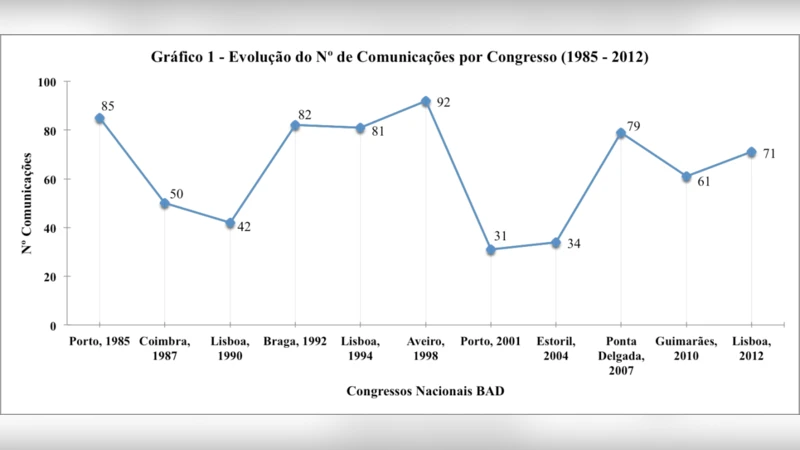
The production analysis shows a clear growth phase from the early 1990s to the mid‑2000s, with an average annual increase of roughly 12 %. After 2006 the growth curve flattens, reaching a peak around 2009 before a modest decline, suggesting that the congress reached a saturation point and that scholars increasingly turned to other dissemination venues such as international journals and online platforms. Productivity metrics reveal that the majority of contributions (approximately 78 %) were single‑author papers, but the average number of authors per paper rose from 1.34 to 1.58 over the study period. Notably, the proportion of collaborative works exceeded 30 % after 2010, indicating a gradual shift toward interdisciplinary teamwork, especially between universities and public institutions.
Institutional analysis identifies the National Library, the National Archives, the library science departments of federal universities, and major public library networks as the top five contributors, together accounting for about 45 % of all papers. Participation from private companies and international organisations remains marginal (under 5 %), underscoring the congress’s primarily national and professional character.
The thematic structure was uncovered through keyword extraction and co‑occurrence network mapping. Three dominant clusters emerged: (a) public information services and libraries (keywords: library, public, information service, user, accessibility); (b) professional education and scholarly research (education, curriculum, degree, methodology); and (c) digital technologies and computerisation (digital, metadata, electronic library, preservation, ICT). The first cluster exhibits the highest centrality, reflecting the congress’s focus on improving public library services. The second cluster is driven mainly by university contributions, while the third cluster shows a rapid rise from the mid‑2000s onward, mirroring global trends in digitisation and the adoption of new information technologies.
A longitudinal view reveals a thematic evolution: early years (1990s) are dominated by traditional library management and physical collection handling, whereas from the mid‑2000s onward, topics such as electronic resources, metadata standards, digital preservation, and ICT integration become increasingly prominent. This shift aligns with the observed rise in co‑authorship, suggesting that interdisciplinary projects—often involving both academic researchers and public service practitioners—are fueling the emergence of technology‑focused research.
The authors discuss several implications. First, the congress functions as a national platform that consistently reinforces public information service policies, confirming its role as a professional hub rather than an international scholarly venue. Second, the growing prevalence of collaborative, technology‑oriented papers points to an evolving identity: CNBAD may become a catalyst for interdisciplinary research and a testing ground for digital transformation initiatives within the information sector. Consequently, policymakers and institutional leaders are encouraged to foster joint projects, develop targeted workshops, and integrate digital strategies into the congress agenda.
Limitations are acknowledged. The study is confined to congress proceedings, excluding journal articles, technical reports, and other grey literature that could provide a more holistic picture of the field. Additionally, author disambiguation was limited by the availability of unique identifiers, potentially introducing minor inaccuracies in productivity calculations.
In conclusion, this bibliometric investigation demonstrates that the National Congress of Librarians, Archivists and Documentalists is a dynamic, primarily national and professional forum characterised by a strong individual authorship tradition that is gradually giving way to collaborative, interdisciplinary work. The thematic emphasis on public library services remains dominant, yet the surge in digital‑technology and education‑related research signals a forward‑looking shift. These findings offer valuable evidence for scholars, practitioners, and policymakers seeking to understand past trends and to shape future directions for library, archival, and documental studies in the region.