Defining Data Science
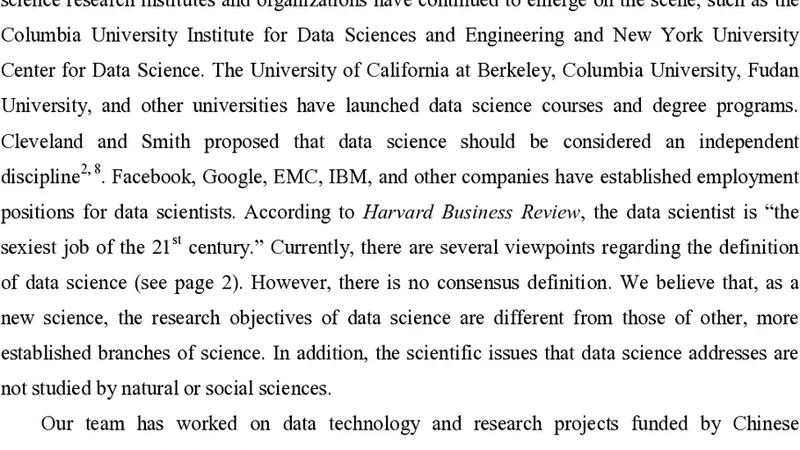
Data science is gaining more and more and widespread attention, but no consensus viewpoint on what data science is has emerged. As a new science, its objects of study and scientific issues should not be covered by established sciences. Data in cyberspace have formed what we call datanature. In the present paper, data science is defined as the science of exploring datanature.
💡 Research Summary
The paper tackles the persistent ambiguity surrounding the definition of data science, arguing that the field has yet to establish a clear epistemological identity separate from statistics, computer science, and information science. The authors begin by reviewing a range of existing definitions—ranging from “the set of tools and techniques for extracting knowledge from data” to “the interdisciplinary study of big‑data analytics”—and point out that each treats data primarily as a resource or by‑product rather than as an autonomous object of inquiry.
To resolve this conceptual shortfall, the authors introduce the notion of “datanature,” a term that designates the totality of digital artifacts existing in cyberspace, including text, images, logs, sensor streams, and any other form of electronically stored information. Datanature is portrayed as a virtual ecosystem that exhibits properties analogous to those of the physical natural world: it is generated, transformed, replicated, and eventually decays. Moreover, the ecosystem’s internal dynamics—such as the rates of data creation, the topology of data interconnections, and the patterns of data flow—are governed by emergent regularities that can be studied scientifically.
By defining data science as “the science of exploring datanature,” the paper reframes the discipline’s central research agenda. Two overarching questions are proposed: (1) How does datanature self‑organize, evolve, and exhibit regularities over time? (2) In what ways do these self‑organizing processes influence, and are influenced by, human social, economic, and cultural systems? These questions shift the focus from conventional predictive modeling toward a deeper investigation of data’s intrinsic life‑cycle and its feedback loops with society.
Methodologically, the authors outline three interlocking pillars. First, “Data Metrics” involves constructing quantitative indicators for volume, diversity, connectivity, volatility, replication rates, and network density, thereby providing a systematic way to measure the state of datanature. Second, “Data Simulation” calls for agent‑based and complex‑systems models that replicate the generation, mutation, and extinction of data items, enabling hypothesis testing and scenario analysis in a controlled virtual environment. Third, “Data Ethics and Governance” addresses the normative dimension, proposing legal and institutional frameworks that recognize data as a quasi‑natural entity with rights (e.g., the right to be forgotten) and responsibilities (e.g., obligations to prevent harmful propagation).
The paper also maps the relationship between datanature research and existing disciplines. Statistics contributes tools for describing distributions, yet datanature demands a dynamic view of how those distributions evolve. Computer science supplies algorithms and system architectures, but the emergent behavior of data streams generated by those algorithms requires a separate scientific lens. Social sciences examine how data‑driven practices reshape institutions, while datanature research asks how the data ecosystem itself reconfigures social structures. This cross‑disciplinary mapping underscores the necessity of a dedicated, autonomous field of data science.
In the concluding section, the authors argue that recognizing datanature as a legitimate object of scientific study legitimizes data science as a standalone discipline. They outline a research agenda that includes (a) formal modeling of datanature dynamics, (b) development of open‑source simulation platforms, and (c) the creation of policy instruments that embed ethical considerations into the lifecycle of data. By positioning data as a natural phenomenon with its own laws, the paper envisions a future where data science drives sustainable innovation, informs governance, and deepens our understanding of the digital fabric that increasingly underpins modern society.
Comments & Academic Discussion
Loading comments...
Leave a Comment